Bessant announced the toughest sanctions in history against Iran, and Trump's escalating economic war pushed oil prices to a near one-month high.
2026-08-21 09:48:59
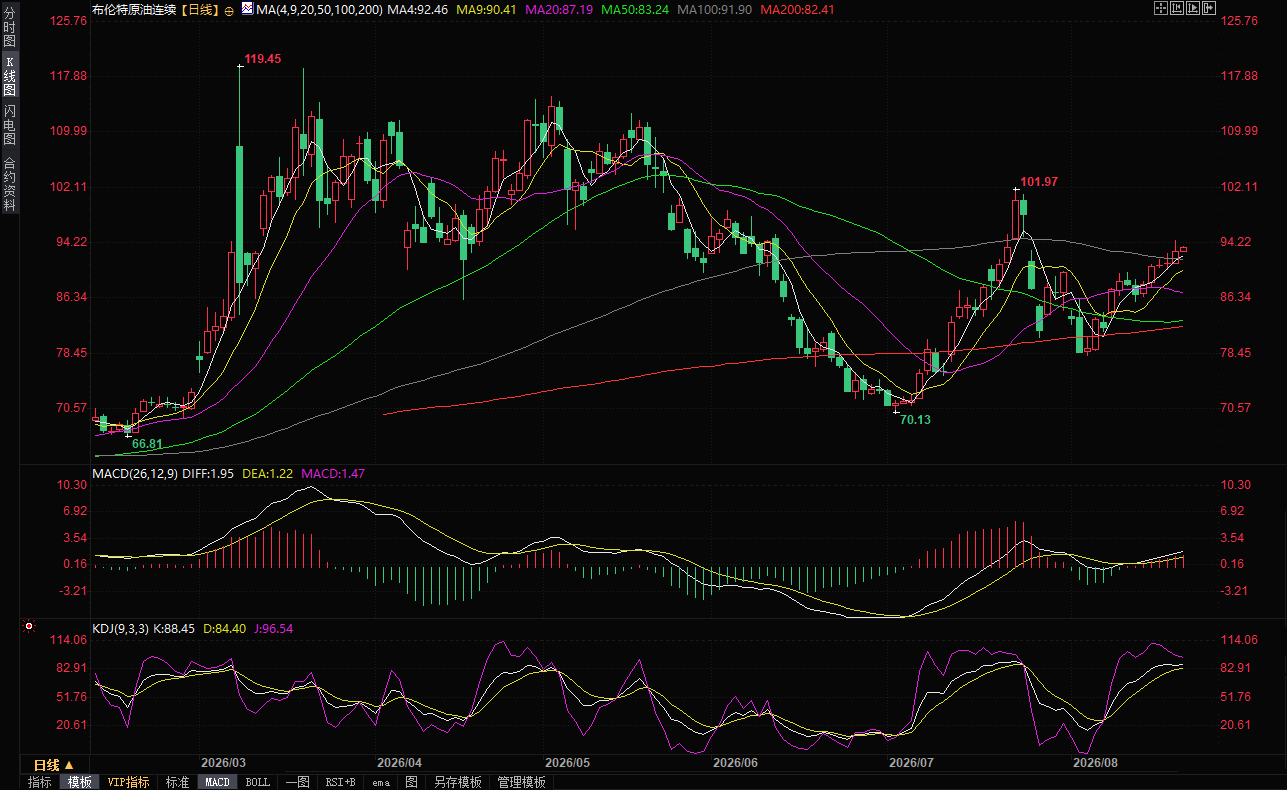
U.S. Treasury Secretary Scott Bessant stated on Thursday that Washington will impose the "toughest sanctions in history" on Iran, combining them with the existing maritime blockade to form a "combination punch" aimed at collapsing the Iranian regime. This statement, following President Donald Trump's threat of "economic war" the previous day, directly pushed international oil prices to a near one-month high, with Brent crude reaching a high of $94.71 per barrel. It also triggered a strong backlash from Iran, which accused it of "economic terrorism" and crimes against humanity. The current conflict has lasted for nearly six months, and the disruption to Middle Eastern oil shipments remains unresolved. The global energy market is closely watching this latest development in the shift towards economic pressure. On Friday (August 21) in early Asian trading, Brent crude fluctuated at high levels, currently trading around $93.71 per barrel. 
 (Brent crude oil daily chart, source: EasyForex)
Details of Trump's "Economic D-Day" threats and Bessant's combined punches
On Wednesday (August 19), Trump warned on social media that he would launch an "unprecedented economic war and isolation measures" against Iran, stating that any country providing Iran with "lifelines of any kind" through financial institutions, businesses, airports, or government agencies would face enormous economic consequences. He described this move as an "economic D-Day," explicitly calling on allies to join the effort to isolate Tehran, while emphasizing the need to cut off financial channels supporting Iran, oil smuggling networks, currency exchange businesses, and ship registration. Trump did not disclose specific operational details, but the wording suggests that the pressure could extend to third-party countries. Bessant later elaborated in an interview, calling it "the largest coordinated economic isolation operation in world history." He pointed out that the US has already imposed a naval blockade on Iran (starting in April 2026, with a one-month pause in mid-June), and now, combined with the toughest sanctions in history, it forms a "combination punch." Bessant emphasized, "These measures will work in Iran, and we will bring this regime down. Now it's time for our allies and the rest of the world to make a choice. You either stand with us or stand against us." He plans to elaborate on the specific measures at a press conference next Monday (August 24), stating that if businesses continue to conduct financial transfers, oil purchases, or maritime transshipments with Iran, the US Treasury and government will use all their resources to combat it. Bessant believes that maximum economic pressure likely means there will be no renewed large-scale military action, and the oil market is misinterpreting this signal. He stated that the US possesses asymmetric information and does not understand why oil prices have risen as a result.Oil price reaction, conflict background and energy market pressure
International oil prices rose to a more than three-week high on Thursday, influenced by threats of economic penalties from the United States. Brent crude futures settled at around $93.78 per barrel, up about 2.4% from the previous trading day, reaching a high of $94.71 per barrel during the session, the highest since July 24. West Texas Intermediate (WTI) crude also rose in tandem to around $87-$88, reaching even higher levels at times. This conflict, which began in late February 2026 with US-Israeli military action against Iran, has lasted for nearly six months, severely disrupting Middle Eastern oil transportation, leaving millions of barrels of oil stranded, and significantly reducing shipping in the Strait of Hormuz. The passageway, which previously carried about one-fifth of the world's oil and liquefied natural gas, remains under pressure. Market analysts believe that the escalation of the economic war has increased the long-term risk premium of supply disruptions, even as Bessant attempts to downplay the possibility of a military restart. Some institutions previously estimated that if the Strait of Hormuz disruption were to continue for another month, Brent crude prices could increase by an additional $7 to $8. The current consecutive days of price increases reflect investors' concerns about the protracted conflict. The United States hopes to force an end to the war through economic means, but short-term fluctuations are still difficult to avoid.Iran's long-term sanctions pressure and domestic economic difficulties
Iran's economy has long been under pressure. Since the 1979 Islamic Revolution, Tehran has faced nearly 50 years of almost continuous and severe sanctions, with soaring inflation and the cost of living in recent years triggering domestic protests. The previous US maximum pressure campaign and blockade have significantly compressed Iran's oil revenues and financial channels; some estimates suggest that Iran has lost approximately $4.8 billion in oil revenues during the blockade. Bessenter noted that high food and general inflation in Iran will further weaken the regime's ability to pay for military spending and maintain operations. Iran is no stranger to sanctions, having previously circumvented pressure through shadow fleets, discounted sales to major Asian powers, and alternative trade networks with countries like Russia. However, if the new round of "the toughest in history" measures is implemented and widely adopted, these channels could be further tightened.Iran strongly reacted, calling the sanctions "economic terrorism."
Iran's Foreign Ministry swiftly responded, condemning the US economic and trade sanctions as "economic terrorism" and crimes against humanity, stating that they violated the basic human rights of Iranian citizens and were a continuation of 73 years of hostility and hatred towards the Iranian people by US politicians. The statement emphasized that the measures would harm ordinary citizens, and those who formulated and implemented them should be prosecuted and punished. Iran will firmly defend its national interests and resist military, economic, political, and psychological pressure, stating that economic pressure is the other side of war and threatens global peace and security. Iranian Foreign Minister Abbas Araqchi stated on the X platform that Trump's remarks were an attempt to divert the American public's attention from domestic economic problems, including record debt and rising interest rates. He pointed out that Washington's persistence in its failed policies will only lead to more failures and further alienate the Iranian people, while threatening the global economy and national sovereignty. Araqchi described the so-called "economic doomsday" as a smokescreen for America's own crisis. It is worth noting that the US public debt surpassed the $40 trillion mark for the first time around August 18, reaching approximately $40.05 trillion, further intensifying domestic fiscal discussions. Iran used this opportunity to emphasize the inherent contradictions in US policy.International Impact and Potential Chain Reaction
This round of pressure will primarily test the stances of allies and key trading partners, including major Asian powers. As major buyers of Iranian oil, these Asian powers face the dual considerations of energy security and pressure from the US. Bessant explicitly stated that such dialogue is better conducted privately, but a public call for cooperation has been sent. Other countries providing support to Iran through banks, businesses, or ports may face the risk of secondary sanctions. The protracted conflict has led to increased uncertainty in global supply chains, and oil price volatility could further impact inflation and monetary policy. With the US midterm elections approaching, domestic sensitivity to the costs of war and oil prices is also increasing. Bessant emphasized that economic pressure can reduce the need for military resurgence, indicating that Washington is attempting to achieve its strategic objectives through non-military means.Editor's Summary
The US is shifting from military action to high-intensity economic isolation, attempting to force Iran to comply through a combination of sanctions and blockades, while reducing the need to restart large-scale military operations. Bessen will announce specific measures on Monday, and the positions of allies and key trading partners, such as major Asian powers, will be crucial variables. Oil prices have already reflected the rising risk premium, and Iran's tough response indicates that the conflict is unlikely to be completely de-escalated in the short term. Global energy markets, trade routes, and the economies of relevant countries will continue to be affected by this game, with the outcome depending on the strength of implementation and the degree of international coordination. The US's own fiscal background, with debt exceeding $40 trillion, also adds a complex domestic political dimension to this economic war. (Brent crude oil daily chart, source: EasyForex)Frequently Asked Questions
Q: What exactly does Bessant mean by the "toughest sanctions in history"? When is it expected to be implemented? A: The complete list has not yet been released. Bessant only stated that he would elaborate on it at a press conference on August 24, emphasizing that it would form a "combination punch" with the existing maritime blockade. Judging from Trump's statements, the measures may cover cutting off financial channels, cracking down on oil trade and transshipment, and punishing third parties (including banks, companies, airports, ship registrations, etc.) that provide "lifelines" to Iran, with the goal of achieving "the largest coordinated economic isolation in world history." The strength of enforcement will depend on the US's ability to coordinate with allies and China, as well as the actual scope of application of secondary sanctions. The market generally expects that relevant financial institutions and companies will quickly assess compliance risks after the details are released. Q: Why are oil prices rising due to economic pressure? Why does Bessant believe the market has misinterpreted the situation? What does the current oil price level indicate? A: Market concerns that an economic war will exacerbate uncertainty in the Middle East and could further disrupt shipping and crude oil supply in the Strait of Hormuz have pushed Brent crude to a near one-month high (approximately $94.71 per barrel). Bessant pointed out that maximum economic pressure actually reduces the likelihood of large-scale military action. The US possesses asymmetric information, and the rise in oil prices does not reflect the true intention of the pressure. The conflict has lasted for nearly six months, and the risk of supply disruption itself has supported oil prices. Current levels reflect the repricing of risk premiums. If the conflict prolongs or sanctions lead to a further contraction in actual supply, oil prices still have room to rise, but there is also the possibility of a decline as economic pressure takes effect. Question: What is the basis for Iran's claim that sanctions constitute "economic terrorism"? What is the actual state of its domestic economy? Answer: The Iranian Foreign Ministry believes that sanctions directly target the basic human rights of ordinary citizens, constitute crimes against humanity, are a continuation of 73 years of US hostility, and call them the other side of war. Foreign Minister Araghchi further pointed out that sanctions are a diversion from the US domestic debt (which has exceeded $40 trillion) and interest rate issues. He argued that persisting with failed policies will only lead to more failures and alienate the Iranian people, while threatening the global economy and sovereignty. The Iranian economy has long been affected by sanctions. In recent years, high inflation and soaring living costs have triggered protests, and the blockade has caused significant losses in oil revenue. Despite this, Tehran has partially maintained operations through shadow networks and alternative markets. The full implementation of the new measures will further test its resilience. Q: What is the current status of the US maritime blockade of Iran? How does it coordinate with the new sanctions? What impact will it have on global shipping? A: The US imposed a maritime blockade on Iran in April 2026, which was suspended for a month in mid-June. Bessant stated that the existing blockade, combined with the upcoming severe sanctions, constitutes a "combination punch" aimed at comprehensively compressing the Iranian regime's operational capacity and ultimately causing its collapse. The blockade has already significantly impacted oil exports and shipping, with a sharp decrease in the daily number of ships passing through the Strait of Hormuz. The new sanctions will further increase pressure on the financial and trade fronts, potentially forcing more countries to reduce their dealings with Iran. Global shipping and energy trade will therefore face higher compliance costs and uncertainty, and related insurance and freight rates may also be adjusted accordingly. Q: What does this round of economic pressure mean for global energy and for the US itself? A: The Strait of Hormuz previously handled about one-fifth of global oil and liquefied natural gas transport. The conflict has led to a sharp decline in shipping, pushing up oil prices and risk premiums. Asian powers and other Gulf energy-dependent nations face direct challenges to their interests, with Bessant explicitly calling for their cooperation in reopening the Strait. Third parties continuing trade with Iran could face secondary US sanctions, increasing pressure on global supply chains and sovereign choices. For the US, economic pressure can reduce military costs and address domestic concerns about war and oil prices, but with its debt exceeding $40 trillion and rising interest rates, any action that exacerbates global uncertainty could backfire on its domestic economy. The ultimate outcome depends on the strength of implementation and the degree of international cooperation; short-term volatility and uncertainty will persist. At 09:46 Beijing time, Brent crude oil was trading at $93.91 per barrel.- Risk Warning and Disclaimer
- The market involves risk, and trading may not be suitable for all investors. This article is for reference only and does not constitute personal investment advice, nor does it take into account certain users’ specific investment objectives, financial situation, or other needs. Any investment decisions made based on this information are at your own risk.