Expectations of the US Treasury expanding its long-term Treasury bond buyback program have boosted gold prices, which are poised to continue strengthening.
2026-08-21 09:54:58
Spot gold rose slightly to around $4,530 in early Asian trading on Friday, regaining buying support after earlier weakness. Gold prices had previously retreated due to changes in US fiscal policy, primarily because the US government unexpectedly signaled an increase in long-term Treasury bond buybacks, causing the market to reassess the supply and demand relationship in the US long-term bond market and future yield changes. However, gold subsequently stabilized, indicating that investors' interpretation of US policy and interest rate prospects has not entirely shifted to be bearish for precious metals.  U.S. Treasury Secretary Scott Bessant said on Thursday that the Treasury Department may increase the scale of its long-term Treasury bond repurchase program to over $4 billion in the future. This move is seen by the market as a measure to improve liquidity in the long-term Treasury bond market and alleviate some of the funding pressure. Bessant also emphasized that the Treasury repurchase decision is not directly related to interest rate levels, but the market is still closely watching the potential impact of this policy on long-term yields. The Treasury Department has previously stated that it will increase the scale of its long-term Treasury bond repurchases to improve the operation of the long-term bond market. For gold, the key is not whether the Treasury Department directly changes interest rate policy, but whether long-term Treasury yields can be stabilized as a result. If long-term yields continue to rise, gold, an asset that does not generate interest income, will typically face higher opportunity costs; conversely, if long-term yields are controlled, gold's relative attractiveness may be enhanced again. Currently, U.S. interest rate expectations remain the main constraint on gold price increases. Market data shows that investors currently expect a 36.2% probability of a rate hike at the next Federal Reserve policy meeting, down from about 47% a month ago. While the decreased probability of a rate hike is generally beneficial to gold, the market has not completely ruled out the possibility of further tightening of policy in the future. Changes in energy prices are increasing this uncertainty. If crude oil prices remain high, energy costs may be passed on to the overall price system through transportation, manufacturing, and consumption, thus delaying the decline in inflation. For the Federal Reserve, if inflation shows renewed stickiness, policymakers may need to maintain higher interest rates for a longer period, or even reconsider the possibility of raising rates. Therefore, the core contradiction currently facing gold is the interplay between the support provided by US fiscal and bond policies and the potential for energy inflation to push interest rates higher again. From an asset allocation perspective, gold still possesses strong safe-haven attributes. Global investors are not only focusing on US interest rates and the dollar's trajectory but also closely monitoring geopolitical risks, energy supply, and global financial market volatility. If energy markets and geopolitical risks continue to escalate, gold may attract new safe-haven inflows. Furthermore, uncertainty in the US long-term bond market may also prompt some investors to increase their gold allocations to mitigate the impact of traditional bond asset volatility on their portfolios. TD Securities believes that recent US policy signals generally still provide some support for gold. The institution points out that the US Treasury's signals of support for the long-term US Treasury market, coupled with the Federal Reserve's ability to ignore temporary energy price increases, will create a relatively favorable policy combination for gold. This means that even with the recent rise in US Treasury yields, the medium-term fundamentals for gold have not been significantly damaged. However, after the rapid rebound in gold prices to around $4,530, it is necessary to be wary of profit-taking at higher levels. Gold is currently in a relatively high price range, and if US economic data strengthens again, the US dollar index rebounds significantly, or US Treasury real yields continue to rise, gold may experience a period of adjustment. Therefore, investors should currently focus on the US Purchasing Managers' Index, inflation data, labor market performance, and speeches by Federal Reserve officials, as these factors could change market judgments on the future path of interest rates. From a market sentiment perspective, gold bulls still hold a certain advantage, but the willingness to chase higher prices is not particularly strong. The market prefers to wait for new macroeconomic data to confirm the direction of interest rates. If US economic data weakens, the market lowers its expectations for future rate hikes again, and long-term US Treasury yields are suppressed by policy operations, then gold is expected to further challenge recent highs; if inflation accelerates again and pushes interest rate expectations towards a hawkish stance, gold may face more significant downward pressure. From a daily chart perspective, spot gold currently maintains a relatively clear bullish pattern, with prices trading above the 100-day simple moving average and the Bollinger Band's middle band, indicating that the medium-term uptrend structure remains intact. Gold prices are gradually approaching the upper Bollinger Band, and the 14-day RSI is around 67.54, already in relatively strong territory and not far from the traditional overbought zone around 70. This suggests that upward momentum remains strong, but as prices approach the upper band, the probability of short-term consolidation at higher levels is increasing. On the downside, the first support level to watch is the recent pivot point around $4500, followed by the 100-day moving average around $4380, and then the Bollinger Band's middle band around $4252. As long as gold prices can stabilize above $4380, the overall bullish structure remains dominant. Deeper support lies at the lower Bollinger Band around $3915. The first resistance level is located near the upper Bollinger Band at around $4585. If gold prices can effectively break through and stabilize above $4585, the upside potential is expected to expand further, potentially extending towards new historical highs. Looking at the 4-hour chart, gold rebounded from its previous pullback to around $4530, with the short-term structure shifting back towards a bullish bias. However, the price is already close to the upper resistance level, increasing the risk of chasing the rally. If gold prices can consistently find support above $4500 and further break through $4585, the 4-hour uptrend is likely to strengthen, and the market may re-enter a trend acceleration phase. Conversely, if multiple attempts to break through $4585 fail, and short-term momentum shows a clear divergence, gold prices may first pull back to test $4500, and then potentially seek support around $4380. The key levels on the 4-hour chart are whether $4500 can hold and whether $4585 can be effectively broken.
 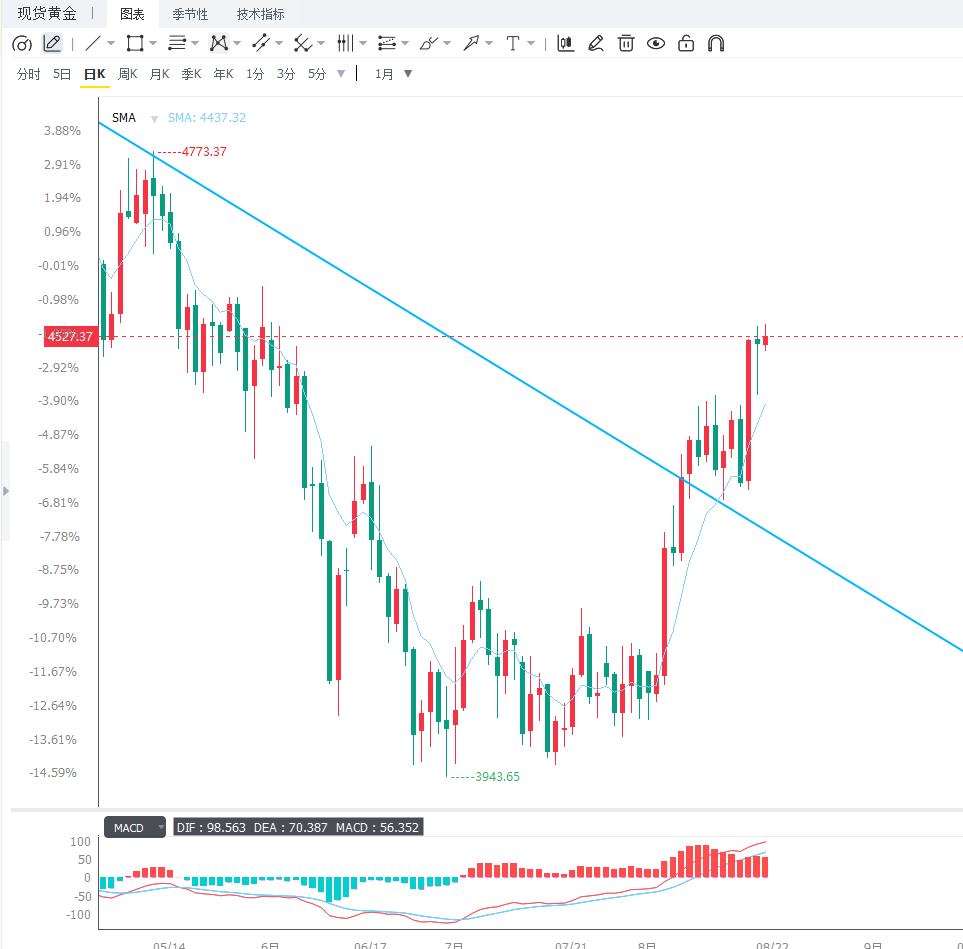 Editor's Summary: Gold is currently maintaining a relatively strong upward trend. The US Treasury's signal to expand the scale of long-term Treasury bond repurchase operations provides some policy expectations for stabilizing long-term bond yields and indirectly improves the interest rate environment for gold. However, the inflationary risks brought about by rising energy prices may still force the Federal Reserve to maintain a tight policy, thereby limiting the speed of gold's rise. In the short term, $4,500 is an important defense line for the bulls, while $4,585 is a key resistance level that will determine the next round of upward movement. If it breaks through $4,585, gold may further challenge new highs; if it fails to break through and falls below $4,500, the risk of high-level consolidation or a pullback will increase significantly. Overall, the medium-term trend for gold remains bullish, but in the short term, it has entered a phase where high-level volatility and fluctuating policy expectations need to be guarded against.
U.S. Treasury Secretary Scott Bessant said on Thursday that the Treasury Department may increase the scale of its long-term Treasury bond repurchase program to over $4 billion in the future. This move is seen by the market as a measure to improve liquidity in the long-term Treasury bond market and alleviate some of the funding pressure. Bessant also emphasized that the Treasury repurchase decision is not directly related to interest rate levels, but the market is still closely watching the potential impact of this policy on long-term yields. The Treasury Department has previously stated that it will increase the scale of its long-term Treasury bond repurchases to improve the operation of the long-term bond market. For gold, the key is not whether the Treasury Department directly changes interest rate policy, but whether long-term Treasury yields can be stabilized as a result. If long-term yields continue to rise, gold, an asset that does not generate interest income, will typically face higher opportunity costs; conversely, if long-term yields are controlled, gold's relative attractiveness may be enhanced again. Currently, U.S. interest rate expectations remain the main constraint on gold price increases. Market data shows that investors currently expect a 36.2% probability of a rate hike at the next Federal Reserve policy meeting, down from about 47% a month ago. While the decreased probability of a rate hike is generally beneficial to gold, the market has not completely ruled out the possibility of further tightening of policy in the future. Changes in energy prices are increasing this uncertainty. If crude oil prices remain high, energy costs may be passed on to the overall price system through transportation, manufacturing, and consumption, thus delaying the decline in inflation. For the Federal Reserve, if inflation shows renewed stickiness, policymakers may need to maintain higher interest rates for a longer period, or even reconsider the possibility of raising rates. Therefore, the core contradiction currently facing gold is the interplay between the support provided by US fiscal and bond policies and the potential for energy inflation to push interest rates higher again. From an asset allocation perspective, gold still possesses strong safe-haven attributes. Global investors are not only focusing on US interest rates and the dollar's trajectory but also closely monitoring geopolitical risks, energy supply, and global financial market volatility. If energy markets and geopolitical risks continue to escalate, gold may attract new safe-haven inflows. Furthermore, uncertainty in the US long-term bond market may also prompt some investors to increase their gold allocations to mitigate the impact of traditional bond asset volatility on their portfolios. TD Securities believes that recent US policy signals generally still provide some support for gold. The institution points out that the US Treasury's signals of support for the long-term US Treasury market, coupled with the Federal Reserve's ability to ignore temporary energy price increases, will create a relatively favorable policy combination for gold. This means that even with the recent rise in US Treasury yields, the medium-term fundamentals for gold have not been significantly damaged. However, after the rapid rebound in gold prices to around $4,530, it is necessary to be wary of profit-taking at higher levels. Gold is currently in a relatively high price range, and if US economic data strengthens again, the US dollar index rebounds significantly, or US Treasury real yields continue to rise, gold may experience a period of adjustment. Therefore, investors should currently focus on the US Purchasing Managers' Index, inflation data, labor market performance, and speeches by Federal Reserve officials, as these factors could change market judgments on the future path of interest rates. From a market sentiment perspective, gold bulls still hold a certain advantage, but the willingness to chase higher prices is not particularly strong. The market prefers to wait for new macroeconomic data to confirm the direction of interest rates. If US economic data weakens, the market lowers its expectations for future rate hikes again, and long-term US Treasury yields are suppressed by policy operations, then gold is expected to further challenge recent highs; if inflation accelerates again and pushes interest rate expectations towards a hawkish stance, gold may face more significant downward pressure. From a daily chart perspective, spot gold currently maintains a relatively clear bullish pattern, with prices trading above the 100-day simple moving average and the Bollinger Band's middle band, indicating that the medium-term uptrend structure remains intact. Gold prices are gradually approaching the upper Bollinger Band, and the 14-day RSI is around 67.54, already in relatively strong territory and not far from the traditional overbought zone around 70. This suggests that upward momentum remains strong, but as prices approach the upper band, the probability of short-term consolidation at higher levels is increasing. On the downside, the first support level to watch is the recent pivot point around $4500, followed by the 100-day moving average around $4380, and then the Bollinger Band's middle band around $4252. As long as gold prices can stabilize above $4380, the overall bullish structure remains dominant. Deeper support lies at the lower Bollinger Band around $3915. The first resistance level is located near the upper Bollinger Band at around $4585. If gold prices can effectively break through and stabilize above $4585, the upside potential is expected to expand further, potentially extending towards new historical highs. Looking at the 4-hour chart, gold rebounded from its previous pullback to around $4530, with the short-term structure shifting back towards a bullish bias. However, the price is already close to the upper resistance level, increasing the risk of chasing the rally. If gold prices can consistently find support above $4500 and further break through $4585, the 4-hour uptrend is likely to strengthen, and the market may re-enter a trend acceleration phase. Conversely, if multiple attempts to break through $4585 fail, and short-term momentum shows a clear divergence, gold prices may first pull back to test $4500, and then potentially seek support around $4380. The key levels on the 4-hour chart are whether $4500 can hold and whether $4585 can be effectively broken. Editor's Summary: Gold is currently maintaining a relatively strong upward trend. The US Treasury's signal to expand the scale of long-term Treasury bond repurchase operations provides some policy expectations for stabilizing long-term bond yields and indirectly improves the interest rate environment for gold. However, the inflationary risks brought about by rising energy prices may still force the Federal Reserve to maintain a tight policy, thereby limiting the speed of gold's rise. In the short term, $4,500 is an important defense line for the bulls, while $4,585 is a key resistance level that will determine the next round of upward movement. If it breaks through $4,585, gold may further challenge new highs; if it fails to break through and falls below $4,500, the risk of high-level consolidation or a pullback will increase significantly. Overall, the medium-term trend for gold remains bullish, but in the short term, it has entered a phase where high-level volatility and fluctuating policy expectations need to be guarded against.
- Risk Warning and Disclaimer
- The market involves risk, and trading may not be suitable for all investors. This article is for reference only and does not constitute personal investment advice, nor does it take into account certain users’ specific investment objectives, financial situation, or other needs. Any investment decisions made based on this information are at your own risk.