Treasury sanctions backfire! Oil prices and Treasury yields are driving the US crazy.
2026-08-21 16:30:59
On Friday (August 21), during the Asian and European sessions, international crude oil prices rose slightly before retreating, but still held onto most of Thursday's gains. Currently, WTI crude oil futures are trading around 86.22, down 0.71%. Driven by escalating geopolitical conflicts and disruptions to shipping in key straits, international crude oil prices rose significantly. In five trading days, Brent crude has risen by over 7%, and WTI by over 8%. Meanwhile, the recent actions of the US Treasury Department have been peculiar and contradictory. On the one hand, it spearheaded economic sanctions against Iran; on the other hand, it continues to intervene in long-term US Treasury yields, attempting to lower the government's debt issuance costs. Increased geopolitical tensions due to sanctions will push up oil prices, indirectly affecting the bond market. These two policy objectives thus create an inherent conflict. If oil prices surge, it will be very detrimental to the Treasury Department's goal of controlling debt issuance costs; conversely, controlling oil prices to ease sanctions will weaken the effectiveness of economic sanctions. Oil price risks are brewing, becoming a policy dilemma that the US cannot avoid. 
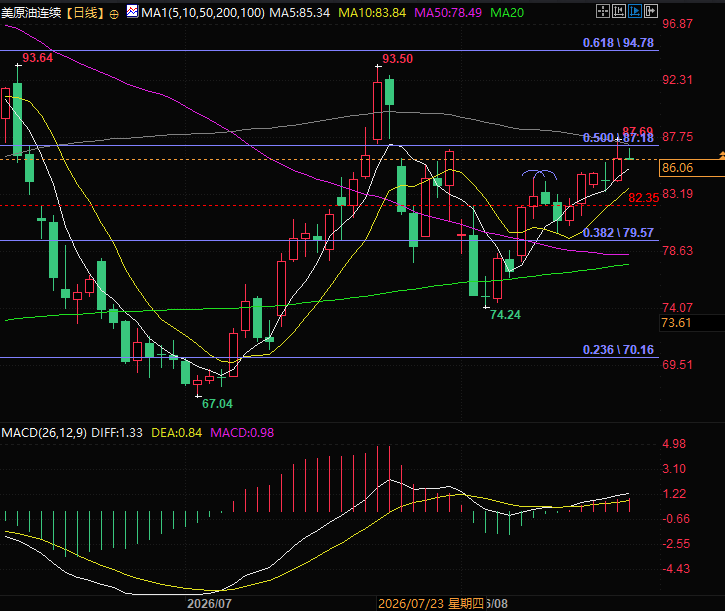 (WTI crude oil futures daily chart, source: EasyTrade) At 16:27 Beijing time, WTI crude oil futures were trading at $86.16 per barrel.
Diplomatic talks between the US and Iran have stalled, and the sanctions game is constrained by oil prices.
The United States continues to escalate economic pressure on Iran, with the Trump administration signaling threats of a "devastating economic war." US Treasury Secretary Scott Bessant announced the strongest sanctions package in history and called on multiple countries, including China, to join the pressure campaign against Iran. Iran strongly denounced the US sanctions as illegal and warned of serious consequences for further escalation. US Vice President Vance also acknowledged that economic sanctions are Washington's most effective tool, but given rising energy prices, this pressure strategy is a "delicate balancing act," with the sanctions driving up oil prices being an external cost the US must bear. my country has also explicitly rejected the US's demands for further economic restrictions on Iran, and the window for resolving the conflict diplomatically between the US and Iran is currently stalled.US forces in the Middle East complete aircraft carrier rotation and implement maritime blockade operations.
On the military deployment front, the US military in the Middle East has completed its aircraft carrier rotation adjustment. The USS George Washington has arrived in the Middle East theater, replacing the USS Abraham Lincoln, which had exceeded its deployment period and was returning to the USS Homeland. The Lincoln's deployment at sea lasted more than nine months, raising concerns about crew fatigue, mental health, and troop morale. The US Central Command is currently carrying out a blockade operation against Iranian ports. Public information shows that the US military has forced 67 commercial vessels to change course, dealt with 3 vessels, and conducted boarding inspections on 2 vessels, indicating a continued escalation of the maritime military standoff in the Gulf region.Navigation in the Strait of Hormuz has plummeted, and large oil tankers have almost disappeared.
As a vital global energy chokepoint, navigation data in the Strait of Hormuz directly reflects market risk aversion. According to Kpler, a shipping data agency, only seven commodity vessels passed through the Strait of Hormuz on Thursday, half the 14 vessels of the previous day; four entered the strait, and three exited. Before the conflict erupted in February, nearly one-fifth of global crude oil and liquefied natural gas trade passed through this waterway. On the latest trading day, no very large crude carriers (VLCCs) or LNG carriers completed passage; only one large gas carrier carrying propane and butane exited the strait via the Iranian side. More and more ship owners are choosing alternative routes or disabling their ship tracking systems to mitigate risk, as the US and Iran continue their standoff over control of this crucial waterway.Traffic flow in the Bab el-Mandeb Strait has also declined, but shipping pressure in the Red Sea remains.
In addition to the Strait of Hormuz, shipping traffic in the Bab el-Mandeb Strait also declined. Kpler data shows that a total of 23 commodity vessels passed through the Bab el-Mandeb Strait on Thursday, compared to 34 vessels per day for the previous two days. Of the 23 vessels, 16 entered and 7 left the Red Sea. The departing vessels included two Suez-class oil tankers carrying crude oil destined for Vietnam and India, respectively. The simultaneous pressure on two key energy routes further exacerbates market concerns about disruptions to the crude oil supply chain.The situation in Lebanon has become more uncertain, increasing the risk of spillover from regional conflict.
Beyond the Gulf, the situation in Lebanon further amplifies the overall uncertainty in the Middle East. The United States has introduced a new round of sanctions against Hezbollah, formally designating the Lebanese armed group as an Iranian proxy, citing Hezbollah's deep ties with the Iranian Revolutionary Guard. Meanwhile, multiple nighttime Israeli airstrikes and artillery attacks on southern Lebanon have compounded the risks on multiple fronts, keeping the possibility of regional conflict escalating significantly and making it difficult for the geopolitical risk premium in the oil market to dissipate quickly.Summary and Technical Analysis
The future direction of oil prices originally depended on whether shipping in the Taiwan Strait could return to normal. However, US Treasury Secretary Bessenter's actions have led the US to be indecisive and caught in a dilemma, with its policies constrained on both sides. Observing the subsequent evolution of the US-Iran conflict requires close attention to three variables: whether Iran's military strategy will shift towards offensive or more aggressive military actions; whether rising US Treasury yields will force the US to adjust its Middle East policy and for the White House to release conciliatory signals; and the potential signals of encouragement for peace talks from future meetings between Chinese and American leaders. Although oil price increases will be constrained by multiple factors, the reality of deteriorating shipping lanes could still push oil prices to new highs. For oil bulls, it is necessary to be wary of sudden market disturbances caused by Trump's social media statements, as high oil prices are a situation the US cannot afford. Technically, oil prices are facing resistance above 87.18 at the 0.5 Fibonacci retracement level, currently forming a small double-top pattern on the daily chart. Current resistance is around 87.18, while support is at the 5-day moving average. (WTI crude oil futures daily chart, source: EasyTrade) At 16:27 Beijing time, WTI crude oil futures were trading at $86.16 per barrel.
- Risk Warning and Disclaimer
- The market involves risk, and trading may not be suitable for all investors. This article is for reference only and does not constitute personal investment advice, nor does it take into account certain users’ specific investment objectives, financial situation, or other needs. Any investment decisions made based on this information are at your own risk.