The disruptive effect of Trump's social media pronouncements on international oil prices continues to diminish.
2026-08-21 18:10:58
In today's world, where geopolitics and financial markets are deeply intertwined, Trump's posts on truth-based social media platforms have demonstrated his influence on international oil prices. Research has found that over time, the short-term impact of Trump's social media posts regarding the situation in Iran on Brent crude oil prices is weakening, and the once-sensitive news-driven price movements have gradually become less pronounced.  Market participants have been closely monitoring Trump's public statements, attempting to glean insights into future US diplomatic and military moves and assess the potential impact of related policies on Middle Eastern oil transport routes, crude oil shipping trade, and regional energy infrastructure security. Professional trading teams from large investment banks, multinational hedge funds, and commodity traders have been working overnight to analyze subtle nuances in high-level statements and quickly adjust their long and short positions in crude oil futures. Retail speculative funds are also highly susceptible to following short-term sentiment and engaging in speculative trading. This combination of factors amplifies the short-term oil price volatility triggered by news, further amplifying the market effect of public opinion. Looking back at the entire market reaction to this round of US-Iran geopolitical conflict, the trajectory of market sentiment shifts is very clear. Oil analyst Ben Cahill, a senior fellow at the Atlantic Council, explains that in the early stages of the conflict, the entire market was in a typical information vacuum. No one could accurately predict the US policy direction, diplomatic stance, and core strategic objectives. This high degree of uncertainty led to an overreaction to every related social media post by Trump. In the early stages of geopolitical conflicts, official and effective public information was scarce, and the market lacked a stable and credible pricing anchor. Any public statements from high-ranking government officials were easily interpreted and amplified by market participants, leading to short-term emotional price movements lacking fundamental support. This was the core reason why oil prices were extremely sensitive to news in the early stages. However, this market pattern did not last. After months of market adjustment and emotional digestion, the market influence of Trump's social media posts has significantly diminished. Cahill stated that the market no longer reacts strongly to posts on such platforms, and these online statements no longer accurately reflect the actual situation on the ground in the Middle East. Even if Trump frequently releases information regarding the status of navigation in the Strait of Hormuz, US energy policy, and US military deployments, it is difficult to have a substantial impact on oil shipping patterns and market pricing. After experiencing multiple rounds of news-driven price movements, traders gradually realized that many public statements serve more as domestic propaganda and political maneuvering, and do not necessarily indicate large-scale military action or a hardline diplomatic policy in the short term. Therefore, the market is no longer willing to pay an additional short-term risk premium for such social media news, and the trading enthusiasm generated by such news has naturally continued to cool down.
 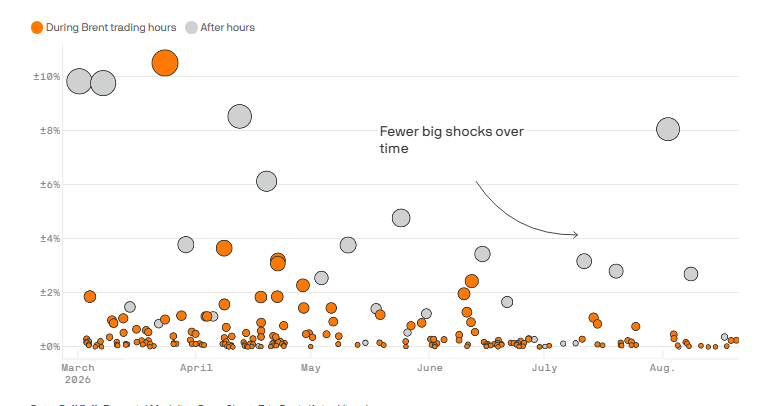 (The absolute percentage change in the average Brent crude oil price within five minutes before and after Trump posted messages mentioning "Iran" or "Hormuz" from February 28, 2026 to August 19, 2026. Yellow represents trading hours, and gray represents non-trading hours.) From February to August 2026, statistics show that Trump posted 269 messages related to Iran and the Strait of Hormuz on social media platforms. Data shows that the average fluctuation of crude oil futures prices within a normal five-minute timeframe is 0.26%. However, within the five-minute trading window following the posting of these social media messages, oil price fluctuations reached four times the benchmark level, with an average fluctuation of 0.75%, demonstrating the strong disruptive effect of initial public opinion on oil prices. The research team rigorously designed data screening rules, actively eliminating other major disruptive events such as OPEC+ production cut meetings, the release of US crude oil inventory data, and unexpected accidents in major oil-producing countries. This approach effectively removed various confounding factors, allowing for the separate calculation of the short-term oil price impact of the social media posts themselves, ensuring the rigor and accuracy of the analysis. A review of the overall price fluctuation data reveals a clear trend of diminishing impact from Trump's social media posts on oil prices. In fact, the market influence of Trump's social media posts extends beyond oil price volatility, fostering a differentiated information service system on Wall Street. Reportedly, the Truth social media platform has already launched a paid, first-come-first-served information service for Wall Street institutions, with annual fees reaching up to $1.2 million. Paying institutions gain access to millisecond-level data on the platform's posts, allowing them to seize trading opportunities. This controversial paid service is currently facing multiple legal challenges. Institutional traders who receive first-hand information can exploit this millisecond-level information gap to complete futures trades ahead of time, capturing arbitrage opportunities arising from rapid price movements. This differentiated information privilege severely undermines the fairness of capital market transactions and has sparked widespread criticism and controversy from market participants and regulators. More importantly, the waning influence of Trump's public opinion on the energy market is not merely a subtle change in the financial market, but also reflects a profound logic of political maneuvering in the United States. Currently, the Democratic Party has made energy price volatility a core issue for attacking the Republican Party in the midterm elections, as the level of energy prices directly affects voters' interests and voting intentions. Cahill admitted that in the initial months of the conflict, the White House effectively stabilized oil prices and calmed market sentiment by precisely controlling market expectations through media guidance. However, this media manipulation tactic has now completely failed. Ordinary voters are extremely sensitive to changes in energy expenditures such as fuel and heating; the level of energy costs directly influences people's quality of life and voting intentions. Once the White House loses its ability to guide the energy market and calm public sentiment through verbal statements, not only will the commodity market lose its short-term media anchor, but the White House will also face significantly increased domestic governance pressure, adding considerable uncertainty to the Republican Party's midterm elections.
Market participants have been closely monitoring Trump's public statements, attempting to glean insights into future US diplomatic and military moves and assess the potential impact of related policies on Middle Eastern oil transport routes, crude oil shipping trade, and regional energy infrastructure security. Professional trading teams from large investment banks, multinational hedge funds, and commodity traders have been working overnight to analyze subtle nuances in high-level statements and quickly adjust their long and short positions in crude oil futures. Retail speculative funds are also highly susceptible to following short-term sentiment and engaging in speculative trading. This combination of factors amplifies the short-term oil price volatility triggered by news, further amplifying the market effect of public opinion. Looking back at the entire market reaction to this round of US-Iran geopolitical conflict, the trajectory of market sentiment shifts is very clear. Oil analyst Ben Cahill, a senior fellow at the Atlantic Council, explains that in the early stages of the conflict, the entire market was in a typical information vacuum. No one could accurately predict the US policy direction, diplomatic stance, and core strategic objectives. This high degree of uncertainty led to an overreaction to every related social media post by Trump. In the early stages of geopolitical conflicts, official and effective public information was scarce, and the market lacked a stable and credible pricing anchor. Any public statements from high-ranking government officials were easily interpreted and amplified by market participants, leading to short-term emotional price movements lacking fundamental support. This was the core reason why oil prices were extremely sensitive to news in the early stages. However, this market pattern did not last. After months of market adjustment and emotional digestion, the market influence of Trump's social media posts has significantly diminished. Cahill stated that the market no longer reacts strongly to posts on such platforms, and these online statements no longer accurately reflect the actual situation on the ground in the Middle East. Even if Trump frequently releases information regarding the status of navigation in the Strait of Hormuz, US energy policy, and US military deployments, it is difficult to have a substantial impact on oil shipping patterns and market pricing. After experiencing multiple rounds of news-driven price movements, traders gradually realized that many public statements serve more as domestic propaganda and political maneuvering, and do not necessarily indicate large-scale military action or a hardline diplomatic policy in the short term. Therefore, the market is no longer willing to pay an additional short-term risk premium for such social media news, and the trading enthusiasm generated by such news has naturally continued to cool down. (The absolute percentage change in the average Brent crude oil price within five minutes before and after Trump posted messages mentioning "Iran" or "Hormuz" from February 28, 2026 to August 19, 2026. Yellow represents trading hours, and gray represents non-trading hours.) From February to August 2026, statistics show that Trump posted 269 messages related to Iran and the Strait of Hormuz on social media platforms. Data shows that the average fluctuation of crude oil futures prices within a normal five-minute timeframe is 0.26%. However, within the five-minute trading window following the posting of these social media messages, oil price fluctuations reached four times the benchmark level, with an average fluctuation of 0.75%, demonstrating the strong disruptive effect of initial public opinion on oil prices. The research team rigorously designed data screening rules, actively eliminating other major disruptive events such as OPEC+ production cut meetings, the release of US crude oil inventory data, and unexpected accidents in major oil-producing countries. This approach effectively removed various confounding factors, allowing for the separate calculation of the short-term oil price impact of the social media posts themselves, ensuring the rigor and accuracy of the analysis. A review of the overall price fluctuation data reveals a clear trend of diminishing impact from Trump's social media posts on oil prices. In fact, the market influence of Trump's social media posts extends beyond oil price volatility, fostering a differentiated information service system on Wall Street. Reportedly, the Truth social media platform has already launched a paid, first-come-first-served information service for Wall Street institutions, with annual fees reaching up to $1.2 million. Paying institutions gain access to millisecond-level data on the platform's posts, allowing them to seize trading opportunities. This controversial paid service is currently facing multiple legal challenges. Institutional traders who receive first-hand information can exploit this millisecond-level information gap to complete futures trades ahead of time, capturing arbitrage opportunities arising from rapid price movements. This differentiated information privilege severely undermines the fairness of capital market transactions and has sparked widespread criticism and controversy from market participants and regulators. More importantly, the waning influence of Trump's public opinion on the energy market is not merely a subtle change in the financial market, but also reflects a profound logic of political maneuvering in the United States. Currently, the Democratic Party has made energy price volatility a core issue for attacking the Republican Party in the midterm elections, as the level of energy prices directly affects voters' interests and voting intentions. Cahill admitted that in the initial months of the conflict, the White House effectively stabilized oil prices and calmed market sentiment by precisely controlling market expectations through media guidance. However, this media manipulation tactic has now completely failed. Ordinary voters are extremely sensitive to changes in energy expenditures such as fuel and heating; the level of energy costs directly influences people's quality of life and voting intentions. Once the White House loses its ability to guide the energy market and calm public sentiment through verbal statements, not only will the commodity market lose its short-term media anchor, but the White House will also face significantly increased domestic governance pressure, adding considerable uncertainty to the Republican Party's midterm elections.
- Risk Warning and Disclaimer
- The market involves risk, and trading may not be suitable for all investors. This article is for reference only and does not constitute personal investment advice, nor does it take into account certain users’ specific investment objectives, financial situation, or other needs. Any investment decisions made based on this information are at your own risk.