With a $40 trillion debt, why is the US so recklessly provoking conflicts and waging tariff wars?
2026-08-21 20:07:03
In August 2026, the U.S. federal debt officially surpassed $40 trillion, setting a landmark record in U.S. fiscal history. New debt since 2019 has reached $17 trillion, a short-term increase roughly equivalent to the accumulated debt over the 225 years since the founding of the United States, demonstrating a clear acceleration in debt expansion. Since 2018, federal fiscal revenue has grown by 68%, maintaining a historical average of around 17% of GDP; conversely, fiscal expenditure as a percentage of GDP has risen from 20% before the pandemic to over 24%. This indicates that the core driver of this round of debt expansion is not revenue contraction, but rather structural expansion and imbalance on the expenditure side. Coupled with a high-interest-rate environment, interest payments on U.S. Treasury bonds reached $963 billion in the first ten months of fiscal year 2026, surpassing defense spending and federal healthcare to become the second largest rigid expenditure, making interest payment pressure fully apparent. 
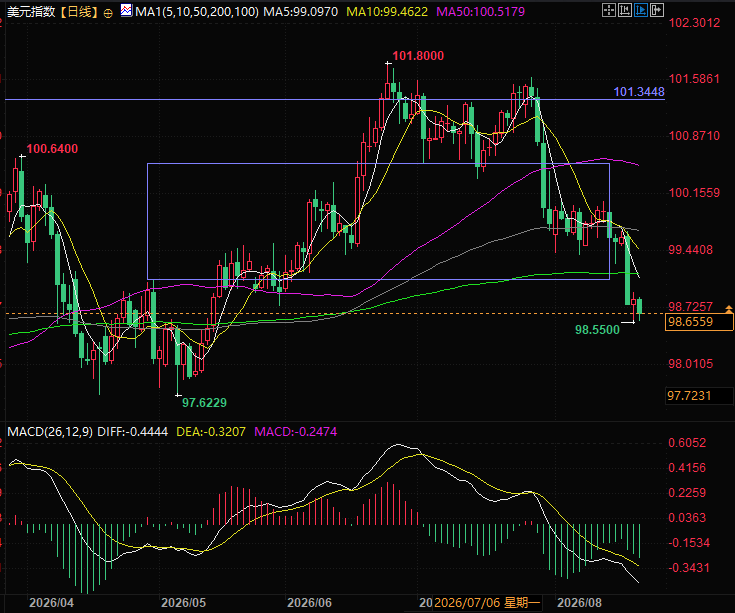 (US Dollar Index Daily Chart, Source: FX678) At 19:58 Beijing time, the US Dollar Index is currently at 98.65.
The endogenous toxins of high government debt: crowding-out effect and high long-term interest rates
The out-of-control debt problem is not only a fiscal deficit issue, but also profoundly erodes the vitality of the real economy. In the capital market, the total amount of loanable funds is limited. When the government issues $40 trillion in national debt, it creates a severe "debt crowding-out effect": it squeezes out private and corporate resources. The government takes away the vast majority of funds in the market, leaving significantly less for businesses to use for technology research and development, factory expansion, and for individuals to use for housing and car purchases. This drives up long-term borrowing costs, and to attract enough funds to buy massive amounts of national debt, yields are artificially inflated. As the "anchor" for global financial asset pricing, US Treasury yields directly raise mortgage rates and corporate bond financing costs. Many private projects with long-term innovation potential are forced out of the market because they cannot afford the high interest rates, leading to a slowdown in overall productivity growth and a predicament of "high debt, high interest rates, and low growth" for the real economy.Hidden Concerns About Foreign Capital Selling Off: How Did the US Fight the "War to Defend US Debt"?
With the expansion of debt, the US dollar index has recently fallen sharply, putting the willingness of overseas central banks and other institutions to absorb US Treasury bonds to the test. If foreign investors sell off US Treasury bonds in a concentrated manner, it will trigger a crisis of a sharp drop in US Treasury bond prices and a surge in yields. To prevent large-scale outflows of foreign capital, the United States has a clear combination strategy at the financial and macro levels: the Treasury Department smooths out long-term yields by "buying long and selling short" (repurchasing long-term old bonds and issuing short-term Treasury bonds), while providing the Standing Repurchase Facility (FIMA) to allow foreign central banks to directly pledge US Treasury bonds for dollars, preventing them from selling them off in the secondary market in a concentrated manner; in addition, by modifying regulatory rules, it forces domestic commercial banks and funds to take over, transforming the debt into "internal circulation". Reshaping the narrative of "high GDP growth" and "high productivity": the fundamental concern of investors selling US Treasury bonds is that the debt growth rate exceeds the GDP growth rate (r>g). To this end, the United States is vigorously creating a narrative of a "super technology cycle" represented by AI and capacity expansion, trying to prove to the world that the huge debt capital is being transformed into generative AI, next-generation computing infrastructure and energy grids, and that the future total factor productivity (TFP) will leap forward, driving GDP to outpace debt costs.Recent events in the US amid the US debt crisis
Why did the US suddenly launch a tariff war, simultaneously vying for oil and waging war? The most direct motivation for initiating a widespread tariff war is to increase direct fiscal revenue. With the political deadlock between the two parties making it difficult to raise domestic income tax, imposing high tariffs on imported goods has become a direct tool to replenish fiscal revenue. At the same time, the tariff war attempts to forcibly pull the manufacturing chain back to the US, boosting domestic fixed asset investment (I) and artificially inflating GDP growth. Crude oil is the underlying asset for global commodity settlements. By controlling key global energy production areas and transportation routes, and seizing control of crude oil, the US can not only directly generate huge sales revenue and tax revenue for its energy companies, raising domestic GDP , but also leverage the "petrodollar" system to bind global liquidity, ensuring that US Treasury bonds remain the ultimate safe haven for global commodity trade settlements. The US's instigation of geopolitical risks creates demand for safe-haven assets and a rigid demand for US Treasury bonds . When other parts of the world (such as Europe, the Middle East, or the Asia-Pacific region) are embroiled in geopolitical turmoil, global capital, even knowing the long-term fiscal imbalance risk associated with US Treasury bonds, will still regard them as the "only safe haven in the world" in the absence of other highly liquid and deeply entrenched alternative assets. The rise in geopolitical risks objectively creates strong external rigid demand for US Treasury bonds, supporting their value.Summarize:
Whether it's launching a tariff war to increase short-term revenue, or vying for energy and creating geopolitical risks to stimulate demand for US Treasury bonds as a safe haven, these are essentially spillover effects from the failure of traditional fiscal policies. However, these external arbitrage tactics still fail to solve the fundamental problem. The costs of tariff shifting will ultimately translate into domestic inflation, and geopolitical risks will erode the foundation for global economic recovery. Faced with a massive $40 trillion debt, marginal fiscal and tax adjustments and external leverage cannot reverse the trend. Under the existing framework, continuing to tighten fiscal spending, reshaping fiscal discipline, and genuinely promoting real productivity growth remain the only fundamental path for the US to escape the debt spiral. Currently, this explains why the dollar index has collapsed in just a few days; after using all available means, the market will ultimately vote with the dollar and US Treasury bonds. (US Dollar Index Daily Chart, Source: FX678) At 19:58 Beijing time, the US Dollar Index is currently at 98.65.
- Risk Warning and Disclaimer
- The market involves risk, and trading may not be suitable for all investors. This article is for reference only and does not constitute personal investment advice, nor does it take into account certain users’ specific investment objectives, financial situation, or other needs. Any investment decisions made based on this information are at your own risk.