US Treasury repurchase agreements and geopolitical risks are offsetting each other, causing the euro to fluctuate around the 1.17 level.
2026-08-24 10:05:00
On Monday (August 24) during Asian trading hours, the euro fluctuated at high levels against the US dollar, currently trading slightly higher around 1.1680. Last week, the euro briefly touched 1.1710, a new high since May 14. The dollar was pressured by the US Treasury's expansion of its long-term debt buyback program, with Treasury Secretary Bessant indicating that the buyback program could exceed $4 billion per tranche, aiming to signal that "yields are not reflecting fundamentals." However, further upside for the euro may be limited – escalating geopolitical tensions between the US and Iran provided safe-haven buying support for the dollar, with Iran warning of "earthquake-like" retaliatory measures. In the Eurozone, sticky inflation data and expectations of further interest rate hikes by the European Central Bank provided structural support for the euro. While the Eurozone's one-year inflation expectation slightly decreased to 2.9%, it remains well above the 2% target. Rabobank expects the ECB to begin discussing a structural long-term refinancing operations framework before the end of the year. 
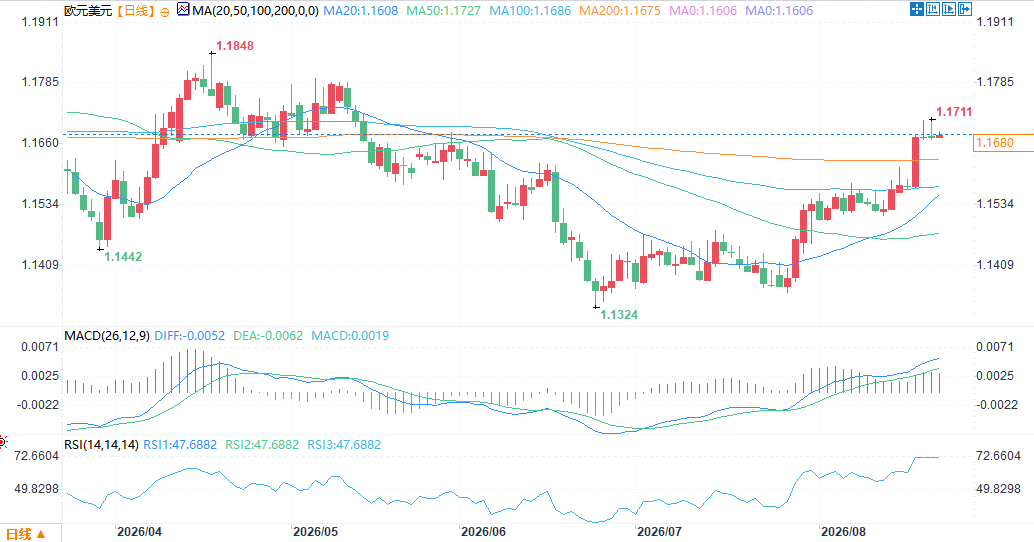 (Euro/USD daily chart, source: FX678) At 10:01 Beijing time on August 24, the euro was trading at 1.1680/81 against the US dollar.
US Treasury repurchases continue to put downward pressure on the dollar, and Bessant hinted at a possible further expansion.
The euro held steady against the dollar in Asian trading, maintaining its strength for the fourth consecutive session. The US Treasury pledged to at least double its long-term debt buyback program to $4 billion per tranche to curb rising yields, with Treasury Secretary Bessant further hinting that the program could exceed $4 billion. This strategic move aims to signal to the market that high yields do not accurately reflect economic fundamentals. However, further downside for the dollar may be limited by geopolitical risks. Iran's foreign minister stated that the impending US sanctions were a "desperate measure" and would not weaken Tehran; Iran's security chief warned of an "earthquake-like" retaliation if Trump takes further action. The escalating US-Iran standoff provided safe-haven buying support for the dollar, limiting the euro's upside potential against the dollar.Eurozone inflation remains above target, and expectations for a European Central Bank rate hike remain solid.
For the euro, sticky inflation data and market expectations that the European Central Bank (ECB) will maintain its tightening stance provided support. Eurozone one-year inflation expectations fell slightly to 2.9% from 3% in June, a decline that remains well above the ECB's 2% medium-term target, indicating that price pressures have not completely subsided. The resilience of core inflation, particularly in the services sector, continues to be a focus for policymakers. The market continues to price in the possibility of further tightening after the June rate hike, with some traders already incorporating the probability of an additional 25 basis point rate hike into the short-term yield curve. ECB President Christine Lagarde has recently emphasized on several occasions that the path of inflation back to the target remains cautious, and policy rates need to remain at a restrictive level for a sufficiently long period. High services inflation, coupled with wage growth and resilient demand, further solidifies the hawkish stance. These factors collectively support the euro exchange rate, enabling it to demonstrate relative resilience against the backdrop of increased dollar volatility. Investors generally believe that as long as inflation expectations do not significantly decline to near the target level, the ECB is unlikely to shift towards easing, thus providing continued fundamental support for the euro.The European Central Bank's structural LTRO framework is in the works.
Analysts at Rabobank expect the European Central Bank (ECB) to gradually shift to a new framework for structural longer-term refinancing operations (LTROs) as excess liquidity gradually declines, in order to meet the banking system's reserve requirements in a more sustainable way. The bank noted that "the ECB may begin discussing the design of structural LTROs by the end of this year, but the launch date depends on the actual reserve requirements of banks." In their view, "12 months is a reasonable timeframe for these operations," providing medium-term funding support while avoiding excessive distortion of market pricing. The central bank may favor a more market-driven approach, Rabobank added, "The ECB may issue LTROs through auctions rather than fixed-rate full allocation procedures," making the new tool closer to standard refinancing operations while still effectively supporting reserve requirements. This design helps improve the efficiency of fund allocation, reduces excessive intervention in bank balance sheets, and better connects with the quantitative tightening process. The market is closely watching the details and timeline of this framework, as it could affect the Eurozone interbank liquidity premium, short-term interest rate trends, and the overall transmission efficiency of monetary policy.Summarize
The US dollar came under pressure as the US Treasury expanded its long-term repurchase program, with Bessant hinting that the repurchase program could exceed $4 billion. However, geopolitical tensions between the US and Iran provided safe-haven buying support for the dollar, limiting further upside for the euro. Sticky inflation in the Eurozone and expectations of ECB rate hikes continue to provide structural support for the euro, with one-year inflation expectations still well above the 2% target. Rabobank expects the ECB to begin discussing a structural LTRO framework before the end of the year. Overall, the euro is biased towards a short-term bullish trend, but its upside is constrained by geopolitical risks, with 1.1700 remaining a key resistance level. (Euro/USD daily chart, source: FX678) At 10:01 Beijing time on August 24, the euro was trading at 1.1680/81 against the US dollar.
- Risk Warning and Disclaimer
- The market involves risk, and trading may not be suitable for all investors. This article is for reference only and does not constitute personal investment advice, nor does it take into account certain users’ specific investment objectives, financial situation, or other needs. Any investment decisions made based on this information are at your own risk.