With the US PCE and Jackson Hole signals approaching, gold bulls may strengthen further.
2026-08-24 16:21:00
Global financial markets opened the week in a state of uncertainty. Hauk Simsen, interest rate strategist at Commerzbank, pointed out that persistently high oil prices and escalating fiscal concerns keep the bond market vulnerable, with yield curves across different maturities globally currently testing multi-year highs. Although the market saw some consolidation in the early session, the fundamental factors driving bond yields higher have not been fundamentally resolved, therefore conditions for a sustained market reversal remain insufficient.  The current bond market faces multiple pressures. On the one hand, persistently high energy prices increase inflation risks, and market concerns about renewed price pressures have not completely subsided. On the other hand, the continued focus on fiscal deficits and debt levels in major economies leads investors to demand higher yields when allocating to long-term bonds. These two factors combined keep term premiums in long-term US Treasuries and major global bond markets at high levels. The impact of oil prices on financial markets is particularly noteworthy. Rising energy prices not only directly push up inflation expectations but may also force central banks to maintain relatively cautious monetary policies when economic growth faces pressure. For the bond market, this means potentially limited room for interest rate cuts; for gold, the impact is more complex. If energy inflation drives real interest rates higher, gold will face some pressure, but if the market focuses more on fiscal risks, monetary credit, and safe-haven demand, gold may attract new inflows. The US dollar market is also showing clear signs of weakness. US fiscal policy intervention in long-term bond yields and a cooling of market expectations for further tightening by the Federal Reserve have weakened the dollar's previous interest rate advantage. Meanwhile, following the expansion of long-term Treasury repurchase operations by the US Treasury, the market has begun to reassess the relationship between US fiscal policy and bond yields. A weakening dollar in the short term provides direct support for gold. Since gold is priced in dollars, a depreciation of the dollar reduces the cost for non-dollar investors to purchase gold, typically benefiting gold prices. Furthermore, if the dollar's weakness persists, funds may further increase allocations to non-dollar assets such as gold, thereby strengthening bullish sentiment in the precious metals market. However, the US Treasury market has yet to establish a clear trend. Yields near multi-year highs suggest that bonds offer some investment value, but fiscal risks and inflationary pressures limit the upside potential of long-term bonds. The market currently needs new macroeconomic data and monetary policy signals to determine the next direction of yields. This week's US PCE inflation data is therefore a crucial window for observation. The PCE is one of the key inflation indicators monitored by the Federal Reserve. If the data further shows easing price pressures, the market may raise expectations for future monetary policy easing, potentially putting pressure on the dollar and Treasury yields, thus providing stronger upward momentum for gold. Conversely, if the PCE indicates that inflation remains resilient, the market may re-bet on higher interest rates remaining for a longer period, and a rebound in the dollar and yields will put short-term pressure on gold. The Jackson Hole annual symposium is also likely to be a key variable for the market this week. Investors are not only focused on the Fed's assessment of inflation and economic growth, but more importantly, on whether policymakers will release clear signals regarding the future path of interest rates. If the policy stance leans towards easing, market risk appetite and bond prices may improve, and gold may continue to be driven by both a weaker dollar and declining real interest rate expectations; if the policy tone is hawkish, gold may experience short-term profit-taking. From a market sentiment perspective, investors have not yet fully formed one-sided bets. Bond market concerns, fiscal risks, energy prices, and monetary policy expectations are intertwined, making funds more inclined to wait for key data to confirm the direction. In this environment, gold's attractiveness comes not only from interest rate expectations but also from its hedging function against fiscal risks and macroeconomic uncertainties. As for the dollar, it is more likely to maintain a weak adjustment pattern in the short term. The dollar index has already shown a significant decline, and without new strong economic data and hawkish policy signals, the basis for a rapid reversal of the dollar remains insufficient. However, if the PCE index reinvigorates inflation concerns, or if Jackson Hole releases a clearly hawkish signal, the US dollar may still experience a temporary rebound. Therefore, short-term volatility driven by events cannot be ignored. From a daily technical perspective, gold remains in an overall bullish trend, with prices holding above key medium-term moving averages and trend support. The current upward momentum has not been broken. If it breaks through the previous high and effectively holds above $4750, the market may open up further upside potential. Conversely, if it repeatedly fails to break through key resistance areas, we need to be wary of increased profit-taking at higher levels and the possibility of a pullback to the previous breakout area of $4400. The US dollar and US Treasury yields will continue to determine whether the gold breakout can continue.
 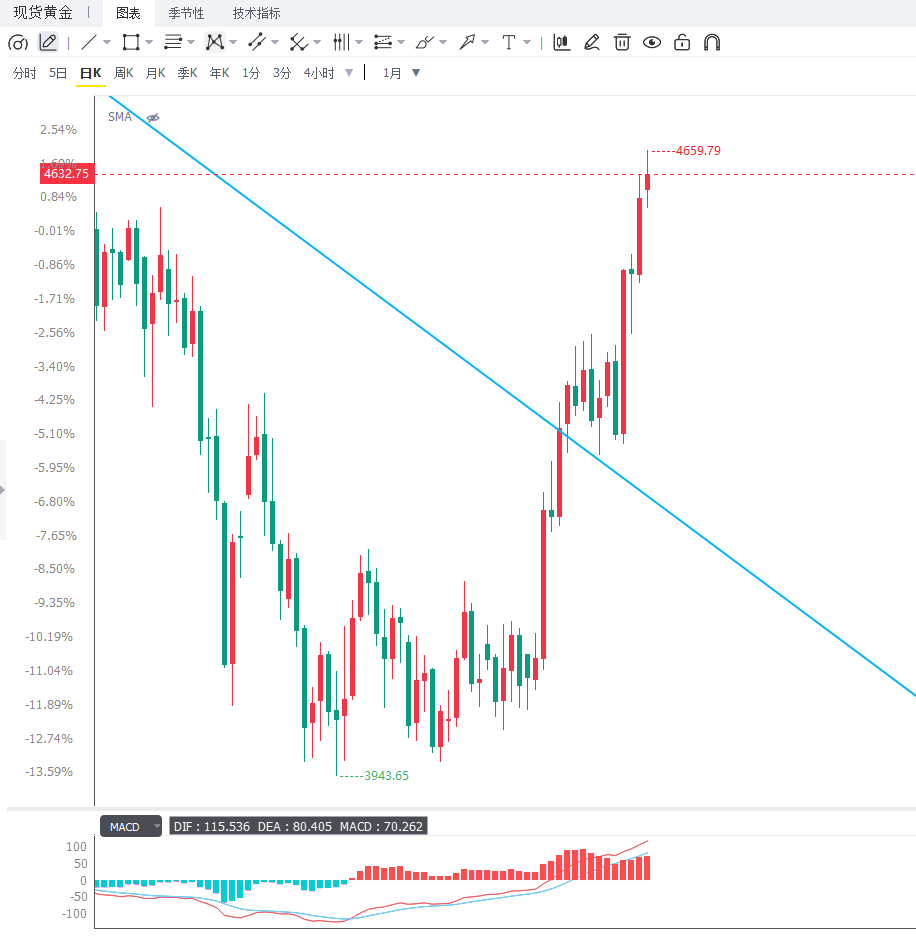 Editor's Summary : Overall, high oil prices, fiscal concerns, and multi-year highs in global bond yields keep the market highly sensitive, while a weak dollar provides more direct upward momentum for gold. Ahead of the US PCE inflation data and the Jackson Hole symposium, the dollar is expected to maintain its weak adjustment, while US Treasuries may continue to be in a directional decision-making phase. If inflation data cools and policy signals lean towards easing, gold bulls are expected to further expand their advantage; if inflation rebounds and pushes yields upward, gold prices may face a short-term pullback. Therefore, the core logic for the next few trading days will still revolve around the transmission chain of "inflation—Fed policy—US Treasury yields—dollar—gold".
The current bond market faces multiple pressures. On the one hand, persistently high energy prices increase inflation risks, and market concerns about renewed price pressures have not completely subsided. On the other hand, the continued focus on fiscal deficits and debt levels in major economies leads investors to demand higher yields when allocating to long-term bonds. These two factors combined keep term premiums in long-term US Treasuries and major global bond markets at high levels. The impact of oil prices on financial markets is particularly noteworthy. Rising energy prices not only directly push up inflation expectations but may also force central banks to maintain relatively cautious monetary policies when economic growth faces pressure. For the bond market, this means potentially limited room for interest rate cuts; for gold, the impact is more complex. If energy inflation drives real interest rates higher, gold will face some pressure, but if the market focuses more on fiscal risks, monetary credit, and safe-haven demand, gold may attract new inflows. The US dollar market is also showing clear signs of weakness. US fiscal policy intervention in long-term bond yields and a cooling of market expectations for further tightening by the Federal Reserve have weakened the dollar's previous interest rate advantage. Meanwhile, following the expansion of long-term Treasury repurchase operations by the US Treasury, the market has begun to reassess the relationship between US fiscal policy and bond yields. A weakening dollar in the short term provides direct support for gold. Since gold is priced in dollars, a depreciation of the dollar reduces the cost for non-dollar investors to purchase gold, typically benefiting gold prices. Furthermore, if the dollar's weakness persists, funds may further increase allocations to non-dollar assets such as gold, thereby strengthening bullish sentiment in the precious metals market. However, the US Treasury market has yet to establish a clear trend. Yields near multi-year highs suggest that bonds offer some investment value, but fiscal risks and inflationary pressures limit the upside potential of long-term bonds. The market currently needs new macroeconomic data and monetary policy signals to determine the next direction of yields. This week's US PCE inflation data is therefore a crucial window for observation. The PCE is one of the key inflation indicators monitored by the Federal Reserve. If the data further shows easing price pressures, the market may raise expectations for future monetary policy easing, potentially putting pressure on the dollar and Treasury yields, thus providing stronger upward momentum for gold. Conversely, if the PCE indicates that inflation remains resilient, the market may re-bet on higher interest rates remaining for a longer period, and a rebound in the dollar and yields will put short-term pressure on gold. The Jackson Hole annual symposium is also likely to be a key variable for the market this week. Investors are not only focused on the Fed's assessment of inflation and economic growth, but more importantly, on whether policymakers will release clear signals regarding the future path of interest rates. If the policy stance leans towards easing, market risk appetite and bond prices may improve, and gold may continue to be driven by both a weaker dollar and declining real interest rate expectations; if the policy tone is hawkish, gold may experience short-term profit-taking. From a market sentiment perspective, investors have not yet fully formed one-sided bets. Bond market concerns, fiscal risks, energy prices, and monetary policy expectations are intertwined, making funds more inclined to wait for key data to confirm the direction. In this environment, gold's attractiveness comes not only from interest rate expectations but also from its hedging function against fiscal risks and macroeconomic uncertainties. As for the dollar, it is more likely to maintain a weak adjustment pattern in the short term. The dollar index has already shown a significant decline, and without new strong economic data and hawkish policy signals, the basis for a rapid reversal of the dollar remains insufficient. However, if the PCE index reinvigorates inflation concerns, or if Jackson Hole releases a clearly hawkish signal, the US dollar may still experience a temporary rebound. Therefore, short-term volatility driven by events cannot be ignored. From a daily technical perspective, gold remains in an overall bullish trend, with prices holding above key medium-term moving averages and trend support. The current upward momentum has not been broken. If it breaks through the previous high and effectively holds above $4750, the market may open up further upside potential. Conversely, if it repeatedly fails to break through key resistance areas, we need to be wary of increased profit-taking at higher levels and the possibility of a pullback to the previous breakout area of $4400. The US dollar and US Treasury yields will continue to determine whether the gold breakout can continue. Editor's Summary : Overall, high oil prices, fiscal concerns, and multi-year highs in global bond yields keep the market highly sensitive, while a weak dollar provides more direct upward momentum for gold. Ahead of the US PCE inflation data and the Jackson Hole symposium, the dollar is expected to maintain its weak adjustment, while US Treasuries may continue to be in a directional decision-making phase. If inflation data cools and policy signals lean towards easing, gold bulls are expected to further expand their advantage; if inflation rebounds and pushes yields upward, gold prices may face a short-term pullback. Therefore, the core logic for the next few trading days will still revolve around the transmission chain of "inflation—Fed policy—US Treasury yields—dollar—gold".
- Risk Warning and Disclaimer
- The market involves risk, and trading may not be suitable for all investors. This article is for reference only and does not constitute personal investment advice, nor does it take into account certain users’ specific investment objectives, financial situation, or other needs. Any investment decisions made based on this information are at your own risk.