Smuggled oil shipments across the Strait cause oil prices to fall; Iranian peace advocates issue urgent statement.
2026-08-24 16:21:02
On Monday (August 24), international oil prices saw a slight pullback during the Asian and European sessions. WTI crude oil futures are currently trading around $85.52, down 1.80%. The impending implementation of a new round of heavy US sanctions against Iran, coupled with a significant reduction in traffic volume in the Strait of Hormuz, has led to increased uncertainty. However, following Iraq's repeated mediation efforts, Iran has approved the passage of some Iraqi oil tankers through the strait, while some cruise ships with their Automatic Identification System (AIS) transponders turned off have also passed through. Amidst this intensified battle between bulls and bears, international oil prices ended a two-week winning streak and saw a correction on Monday. Geopolitical risk premiums are gradually being digested, and the market awaits the release of detailed US sanctions. 
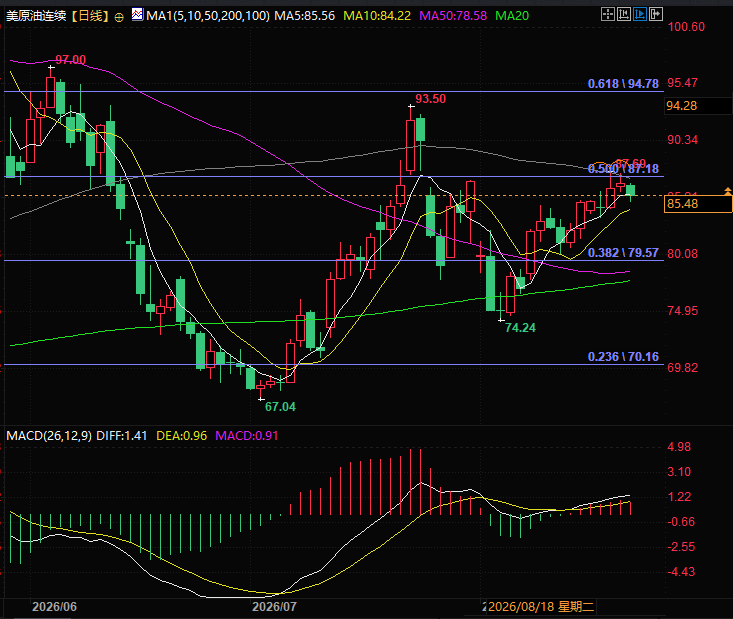 (WTI crude oil futures daily chart, source: EasyTrade) At 16:13 Beijing time, WTI crude oil futures were trading at $85.52 per barrel.
The US-Iran sanctions game has escalated across the board, and the oil trade dispute has intensified.
The US-Iran standoff has recently escalated again, with economic sanctions and geopolitical rhetoric intensifying simultaneously. US Treasury Secretary Bessenter announced the "toughest sanctions in history" against Iran, aimed at severely damaging the Iranian economy, weakening its overseas proxies, and reducing its military spending capabilities. Meanwhile, Trump publicly stated that he would impose hefty economic penalties on all countries providing trade "lifelines" to Iran, completely isolating Iran's foreign trade system. Data shows that Asian countries handle over 80% of Iran's seaborne crude oil exports, making them core oil trading partners. These sanctions directly target Iran's economic lifeline, and the US's intention to target Iranian oil purchasers, refineries, and banks handling financial transactions raises the risk of further escalation of great power rivalry.Iran responds strongly, employing both military and diplomatic pressure tactics.
In response to US sanctions and pressure, the Iranian government issued a strong rebuttal, explicitly denying the international legal validity of the US secondary sanctions and condemning the US move as an abuse of extraterritorial jurisdiction and wanton interference in the internal affairs of an independent nation. The Secretary of Iran's Supreme National Security Council simultaneously warned neighboring countries against participating in the US-led economic blockade of Iran, threatening them with being considered hostile forces. Meanwhile, Iran continues to strengthen its military and geopolitical capabilities. The military confirmed that its underground ballistic missile factories are continuously increasing production capacity, and its missile and drone combat systems are complete, retaining the core capability to blockade the Strait of Hormuz and disrupt international oil shipping. The Speaker of the Iranian Parliament criticized the US's hegemonic actions of favoring Israel and sacrificing the security of its Middle Eastern allies, calling for the construction of an indigenous regional security order to free itself from external interference. Currently, internal factional struggles within Iran are intensifying, with moderate leaders proactively calling for peace and a ceasefire. Iranian President Pezechiyan and Parliament Speaker Ghalibaf publicly refuted the hardline camp within the country, advocating for a swift end to the conflict and a full-scale recovery of the severely damaged domestic economy. Pezechiyan expressed deep concern that the ongoing conflict and heavy sanctions would completely undermine national stability, and explicitly called for an end to the ongoing geopolitical conflict. This statement fully exposes the severe economic pressure Iran is currently facing, with its people and economic system teetering on the brink of collapse. Currently, US-Iran diplomatic negotiations are largely deadlocked, with the US abandoning diplomatic mediation and instead relying on extreme economic sanctions and restrictions on ports and maritime shipping to exert comprehensive pressure on Iran. However, analysts point out that although moderates in Iran are calling for a ceasefire, the lack of a viable negotiation framework means the probability of further escalation of the conflict remains far higher than the probability of a ceasefire and reconciliation. The market will further clarify the direction of factional dominance within Iran this weekend.Navigation in the Strait of Hormuz has nearly come to a standstill, leading to a significant contraction in crude oil supply.
The ongoing US-Iran standoff has brought navigation in the Strait of Hormuz, a vital global energy chokepoint, to a near standstill, resulting in a sharp decline in crude oil transport capacity and a unique risk-averse navigation pattern in the shipping market. The latest data from shipping tracking company Kpler shows that approximately 80% of vessels transiting the Strait of Hormuz in the past two weeks adopted a covert navigation strategy, circumventing geopolitical risks by turning off their Automatic Identification System (AIS) transponders, staying away from the Iranian coastline, and sailing close to the Omani side of the waters. This stealthy shipping operation effectively ensures the basic supply of Gulf oil to the world, preventing an extreme shortage and sharp price surge in international crude oil due to the closure of the waterway. It is also an important means for the market to spontaneously hedge against geopolitical risks in the Strait and maintain the stability of global energy circulation. Meanwhile, vessel tracking data shows that recent traffic volume in the Strait remains at a record low. On Thursday, only four commodity vessels passed through, with no large crude oil or liquefied natural gas carriers. At the end of last week, the total number of commodity vessels transiting the Strait was less than 20. Data from the U.S. Department of Energy corroborates the significant contraction on the supply side. Currently, the seven-day average crude oil transport volume through the Strait is only 8 million barrels per day, a sharp decrease of over 60% from the pre-war level of over 20 million barrels per day, indicating a significant tightening of global crude oil supply. However, there has been some easing in navigation through the Strait. At Iraq's repeated requests, Iran has granted special permission for several Iraqi oil tankers to pass, becoming one of the few exceptions in the frozen shipping industry. Overall, despite U.S. military intervention to escort shipping, Iran still holds the initiative in the Strait game, continuously restricting the efficiency of international crude oil transportation.Iran's resilience in the face of sanctions is evident, but the pace of supply recovery is slow.
The trade sector has already felt the impact of sanctions and heightened tensions, with Iran significantly reducing its crude oil sales orders to key Asian buyers and raising prices substantially, putting pressure on its crude oil export revenue. However, market analysts point out that the recovery of Middle Eastern crude oil supply will be significantly slower than expected, indicating that the US-Iran standoff is protracted. Having endured years of sanctions, Iran has built a sophisticated system for circumventing them, utilizing shell companies, cross-border intermediaries, and shadow tanker fleets. It relies on non-dollar systems such as RMB settlement and barter trade to complete oil transactions and fund transfers, possessing extremely strong risk resistance capabilities. Short-term sanctions are unlikely to force Iran to compromise.Market Outlook: Balance Between Bulls and Bears, Three Core Factors Dominating Oil Price Trends
In summary, the current oil market is showing a near-balance between bulls and bears: In the short term, the implementation of US sanctions and the tightening supply resulting from low traffic flow in the Strait of Hormuz are supporting the bottom of oil prices; however, cooling market risk aversion, profit-taking, Iran's resilience in the face of sanctions, and expectations of potential diplomatic easing, coupled with the fact that some tankers are still actually transporting oil in the Strait of Hormuz, are suppressing the upside potential of oil prices. The core focus going forward will be on the specific details of the implementation of US sanctions, the direction of Iran's internal policies, and the progress of the resumption of traffic flow in the Strait of Hormuz. These three factors will dominate the fluctuations in international oil prices in the next stage. As previously mentioned, the US Treasury's forceful intervention in US Treasury bonds is highly detrimental to continued oil price increases, and such price increases are likely to trigger intervention from the White House, something bulls need to be wary of in the near term. Technically, WTI crude oil futures have retreated after two failed attempts to break through the resistance level of the gap from the end of July, leaving a double-top pattern formed by two-day candlesticks. Current resistance is around 87.18, which is also the 0.5 Fibonacci retracement level of this round of oil price increases, while support is around 83.7. (WTI crude oil futures daily chart, source: EasyTrade) At 16:13 Beijing time, WTI crude oil futures were trading at $85.52 per barrel.
- Risk Warning and Disclaimer
- The market involves risk, and trading may not be suitable for all investors. This article is for reference only and does not constitute personal investment advice, nor does it take into account certain users’ specific investment objectives, financial situation, or other needs. Any investment decisions made based on this information are at your own risk.