The yen weakened across the board, with the USD/JPY pair hovering below the psychological resistance level of 160.
2026-08-24 15:43:04
On Monday (August 24) during the European session, the USD/JPY pair fluctuated slightly higher, currently trading around 159. The US Treasury's expanded buyback program triggered a broad sell-off of the dollar, briefly pushing the USD/JPY pair down to 158.55, but the pair rebounded to around 159.00 as US Treasury yields recovered their losses. 
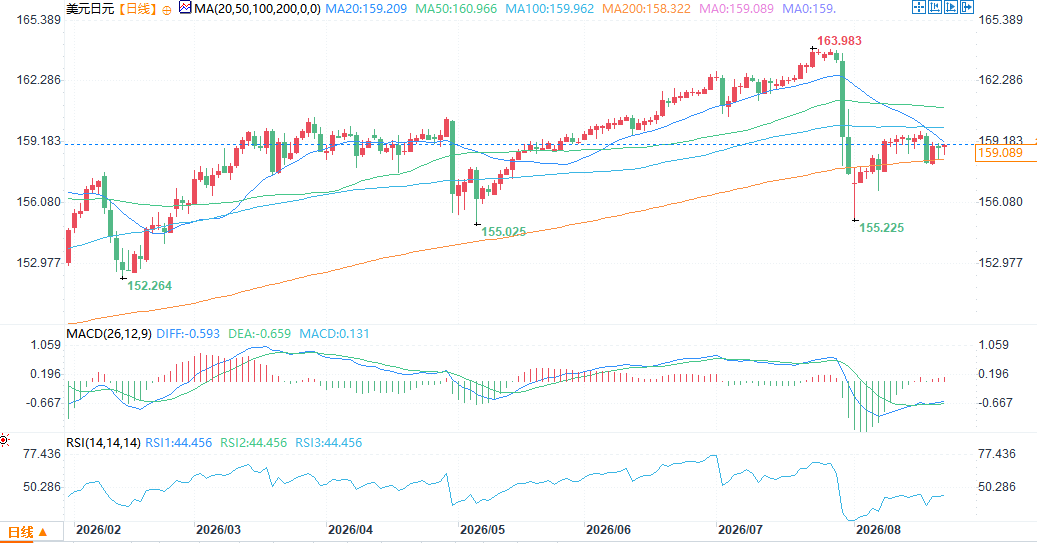 (USD/JPY daily chart, source: FX678) At 15:39 Beijing time on August 24, the USD/JPY exchange rate was 159.11/10.
The USD/JPY pair encountered resistance at 160.00, with concerns about intervention limiting its upside.
The psychological resistance level of 160.00 persists, and continued market vigilance regarding potential intervention by Japanese authorities limits further upside potential. Traders generally believe that the risk of coordinated intervention by the Japanese Ministry of Finance and the Bank of Japan increases significantly once the price approaches the 160 level, and this expectation itself constitutes a strong upward suppressive force. Even if short-term fundamentals support the dollar, intervention concerns make it difficult for bulls to decisively chase higher prices, resulting in repeated resistance near key psychological levels and a clear upward pressure pattern. Historically, Japanese authorities have intervened at similar key levels multiple times, a fact the market vividly remembers. Therefore, whenever the price approaches 160, speculative buying noticeably diminishes, with some funds choosing to take profits early. This "intervention premium" not only suppresses the possibility of a technical breakout but also alters market participants' risk appetite, making the USD/JPY pair more likely to retreat near resistance levels rather than successfully break through. In the short term, as long as intervention concerns persist, the 160 level will continue to serve as effective psychological and actual resistance.US Treasury buybacks triggered a dollar sell-off, but a rebound in yields pushed the exchange rate higher.
The US Treasury's announcement of a plan to expand its Treasury bond buyback program starting in September triggered a broad sell-off in the dollar, pushing the USD/JPY pair down to a low of 158.03 in early Tokyo trading on August 20. The pair avoided breaking below 158.00 and rebounded as US Treasury yields rose, returning above 159.00 and erasing the previous day's losses. However, as of this writing on August 24, the pair is showing a "heavy resistance" pattern around 159, indicating that upward resistance remains. The Treasury's proactive expansion of buybacks was interpreted by the market as a signal of intervention in long-term interest rates, initially raising concerns about US fiscal discipline and driving capital outflows from dollar assets. However, the subsequent rebound in yields provided renewed support for the dollar, showing that interest rate differentials remain a significant driver of exchange rates. In the short term, the pair is expected to fluctuate amid a tug-of-war between selling and yield recovery, with a directional move awaiting clearer policy or data signals.Yen cross rates weaken: Euro rises to highest level against Yen since July 31
Mitsubishi UFJ Financial Group points out that the yen weakened across the board, not just against the dollar, with the euro/yen pair rising to its highest level since July 31, trading around 185.00. This indicates that the yen's weakness is more pronounced in cross-currency pairs, not just against the dollar, but reflecting overall structural pressures on the yen—fundamental factors such as the US-Japan interest rate differential, high energy import costs, and a widening trade deficit are comprehensively suppressing the yen. The contrast between the relatively stable policy expectations in the Eurozone and the loose monetary environment in Japan has further amplified the yen's depreciation among non-US dollar currencies. The synchronized weakening of cross-currency pairs suggests that the yen's weakness is widespread, with investors preferring to use the yen as a funding currency for carry trades rather than simply betting on the strength of the dollar. This structural pressure is unlikely to fundamentally reverse in the short term, and the yen may continue to be under pressure in multiple cross-currency pairs.The Jackson Hole meeting became a key variable in the direction of the US dollar.
Market focus is shifting to the Jackson Hole Economic Symposium, where Federal Reserve Chairman Warsh's speech could provide new directional guidance for the US dollar. If Warsh signals a hawkish stance, the dollar could gain momentum, with USD/JPY potentially retesting 160.00; conversely, a dovish tone could weaken the dollar further, pushing the pair back towards 158.00. Until then, USD/JPY may fluctuate within the 158.00-160.00 range, awaiting a new catalyst to break the deadlock. Jackson Hole has historically been a crucial window for policy signals, especially in the early stages of a new chairman's term, as his remarks significantly impact market interest rate expectations. Traders will closely monitor his statements on inflation, employment, and the policy path; any clear inclination could quickly break the current range and become a key variable determining the short-term direction of USD/JPY.Summarize
The USD/JPY pair tested the psychological resistance level of 160.00 multiple times last week, failing to break through due to market wariness of potential intervention by Japanese authorities. A sell-off triggered by the US Treasury's expanded buyback program pushed the pair down to 158.03, but a rebound in US Treasury yields propelled it back above 159.00. The Jackson Hole symposium is a key variable this week, with Warsh's speech potentially determining the dollar's short-term direction. Until then, the pair is expected to trade within the 158.00-160.00 range. (USD/JPY daily chart, source: FX678) At 15:39 Beijing time on August 24, the USD/JPY exchange rate was 159.11/10.
- Risk Warning and Disclaimer
- The market involves risk, and trading may not be suitable for all investors. This article is for reference only and does not constitute personal investment advice, nor does it take into account certain users’ specific investment objectives, financial situation, or other needs. Any investment decisions made based on this information are at your own risk.