The 6% deficit poses a hidden danger; the US Treasury's intervention fails; gold enters a new cycle.
2026-08-24 18:16:59
Recently, two rounds of cross-border market interventions spearheaded by U.S. Treasury Secretary Scott Bessant have shown signs of waning effectiveness. Their efforts to stabilize asset prices and lower financing costs have only provided temporary market boosts and have failed to reverse fundamental pressures. Both the previous yen-supporting operations in conjunction with Japanese authorities and the latest expansion of the U.S. Treasury repurchase program have ultimately encountered market reversals, exposing deep-seated contradictions in the current U.S. fiscal and monetary system and sparking widespread skepticism on Wall Street regarding the effectiveness of these policies and the independence of the Federal Reserve. 
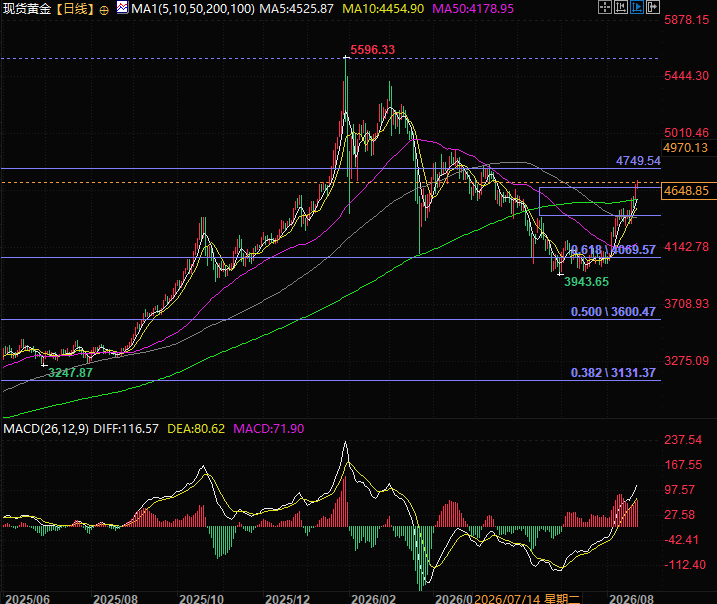 (Spot gold daily chart, source: EasyTrade) At 18:08 Beijing time, spot gold is currently trading at $4,648 per ounce.
The US Treasury repurchase policy was reversed in a single day, significantly diminishing its intervention effect.
Last week, Bessant's intervention in US Treasury bonds had a short-lived effect. On Thursday, the US Treasury Department announced a major move, doubling the scale of long-term Treasury bond repurchase operations, increasing the repurchase amount for a single operation to $4 billion. This was done to raise funds through the issuance of short-term Treasury bills and to increase holdings of existing long-term bonds, aiming to curb the continuously rising yields on long-term bonds. Following the announcement, US BBB-rated bond prices briefly rose, and yields quickly fell, leading to a temporary rebound in the bond market. However, market sentiment quickly reversed, and the positive effects almost entirely disappeared on Thursday. Bond yields only slightly declined compared to before the policy announcement, essentially rendering the intervention in the bond market ineffective. This short-lived intervention, mirroring the yen's support operations, reflects a shared core dilemma between US and Japanese interventions, closely resembling the yen exchange rate intervention led by Bessant a few weeks prior. On July 29, Bessant, together with the Japanese Monetary Authority, intervened to support the yen, briefly reversing its depreciation trend. However, the yen subsequently rebounded, recovering more than half of its gains, significantly diminishing the effectiveness of the intervention. The two rounds of cross-border interventions were not accidental; they shared a common core logic: the US and Japan were jointly combating high bond yields, and the record-high level of government debt was the main driver pushing up the yields on long-term bonds in both countries.The skyrocketing debt level has become the core source of pressure on the bond market.
The data confirms the severity of the debt pressure, and the timing of the policy intervention was highly dramatic. Just hours after the US Treasury announced an expansion of long-term bond repurchase agreements, raising the single-operation limit to $4 billion, the US government debt officially surpassed $40 trillion, reaching 120% of GDP. Japan's situation is even more severe, with its debt ratio exceeding 230%, and long-term bond yields soaring to record highs. The pressure on both countries' bond markets stems entirely from out-of-control fiscal debt problems. Wall Street institutions directly point to the core flaw of Bessant's series of interventions: addressing only the symptoms, not the root cause. JPMorgan's fiscal team analyzed that, with the US economy nearing full employment, the continued maintenance of a 6% budget deficit is the fundamental reason for the persistently high long-term bond yields and rising term premiums. In other words, a 6% deficit rate represents a significantly expansionary fiscal policy. Normally, when developed economies are performing well, deficit rates are generally between 1% and 2%, or even in surplus. However, the US economy is currently nearing full employment, yet it is still maintaining an excessively high 6% deficit, which harbors the risk of structural government spending and fiscal instability. Relying solely on secondary market intervention to regulate interest rates, without a substantial deficit reduction plan, means that all market-supporting operations are merely short-term buffers and cannot reverse the long-term weakening trend of the bond market.Replicating classic reversal tactics, current policies harbor inherent flaws.
From a policy design perspective, Bessant's long-term bond repurchase program replicates the Federal Reserve's "Operation Twist" from the early 1960s. At that time, the Fed boosted the domestic economy while stabilizing the dollar exchange rate through the Bretton Woods system by buying long-term bonds and selling short-term bonds. However, the current policy environment is vastly different. Carl Weinberg, chief economist at High Frequency Economics, points out a key weakness: the US Treasury cannot directly print money to buy bonds and must rely on market funds. If the Fed passively increases its purchases of short-term Treasury bonds, coupled with the Treasury's debt maturity adjustments, it will be seen by the market as a disguised form of money printing, harboring significant inflationary risks. Amidst the policy controversy, US President Trump has again publicly pressured for interest rate cuts, claiming that interest rates should be lowered when economic data is positive. However, his statement contradicts historical facts. The Fed's interest rate cut in 2001 was to address the economic recession following the bursting of the dot-com bubble. During the tech boom of the 1990s, market capital demand was strong, and both long-term and short-term interest rates rose simultaneously—a market logic perfectly consistent with the current artificial intelligence industry boom driving up financing costs.Wall Street collectively warns: Intervention only addresses the symptoms, not the root cause, and the risk of backlash is becoming increasingly apparent.
Weinberg bluntly stated that Bessant's actions were essentially a "disguised tactic," attempting to circumvent the Federal Reserve's interest rate cut decisions and achieve monetary easing through self-intervention, artificially suppressing long-term financing costs. However, Wall Street institutions believe that this expedient measure not only fails to address the root cause but also carries a serious risk of backlash. Ipec Ozcadescuja, a senior analyst at Quote, warned that if the market perceives the US government as solely intervening to control long-term interest rates and avoiding fiscal deficit rectification, investors will demand higher term premiums for long-term bonds, further pushing up long-term bond yields. More importantly, continued intervention will lead the market to question whether the Federal Reserve has become a "puppet tool" of the White House, completely eroding the central bank's credibility and making the US Treasury yield curve even more difficult to manipulate. George Salavelos, chief foreign exchange analyst at Deutsche Bank, pointed out the core market logic: if the US Treasury forcibly props up US Treasury prices and prevents long-term bond yields from rising reasonably, global investors can only repric US Treasury assets by lowering the dollar exchange rate.Human intervention cannot overcome fundamentals; the US economic predicament remains unresolved.
Lowering Treasury yields requires either increased government spending or reduced inflation. However, current government spending needs remain substantial, potentially worsening the fiscal situation. Considering the midterm election sentiment, multiple polls indicate a high probability of Democratic control of the House of Representatives, while the Senate seat allocation remains uncertain. This intensified partisan struggle will significantly increase the difficulty of implementing fiscal consolidation and deficit reduction policies, potentially leading to a continued rise in debt pressure. Beyond fiscal and monetary challenges, structural contradictions in the physical commodity market hinder government revenue growth and sow the seeds of inflation in the US economy. Jeffrey Currie, former head of commodities research at Goldman Sachs and chief strategist at Otis, points out that the current global landscape is characterized by "financial repression and physical scarcity." Increased obstruction at key global logistics routes such as the Strait of Hormuz, the Red Sea, the Rhine River, and the Panama Canal, coupled with limited Russian refining capacity and geopolitical conflicts, have resulted in a sharp rise in diesel prices, even if crude oil prices haven't reached new highs, directly impacting core sectors of the global transportation and agriculture sectors.Summary and Technical Analysis:
Previous articles have consistently highlighted the current opportunity in gold. Ultimately, while fiscal and monetary authorities can artificially intervene in interest rates and control financial market prices, they cannot create tangible goods or resolve supply chain bottlenecks. Under the multiple constraints of high debt, recurring inflation, pressured growth, and escalating geopolitical risks, Bessant's administrative intervention to stabilize the bond market and exchange rate will ultimately be unable to counteract the deep-seated pressures of the economic fundamentals. The US economy is trapped in a multi-faceted predicament of hindered growth, high inflation, and runaway debt. This rise in interest rates, not due to traditional corporate profit increases but rather concerns about debt repayment capacity and the credibility of the dollar, will not become an opportunity cost suppressing gold; instead, it will become the core driving force behind gold's status as the "ultimate risk-free credit asset." Since peaking at the end of July, the dollar index has fallen by 2.9%, while gold prices have risen by 15% from their mid-July lows, with market risk aversion continuing to intensify. The de-risking of US Treasury bonds has freed gold from the constraints of traditional interest costs, elevating it from a simple inflation hedge to a defensive line against sovereign debt and currency devaluation. In the medium to long term, the equity market will suffer from valuation losses due to high financing costs and foreign capital outflows, with only monopolistic giants with excellent cash flow surviving. Only when the Treasury forces the Federal Reserve to begin massive money printing (fiscal monetization) will equities experience a nominal price surge due to a collapse in purchasing power. Meanwhile, the gold market will outperform credit assets in the medium term thanks to the relentless buying by central banks and institutions, achieving a cross-cycle leap in real purchasing power during a long period of massive money printing. (Spot gold daily chart, source: EasyTrade) At 18:08 Beijing time, spot gold is currently trading at $4,648 per ounce.
- Risk Warning and Disclaimer
- The market involves risk, and trading may not be suitable for all investors. This article is for reference only and does not constitute personal investment advice, nor does it take into account certain users’ specific investment objectives, financial situation, or other needs. Any investment decisions made based on this information are at your own risk.