US Treasury's implicit quantitative easing boosts gold prices
2026-08-24 21:57:00
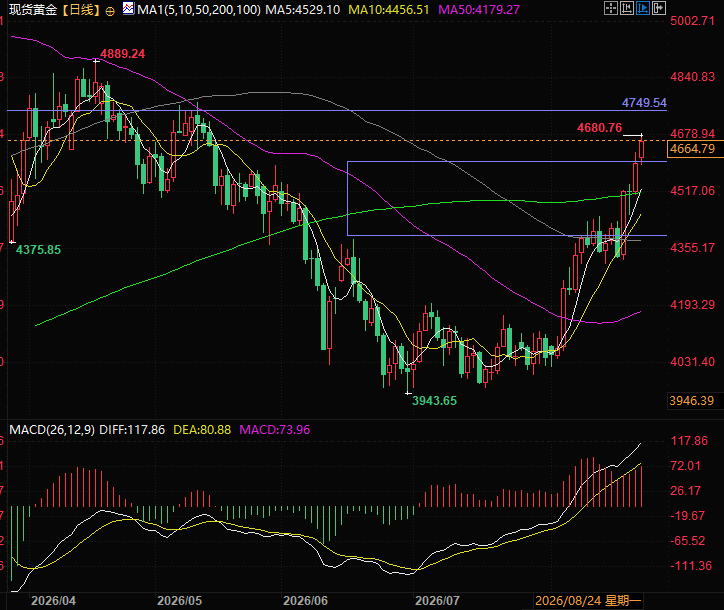
Spot gold prices have been strong recently, reaching a high of around $4669 during the Asian and European sessions on Monday (August 24), setting a new recent record. While the market is generally focused on the Federal Reserve's interest rate decision and inflation data, a macroeconomic undercurrent from the US Treasury is becoming the core engine driving the gold price surge. 
Key expectation gap: The market expected the issuance of short-term bonds, but the Ministry of Finance is preparing to utilize existing TGA (Treasury General Administration of Customs) reserves.
Previously, most market participants generally expected the Treasury to raise funds and maintain operations by issuing a large amount of short-term Treasury bills (T-Bills). However, according to the latest developments revealed by senior officials, the Treasury has not ruled out issuing short-term bonds and may even directly use nearly $1 trillion of Treasury General Account (TGA) funds. There is a difference in market expectations here, which also reflects the change in the degree of Treasury intervention. Originally, the market believed that the Treasury was only preparing to adopt a conventional "sell short, buy long" strategy—raising funds by issuing more short-term Treasury bonds to repurchase long-term Treasury bonds. This would greatly reduce the market supply pressure of long-term Treasury bonds, thereby forcibly lowering the yields of medium- and long-term Treasury bonds, directly benefiting the valuation of long-term assets such as gold and technology stocks. Essentially, this is just a "replacement of existing funds" within the financial system, with relatively limited direct stimulus to overall inflation, representing a mild policy intervention. However, the rumors of using TGA funds have marginally changed the degree of Treasury intervention. If the Treasury directly uses this trillion-dollar amount of existing cash for expenditures or to repurchase long-term bonds, it is equivalent to releasing "dead money" locked in the central bank's warehouse back into the commercial banking system. This gives the Ministry of Finance tremendous control over government bond yields and marks the official launch of the Ministry of Finance's version of "Fiscal QE" (fiscal quantitative easing).The operational logic of fiscal QE: It's not called printing money, but it's just like printing money.
Unlike the Federal Reserve's traditional QE, which creates reserves out of thin air, the Treasury's "Fiscal QE" is a sophisticated liquidity transfer: It activates dormant funds: the Treasury doesn't increase total debt, but instead injects high-energy liquidity directly into the financial market by consuming TGA balances or repurchasing long-term Treasury bonds. As mentioned in previous articles, during the COVID-19 pandemic, the US experienced excessive excess reserves in the interbank market due to QE. Most of the excess reserves released by the Fed's past QE remained tied up in commercial bank accounts, earning interest from the central bank, and couldn't be passed on to the real economy. This time, the Treasury, by issuing high-interest short-term bonds, "attracted" idle funds from banks and money market funds; this directly resulted in the Treasury permanently borrowing the excess reserves of commercial banks because short-term debt can be renewed indefinitely, while the decline in long-term interest rates affected the banks' interest rate spread logic. Subsequently, the Ministry of Finance repurchased long-term government bonds in the secondary market. Since the core holders of these bonds are not commercial banks, but rather non-bank institutions such as pension funds, insurance companies, and asset management firms, the Ministry's repurchase of long-term bonds is equivalent to forcibly replacing the long-term assets of these non-bank institutions with cash deposits. This directly penetrates the liquidity buffer of commercial banks, injecting genuine liquidity into the real economy (pushing up M2). Simultaneously, the purchase of long-term government bonds lowers long-term interest rates and term premiums: through strong intervention in the long-term bond market, the Ministry of Finance acts as the "buyer of last resort," indirectly intervening in long-term interest rates that should be determined by the market. This dilutes the effects of the central bank's tightening: while the Federal Reserve outwardly maintains high interest rates to combat inflation, the Ministry of Finance secretly opens the floodgates of liquidity, keeping the overall financial environment loose.Ultimate Analysis: Why are government bond yields consistently so favorable for gold, regardless of how they change?
From a macroeconomic perspective, the chain reaction triggered by the Treasury's "Fiscal QE" has almost created a "win-win" situation for gold: Scenario 1: Continued easing and monetary policy trigger a "dollar/treasury sell-off." If the Treasury continues to suppress yields through liquidity intervention, the market will deeply realize the fragility of US fiscal sustainability and the further erosion of the dollar's credibility. Regardless of short-term fluctuations in Treasury yields, the expectation of a shaken dollar and Treasury credit will prompt global central banks and institutional investors to flee paper currency and Treasury assets, using gold as the ultimate "no counterparty risk" physical anchor. Scenario 2: A significant increase in inflation expectations drives a deep decline in "real interest rates." The Treasury's forced injection of liquidity will cause inflation expectations to surge much faster than nominal interest rates. The core indicator determining the cost of holding gold is the real interest rate (real interest rate = nominal interest rate - inflation expectations). With the Treasury's QE, even if nominal interest rates rebound somewhat, as long as inflation expectations surge even faster, real interest rates will likely continue to decline or even fall into negative territory, directly removing the biggest obstacle to gold's rise. Scenario 3: The Fed is forced to raise interest rates to combat inflation? —A Slightly Low-Probability Constraint The market had worried that a rebound in inflation triggered by the Treasury's easing policies would force the Federal Reserve to resume interest rate hikes. However, given the extremely high level of US government debt and the enormous burden of interest payments, the Fed's room for aggressive rate hikes is extremely limited. This "slightly low-probability constraint" cannot offset the huge upward momentum brought about by the depreciation of the dollar's credit.Summary and Technical Analysis:
Gold's breakout above 4669 is not a coincidence driven by speculative trading, but rather a true reflection of the market's pricing in the macroeconomic shift of the "Ministry of Finance taking over liquidity." The Ministry of Finance's overall strategy is to utilize previously unused funds held in banks for non-paying employees, thereby lowering national financing costs. If a fiscal version of quantitative easing (QE) is subsequently implemented, it will trigger inflationary expectations and a dollar credit crisis, amplifying gold's certainty as a safe-haven and anti-devaluation asset. Technically, spot gold has broken through the upper edge of its trading range and moved away from the 5-day moving average, suggesting a need for consolidation and a pullback to that level. Given the strong price action, it may consolidate sideways, waiting for the 5-day moving average to rise. The resistance level is around 4750, which also coincides with the 0.786 Fibonacci retracement level.
- Risk Warning and Disclaimer
- The market involves risk, and trading may not be suitable for all investors. This article is for reference only and does not constitute personal investment advice, nor does it take into account certain users’ specific investment objectives, financial situation, or other needs. Any investment decisions made based on this information are at your own risk.