A chart shows that the Baltic Dry Index continues to rise, with freight rates across all ship types strengthening, indicating a recovery in the shipping market during the peak season.
2026-08-24 22:48:07
The latest data shows that the Baltic Dry Index (BDI) reached 2882 points on August 24, 2026, a new high since August 12, 2026, up 1.44% month-on-month, marking the third consecutive day of increase (including zero growth). Looking at the short-term charts, the recent 11 BDI data points show: 5 positive increases, 6 negative increases, and 0 zero increases. Specifically, the Panamax Freight Index (BPI) was 2131 points, up 1.33% from the previous value; the Capesize Freight Index (BCI) was 4643 points, up 2.00%; and the Supramax Freight Index (BSI) was 1641 points, down 12.67%. For detailed charts of the latest 720-day and 10-year trends of the Baltic Dry Index and its three main sub-indices, please refer to the charts specially created by FX678. 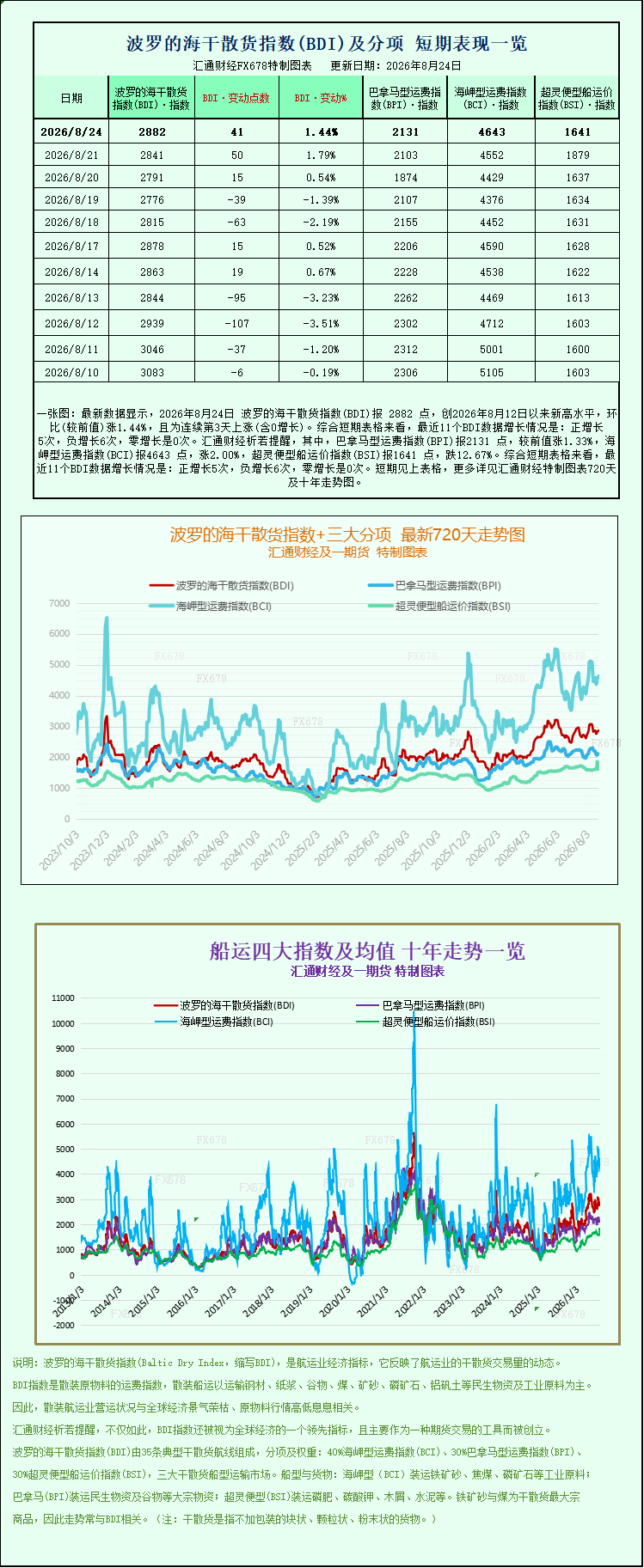 The international dry bulk shipping market saw a comprehensive recovery on Monday, with the Baltic Dry Index (BDI) continuing its rebound, rising for the third consecutive trading day and reaching its highest level in nearly two weeks. Freight rates across all vessel types strengthened simultaneously, exhibiting a rare broad-based increase, indicating a phased recovery in global dry bulk shipping demand. This recovery was not driven by a single vessel type, but rather by a synchronized rise across all vessel types—Capemax, Panamax, and Supramax—reflecting a continued improvement in market supply and demand and rising expectations for the peak season. Data shows that as of the close of trading on August 24, the Baltic Dry Index, which comprehensively reflects the global dry bulk shipping market, rose 41 points, a daily increase of 1.4%, ultimately closing at 2882 points, a new high since August 12. The three-day winning streak of the index has completely reversed the weak and volatile pattern of early August. Coupled with the general increase in freight rates across all vessel types, this fully confirms that the fundamentals of the dry bulk shipping market have shown substantial marginal improvement, and market bullish sentiment continues to rise. The strong rebound in Capesize vessel prices is primarily supported by the dual forces of recovering demand in the Chinese market and expectations of the traditional peak season. Recently, China has released several economic stimulus policy signals, and expectations for the recovery of infrastructure and manufacturing supply chains have continued to strengthen, driving a steady rise in iron ore futures prices. As a core raw material for infrastructure and industrial production, the recovery in iron ore demand directly boosts the growth of ocean shipping orders. Cargo volumes on major iron ore routes from Australia and Brazil to China continue to increase, leading to a surge in demand for large vessel capacity. Meanwhile, September is approaching the traditional peak season for domestic infrastructure construction, and downstream enterprises are replenishing their inventories in advance, further amplifying the demand for ocean freight for commodities such as iron ore and thermal coal, providing solid fundamental support for the rise in Capesize vessel freight rates. From the demand side, with the autumn harvest season approaching in the Northern Hemisphere, global grain trade is gradually entering its traditional peak season. Grain export orders from core grain-producing regions such as the Americas and the Black Sea continue to increase, coupled with rising global energy restocking demand. The demand for cross-border transportation of thermal coal remains rigid, continuously supporting the stabilization and upward trend of Panamax freight rates. Compared to large Capesize vessels, Panamax vessels have more diversified trade routes, broader demand coverage, and stronger price stability, becoming a crucial support for this round of index increases. Besides the core demand-side drivers, the continued rise in the dry bulk index is also inseparable from the favorable support from the shipping market's supply side. Industry analysts point out that the pace of new global dry bulk capacity deployment has slowed recently, while the scrapping of older vessels continues, resulting in a tight supply of effective shipping capacity. At the same time, frequent extreme weather events in some sea areas have impacted port operations and vessel turnover efficiency, leading to short-term capacity allocation constraints and further pushing up shipping freight rates. Coupled with the increased shipping risk premium due to geopolitical tensions, multiple positive factors have resonated, driving the continued recovery of the dry bulk market.
The international dry bulk shipping market saw a comprehensive recovery on Monday, with the Baltic Dry Index (BDI) continuing its rebound, rising for the third consecutive trading day and reaching its highest level in nearly two weeks. Freight rates across all vessel types strengthened simultaneously, exhibiting a rare broad-based increase, indicating a phased recovery in global dry bulk shipping demand. This recovery was not driven by a single vessel type, but rather by a synchronized rise across all vessel types—Capemax, Panamax, and Supramax—reflecting a continued improvement in market supply and demand and rising expectations for the peak season. Data shows that as of the close of trading on August 24, the Baltic Dry Index, which comprehensively reflects the global dry bulk shipping market, rose 41 points, a daily increase of 1.4%, ultimately closing at 2882 points, a new high since August 12. The three-day winning streak of the index has completely reversed the weak and volatile pattern of early August. Coupled with the general increase in freight rates across all vessel types, this fully confirms that the fundamentals of the dry bulk shipping market have shown substantial marginal improvement, and market bullish sentiment continues to rise. The strong rebound in Capesize vessel prices is primarily supported by the dual forces of recovering demand in the Chinese market and expectations of the traditional peak season. Recently, China has released several economic stimulus policy signals, and expectations for the recovery of infrastructure and manufacturing supply chains have continued to strengthen, driving a steady rise in iron ore futures prices. As a core raw material for infrastructure and industrial production, the recovery in iron ore demand directly boosts the growth of ocean shipping orders. Cargo volumes on major iron ore routes from Australia and Brazil to China continue to increase, leading to a surge in demand for large vessel capacity. Meanwhile, September is approaching the traditional peak season for domestic infrastructure construction, and downstream enterprises are replenishing their inventories in advance, further amplifying the demand for ocean freight for commodities such as iron ore and thermal coal, providing solid fundamental support for the rise in Capesize vessel freight rates. From the demand side, with the autumn harvest season approaching in the Northern Hemisphere, global grain trade is gradually entering its traditional peak season. Grain export orders from core grain-producing regions such as the Americas and the Black Sea continue to increase, coupled with rising global energy restocking demand. The demand for cross-border transportation of thermal coal remains rigid, continuously supporting the stabilization and upward trend of Panamax freight rates. Compared to large Capesize vessels, Panamax vessels have more diversified trade routes, broader demand coverage, and stronger price stability, becoming a crucial support for this round of index increases. Besides the core demand-side drivers, the continued rise in the dry bulk index is also inseparable from the favorable support from the shipping market's supply side. Industry analysts point out that the pace of new global dry bulk capacity deployment has slowed recently, while the scrapping of older vessels continues, resulting in a tight supply of effective shipping capacity. At the same time, frequent extreme weather events in some sea areas have impacted port operations and vessel turnover efficiency, leading to short-term capacity allocation constraints and further pushing up shipping freight rates. Coupled with the increased shipping risk premium due to geopolitical tensions, multiple positive factors have resonated, driving the continued recovery of the dry bulk market.- Risk Warning and Disclaimer
- The market involves risk, and trading may not be suitable for all investors. This article is for reference only and does not constitute personal investment advice, nor does it take into account certain users’ specific investment objectives, financial situation, or other needs. Any investment decisions made based on this information are at your own risk.