Silver hovers around $69, while institutional funds flow into gold.
2026-08-25 01:16:59
On Monday (August 24), spot silver fluctuated around $69 during the US trading session, while gold rose by 0.82%, driven by Treasury bonds, the US dollar, and debt-related factors. Although silver received support at the trading level, it did not see a full-blown safe-haven buying.  Last week, gold ETFs saw a net inflow of 46.7 tons, the largest weekly inflow in 10 months. However, silver did not see a similar inflow. The 200-day moving average continues to act as resistance, and the market failed to break Friday's high again on Monday. This week is packed with economic data: Wednesday's PCE inflation data, Warsh's Jackson Hole speech on Friday, and Bessant's latest sanctions details released today, all of which could potentially influence the dollar and US Treasury yields, which are currently the core drivers of silver prices. Spot silver was quoted at $68.649 during the session, down $0.32, or 0.46%; the intraday high was $69.893 and the low was $68.348. Silver's upward momentum is dependent on the dollar and long-term US Treasury bonds . On Monday, silver followed the macroeconomic market fluctuations and lacked its own independent upward logic. Reports indicate that the US Treasury may use approximately $950 billion of ordinary account funds to expand the purchase of long-term government bonds. The U.S. Treasury had previously stated that it would increase the size of its single purchase of existing long-term bonds from at least $2 billion to $4 billion, and Bessant indicated that the actual purchase size might be even larger. After the announcement of the first round of repurchase agreements, U.S. Treasury yields briefly declined before the market rebounded. Last week, the 30-year Treasury yield surged to over 5.30%, a new high since 2007. Monday's report on ordinary accounts gave the Treasury more room to maneuver. On Monday, the 10-year Treasury yield fell by more than 3 basis points to approximately 4.70%; the 30-year yield fell by about 4 basis points to around 5.24%. After last week's decline, the dollar is currently fluctuating in a range near multi-month lows. There is real buying pressure on spot silver: a weakening dollar and yields moving away from their highs. Gold and other metals are all trading on the same issue—can the Treasury stabilize long-term U.S. Treasury bonds amidst the continued expansion of U.S. debt issuance and the fiscal deficit? Silver is in this market, but it is not the leading performer. Three major events this week may shake the macroeconomic support logic for silver. Silver's price movement is highly dependent on the external macroeconomic environment and cannot dictate its own price action. The PCE inflation report is due on Wednesday. This data will simultaneously release figures for household income, consumer spending, and revised GDP. The bond market and the US dollar will react accordingly, causing silver prices to fluctuate. Currently, the bond market is pricing in moderate inflation data; if inflation data exceeds expectations, the entire macroeconomic logic supporting silver will be repriced. Federal Reserve Chairman Kevin Warsh will speak in Jackson Hole on Friday. He has not yet given the trading market a clear signal on the interest rate path. Even without direct policy adjustments, his remarks are enough to stir up precious metal prices. Any discussion of inflation, long-term US Treasury bonds, and debt supply could significantly impact the US dollar and US Treasury yields. The market is paying attention to both his wording and any signals of a policy pause. Bessant is expected to announce details of a new round of sanctions against Iran later on Monday. The sanctions themselves are not unexpected; the key question is whether they will be extended and require China's cooperation in implementation. If Chinese buyers face new risks, the actual impact of sanctions will be significantly amplified. Oil prices remain high, and inflation risks continue to loom over the Federal Reserve; compared to gold, silver is more sensitive to interest rate changes. Middle East geopolitical risks directly benefit gold, continuously driving safe-haven buying; silver can only indirectly benefit from a small portion of the gains. The real risk for silver stems from interest rates, not geopolitical conflicts. Spot silver daily chart technical analysis.
 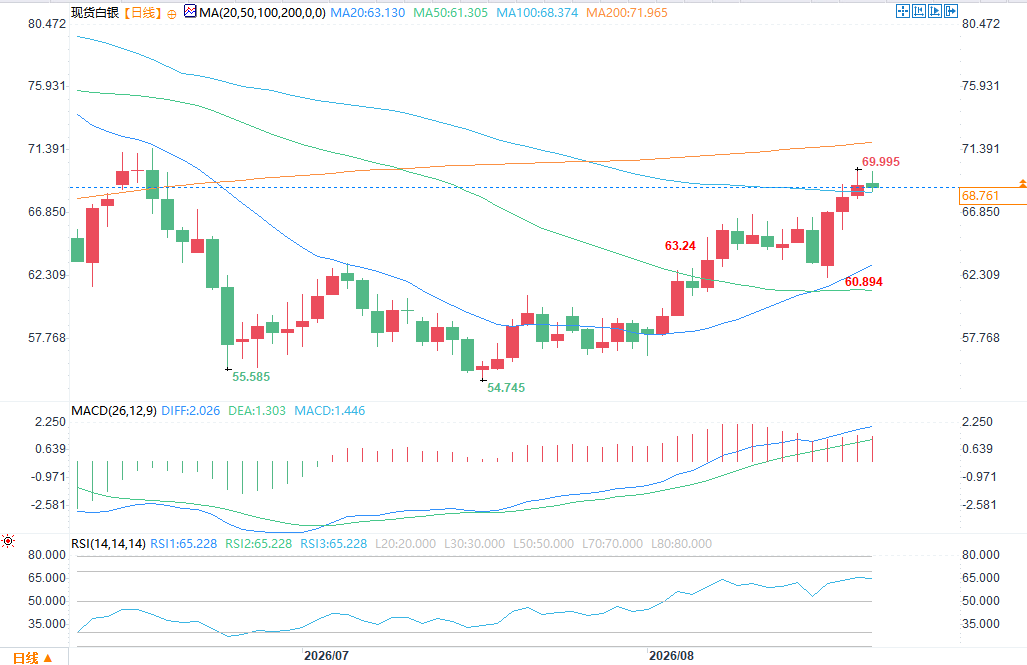 Spot silver failed to break through Friday's high of $70.02 on Monday, retreating slightly. Gold surged, but this didn't translate to silver, prompting some investors to take profits. Daily oscillators indicate the overall trend remains upward. A decisive break above $70.02 would confirm the uptrend. The first target is the 200-day moving average at $72.03, followed by the 50% Fibonacci retracement level at $72.08. Initial testing of this resistance cluster will likely encounter selling pressure; however, a strong hold above the 200-day moving average could lead to further gains towards the 61.8% Fibonacci retracement level at $74.63. The secondary trading range is $62.56-$70.02. If downward pressure persists, spot silver may fall back to the 50% retracement level of $66.29, a price level that could attract value investors. Key Focus Areas Silver's support rests entirely on a continued weakening of the US dollar and a halt to the rebound in US Treasury yields. Wednesday's PCE inflation data will be the first test: higher-than-expected inflation will push up yields, directly eliminating silver's buffer. Friday's Jackson Hole speech by Warsh will be the second test; the content of the speech alone can disrupt yields, and silver will be more affected than gold. Today, the market will focus on whether Bessenter's sanctions details will include China in the implementation process. The 200-day moving average is a crucial technical target. Even with gold's surge, silver failed to break through on Monday. Multiple failed attempts to break previous highs indicate that silver is trapped in a range-bound market. Only by independently breaking through this level and attacking the 200-day moving average can silver escape its passive position of following gold and establish an independent trend.
Last week, gold ETFs saw a net inflow of 46.7 tons, the largest weekly inflow in 10 months. However, silver did not see a similar inflow. The 200-day moving average continues to act as resistance, and the market failed to break Friday's high again on Monday. This week is packed with economic data: Wednesday's PCE inflation data, Warsh's Jackson Hole speech on Friday, and Bessant's latest sanctions details released today, all of which could potentially influence the dollar and US Treasury yields, which are currently the core drivers of silver prices. Spot silver was quoted at $68.649 during the session, down $0.32, or 0.46%; the intraday high was $69.893 and the low was $68.348. Silver's upward momentum is dependent on the dollar and long-term US Treasury bonds . On Monday, silver followed the macroeconomic market fluctuations and lacked its own independent upward logic. Reports indicate that the US Treasury may use approximately $950 billion of ordinary account funds to expand the purchase of long-term government bonds. The U.S. Treasury had previously stated that it would increase the size of its single purchase of existing long-term bonds from at least $2 billion to $4 billion, and Bessant indicated that the actual purchase size might be even larger. After the announcement of the first round of repurchase agreements, U.S. Treasury yields briefly declined before the market rebounded. Last week, the 30-year Treasury yield surged to over 5.30%, a new high since 2007. Monday's report on ordinary accounts gave the Treasury more room to maneuver. On Monday, the 10-year Treasury yield fell by more than 3 basis points to approximately 4.70%; the 30-year yield fell by about 4 basis points to around 5.24%. After last week's decline, the dollar is currently fluctuating in a range near multi-month lows. There is real buying pressure on spot silver: a weakening dollar and yields moving away from their highs. Gold and other metals are all trading on the same issue—can the Treasury stabilize long-term U.S. Treasury bonds amidst the continued expansion of U.S. debt issuance and the fiscal deficit? Silver is in this market, but it is not the leading performer. Three major events this week may shake the macroeconomic support logic for silver. Silver's price movement is highly dependent on the external macroeconomic environment and cannot dictate its own price action. The PCE inflation report is due on Wednesday. This data will simultaneously release figures for household income, consumer spending, and revised GDP. The bond market and the US dollar will react accordingly, causing silver prices to fluctuate. Currently, the bond market is pricing in moderate inflation data; if inflation data exceeds expectations, the entire macroeconomic logic supporting silver will be repriced. Federal Reserve Chairman Kevin Warsh will speak in Jackson Hole on Friday. He has not yet given the trading market a clear signal on the interest rate path. Even without direct policy adjustments, his remarks are enough to stir up precious metal prices. Any discussion of inflation, long-term US Treasury bonds, and debt supply could significantly impact the US dollar and US Treasury yields. The market is paying attention to both his wording and any signals of a policy pause. Bessant is expected to announce details of a new round of sanctions against Iran later on Monday. The sanctions themselves are not unexpected; the key question is whether they will be extended and require China's cooperation in implementation. If Chinese buyers face new risks, the actual impact of sanctions will be significantly amplified. Oil prices remain high, and inflation risks continue to loom over the Federal Reserve; compared to gold, silver is more sensitive to interest rate changes. Middle East geopolitical risks directly benefit gold, continuously driving safe-haven buying; silver can only indirectly benefit from a small portion of the gains. The real risk for silver stems from interest rates, not geopolitical conflicts. Spot silver daily chart technical analysis. Spot silver failed to break through Friday's high of $70.02 on Monday, retreating slightly. Gold surged, but this didn't translate to silver, prompting some investors to take profits. Daily oscillators indicate the overall trend remains upward. A decisive break above $70.02 would confirm the uptrend. The first target is the 200-day moving average at $72.03, followed by the 50% Fibonacci retracement level at $72.08. Initial testing of this resistance cluster will likely encounter selling pressure; however, a strong hold above the 200-day moving average could lead to further gains towards the 61.8% Fibonacci retracement level at $74.63. The secondary trading range is $62.56-$70.02. If downward pressure persists, spot silver may fall back to the 50% retracement level of $66.29, a price level that could attract value investors. Key Focus Areas Silver's support rests entirely on a continued weakening of the US dollar and a halt to the rebound in US Treasury yields. Wednesday's PCE inflation data will be the first test: higher-than-expected inflation will push up yields, directly eliminating silver's buffer. Friday's Jackson Hole speech by Warsh will be the second test; the content of the speech alone can disrupt yields, and silver will be more affected than gold. Today, the market will focus on whether Bessenter's sanctions details will include China in the implementation process. The 200-day moving average is a crucial technical target. Even with gold's surge, silver failed to break through on Monday. Multiple failed attempts to break previous highs indicate that silver is trapped in a range-bound market. Only by independently breaking through this level and attacking the 200-day moving average can silver escape its passive position of following gold and establish an independent trend.
- Risk Warning and Disclaimer
- The market involves risk, and trading may not be suitable for all investors. This article is for reference only and does not constitute personal investment advice, nor does it take into account certain users’ specific investment objectives, financial situation, or other needs. Any investment decisions made based on this information are at your own risk.