With soaring US Treasury yields and Treasury intervention in the market, can Warsh's Jackson Hole debut restore market confidence?
2026-08-25 11:15:00
Federal Reserve Chairman Warsh will deliver his first keynote address at the Jackson Hole Economic Symposium this Friday, a moment significantly more important than recent bond market turmoil. Soaring Treasury yields, Treasury intervention in the bond market, and rising government debt costs force Warsh to strike a balance between the Fed's independence and market expectations. Former Fed officials have noted that an era is dawning where Treasury action is as important as central bank policy, and their interaction will be key to the future. Warsh has previously stated his desire to await recommendations from five special task forces before outlining plans, but the market has quickly concluded that the Fed needs to raise interest rates—US inflation has been above 2% for over five years, and delaying a rate hike could damage the central bank's credibility. 
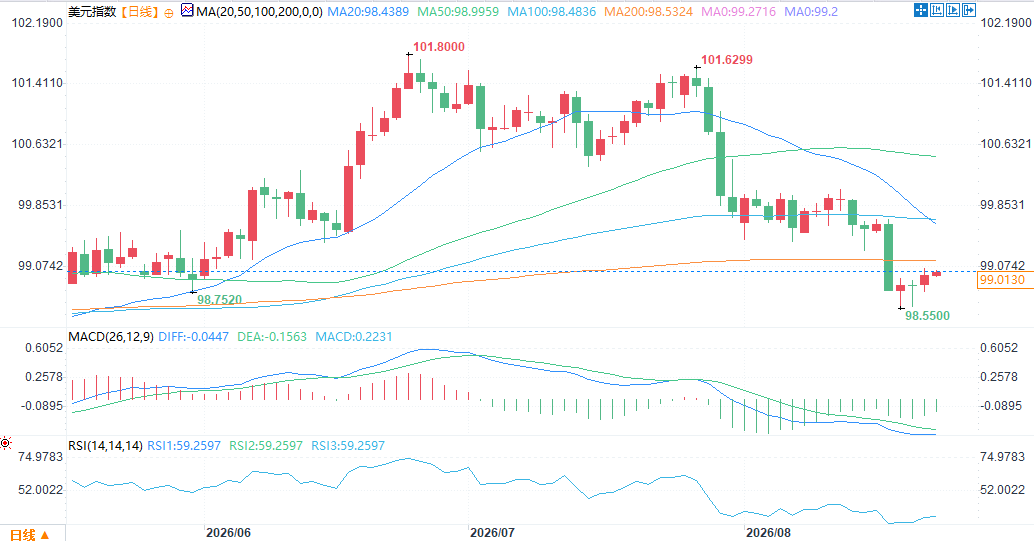 (US Dollar Index Daily Chart, Source: FX678) At 11:12 AM Beijing time on August 25, the US Dollar Index was at 99.04.
Jackson Hole debut: Walsh faces dual pressures from the market and politics
Warsh will deliver a keynote address at the Jackson Hole symposium on Friday, an event whose importance has risen due to recent bond market turmoil. Soaring Treasury yields, the Treasury's decision to intervene in the market, and rising government debt costs have forced Warsh to consider a more aggressive Treasury response. Theoretically, this shouldn't be a concern for the Fed unless there are problems with government funding—but the gap between overnight rates and short-term government debt rates could make it more difficult for the central bank to manage interest rates. A former senior New York Fed official noted, "For better or worse, we are in an era where Treasury aggressive policy is just as important as central bank policy. The interaction between the two will be key to the outlook." Warsh attempts an unconventional argument—that the Fed should stand aside and let the market shape the yield curve, suggesting that tightening at the long end might be preferable to tightening at the short end—but this argument becomes difficult to justify when investors believe Treasury Secretary Bessant is trying to manipulate long-term rates.Inflation has been above target for more than five years, and the market has already priced in interest rate hikes.
With US inflation exceeding the 2% target for over five years, Warsh's colleagues worry that the central bank's credibility could be damaged if the FOMC doesn't raise interest rates. A global savings crunch is reshaping the landscape—rising government debt, disruptions to international trade and supply chains, increasing costs of an aging population, and booming private investment in AI are all vying for investable dollars. The president of the Peterson Institute for International Economics stated that "both the bond market and the FOMC have clearly decided to take action" to address higher inflation and the potential for a long-term upward trend in long-term interest rates.Independence concerns and congressional pressure
Media reports have indicated that Warsh and Trump speak regularly, and Democratic senators on the Senate Banking Committee have requested details of these communications. Trump has so far not criticized Warsh for his delay in cutting interest rates, but Warsh's reluctance to discuss policy has raised questions about his economic assessments. Minutes from the July meeting show that some colleagues worried that delaying rate hikes would lead to a significant increase in borrowing costs later, while others worried that persistently high inflation above 2% would damage public confidence in the Federal Reserve. The former IMF chief economist stated that bond market behavior reflects these concerns, and this week's speech "is an excellent opportunity to clarify his thinking."Potential impact of Jackson Hole speech on the US dollar index
Warsh's speech on Friday is closely related to the short-term trend of the US dollar index. Currently, the dollar index is hovering around 99.00, near its lowest level since mid-May. Market pricing in the Fed's policy path has undergone a significant adjustment—the probability of a September rate hike has fallen from 47% a month ago to about 35%. Analysts believe that if Warsh demonstrates sufficient policy flexibility in his Jackson Hole speech, market concerns about US Treasuries could be partially alleviated, supporting the dollar; conversely, continued erosion of confidence and rising long-term yields will put pressure on the dollar. This assessment accurately summarizes the core contradiction of the dollar—the market is not only concerned about whether the Fed will raise interest rates, but also about whether Warsh can rebuild policy credibility. Currently, the market has two expected paths for Warsh's speech. If Warsh reiterates inflation risks and retains the option of raising interest rates, the dollar may gain short-term rebound momentum, advancing towards the 100.00 level; if Warsh continues to avoid providing forward guidance or adopts a dovish stance, market doubts about the Fed's determination to combat inflation will deepen further, and the dollar may fall back towards 98.00. Former IMF chief economist Obstfeld pointed out that the bond market is speculating on the Federal Reserve's measures to combat inflation, and this week's speech "is an excellent opportunity to clarify ideas" and will play a key guiding role in the direction of the dollar. (US Dollar Index Daily Chart, Source: FX678) At 11:12 AM Beijing time on August 25, the US Dollar Index was at 99.04.
- Risk Warning and Disclaimer
- The market involves risk, and trading may not be suitable for all investors. This article is for reference only and does not constitute personal investment advice, nor does it take into account certain users’ specific investment objectives, financial situation, or other needs. Any investment decisions made based on this information are at your own risk.