Germany's second-quarter economic growth was revised upward to 0.3%. The safe-haven appeal of the pound and its interest rate differential pressured the euro, causing the euro to fall slightly against the pound.
2026-08-25 15:33:00
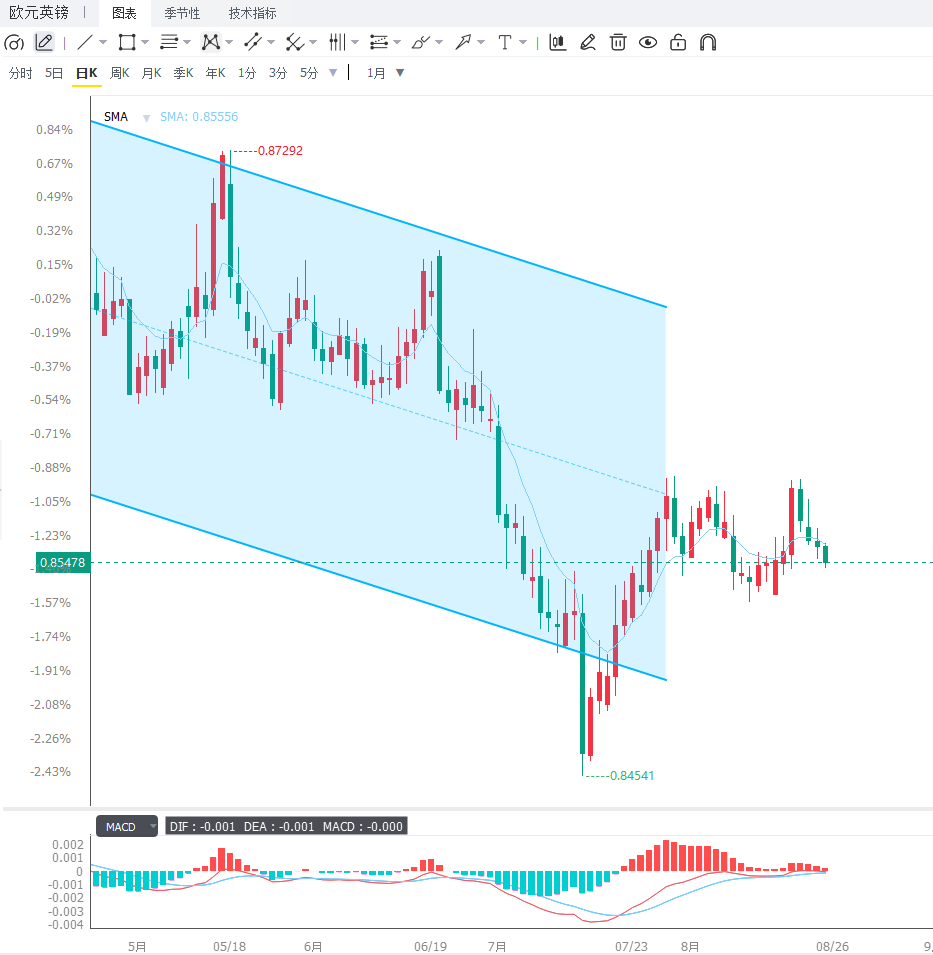
The euro continued its recent weakness against the pound on Tuesday, falling for the fourth consecutive trading day and hitting a weekly low near 0.8550. Despite upward revisions to German second-quarter economic data, the euro failed to gain a significant boost, indicating that the main drivers in the foreign exchange market have shifted from simple economic data to interest rate differentials, asset allocation, and changes in risk appetite.  Data released by Germany's Federal Statistical Office shows that Germany's GDP grew by 0.3% quarter-on-quarter in the second quarter, higher than the previously reported 0.2% and on par with the first quarter's growth rate. Year-on-year, Germany's second-quarter GDP growth was revised upward from the initial 0.9% to 1.0%, significantly higher than the 0.4% in the first quarter. The comprehensive improvement in German economic data suggests that the recovery momentum of Europe's largest economy has strengthened compared to previous assessments, but the market's pricing of this improvement remains limited. Theoretically, improved German economic growth data is beneficial to the euro, as increased economic resilience reduces pressure on the European Central Bank to further ease monetary policy. However, the main problem currently facing the euro is not solely related to the German economy, but rather to the relative yield between the euro and the pound sterling and capital flows. Currently, the market is awaiting the German IFO Business Climate Index. The market expects a slight improvement in German business sentiment in August, with both current economic conditions and future expectations likely to rebound compared to July. If the data is significantly better than expected, it could further strengthen the market's judgment of a stabilizing German economy and provide temporary support for the euro. However, the European economy as a whole still faces the impact of factors such as energy costs, weak manufacturing, and uncertainty in external demand. Even if Germany's economic growth improves, it doesn't necessarily mean the European Central Bank can quickly shift to a tighter monetary policy. Therefore, the support for the euro from improved German economic data may be weaker than the market's reaction to changes in UK interest rate expectations. In contrast, the pound has been relatively strong recently. UK economic data this week was relatively limited, lacking major macroeconomic stimulus, but the pound is still supported by allocation demand. Against the backdrop of a moderate decline in market risk appetite, the pound has not weakened significantly; instead, it has attracted some inflows due to its higher yield spread. Market institutions point out that in the current relatively low-volatility environment, the pound still has some carry trade appeal. When investors want relatively high yield spreads but are unwilling to bear excessive exchange rate volatility, the pound often becomes an important allocation target among G10 currencies. Changes in the Middle East situation have further strengthened this capital flow. After the US expanded sanctions against Iran, market risk appetite declined, while energy supply risks have resurfaced. Traditionally, risk aversion usually favors safe-haven currencies such as the US dollar, but in the current environment, the pound has not been significantly sold off due to its higher yield advantage. This also makes the EUR/GBP face a more complex fundamental environment. On the one hand, improved German economic data and a rebound in European economic expectations could support the euro; on the other hand, UK interest rates and the carry trade appeal of the pound remain more attractive to short-term funds. Without new policy catalysts from the European Central Bank (ECB), it's difficult for the euro to achieve a trend rebound solely based on German GDP data. From the ECB's policy perspective, improved German economic growth has reduced market concerns about a rapid deterioration in the European economy, but it hasn't immediately changed market expectations regarding European monetary policy. If Eurozone inflation is again affected by rising energy prices, the ECB may need to proceed with easing policies more cautiously, which would provide medium-term support for the euro. Meanwhile, although the UK economy also faces pressure, higher interest rates still allow the pound to maintain a certain yield advantage. As long as the expectation of a Bank of England rate cut doesn't accelerate significantly, the pound is likely to remain relatively strong. Therefore, the key for EUR/GBP in the short term is not whether German GDP data improves, but whether the expected interest rate differential between Europe and the UK can change significantly. If the German IFO index improves significantly, and European economic data continues to be positive, the market may increase euro long positions again; if European data remains weak, and the pound continues to be supported by carry trade funds, then EUR/GBP may continue to trade at low levels. From a daily technical perspective, EUR/GBP has weakened for four consecutive trading days, and the price is testing the important area around 0.8550. The short-term downtrend still holds the upper hand, but after consecutive declines, the market is beginning to accumulate some technical rebound demand. If 0.8550 can provide effective support, the exchange rate may see a correction, with the first resistance levels to watch being 0.8580 and 0.8600. If it reclaims 0.8600, the short-term weakness will be somewhat alleviated. On the downside, 0.8550 is currently the most immediate support. If this level is broken, the next target may be around 0.8520, and further down, the important psychological level of 0.8500. A breach of 0.8500 would mean that the EUR/GBP may enter a new downward phase. From a 4-hour chart perspective, EUR/GBP is in a clear downward channel, and short-term rebounds are constantly being suppressed. The 0.8570-0.8580 area forms the first resistance level. If the price fails to break through this area, the bears may still attempt to test the 0.8550 level. A break below 0.8550 could open up further downside potential. Conversely, if the price experiences a technical rebound and breaks through 0.8600, short-term momentum indicators may correct, and the price could extend towards the 0.8620-0.8650 area.
  In summary, the EUR/GBP exchange rate remains in a pattern of relative euro weakness and pound sterling resilience. Germany's Q2 GDP growth was revised upward to 0.3%, with year-on-year growth rising to 1.0%, indicating that the German economy performed better than previously expected. However, this improvement is not yet sufficient to offset the pound's strong interest rate advantage. If German IFO data improves significantly, and European economic and inflation expectations re-emerge, pushing the ECB's policy expectations towards a tighter stance, the euro may have room to recover. If European economic data shows limited improvement, and the pound continues to attract carry trade funds, EUR/GBP may fall below 0.8550 and approach 0.8500. Overall, the current market is more likely to be in a low-level, weak consolidation phase than a one-sided decline. Investors should focus on German IFO data, Eurozone inflation, and changes in UK interest rate expectations, especially observing whether there are new trend changes in the interest rate differential between Europe and the UK.
Data released by Germany's Federal Statistical Office shows that Germany's GDP grew by 0.3% quarter-on-quarter in the second quarter, higher than the previously reported 0.2% and on par with the first quarter's growth rate. Year-on-year, Germany's second-quarter GDP growth was revised upward from the initial 0.9% to 1.0%, significantly higher than the 0.4% in the first quarter. The comprehensive improvement in German economic data suggests that the recovery momentum of Europe's largest economy has strengthened compared to previous assessments, but the market's pricing of this improvement remains limited. Theoretically, improved German economic growth data is beneficial to the euro, as increased economic resilience reduces pressure on the European Central Bank to further ease monetary policy. However, the main problem currently facing the euro is not solely related to the German economy, but rather to the relative yield between the euro and the pound sterling and capital flows. Currently, the market is awaiting the German IFO Business Climate Index. The market expects a slight improvement in German business sentiment in August, with both current economic conditions and future expectations likely to rebound compared to July. If the data is significantly better than expected, it could further strengthen the market's judgment of a stabilizing German economy and provide temporary support for the euro. However, the European economy as a whole still faces the impact of factors such as energy costs, weak manufacturing, and uncertainty in external demand. Even if Germany's economic growth improves, it doesn't necessarily mean the European Central Bank can quickly shift to a tighter monetary policy. Therefore, the support for the euro from improved German economic data may be weaker than the market's reaction to changes in UK interest rate expectations. In contrast, the pound has been relatively strong recently. UK economic data this week was relatively limited, lacking major macroeconomic stimulus, but the pound is still supported by allocation demand. Against the backdrop of a moderate decline in market risk appetite, the pound has not weakened significantly; instead, it has attracted some inflows due to its higher yield spread. Market institutions point out that in the current relatively low-volatility environment, the pound still has some carry trade appeal. When investors want relatively high yield spreads but are unwilling to bear excessive exchange rate volatility, the pound often becomes an important allocation target among G10 currencies. Changes in the Middle East situation have further strengthened this capital flow. After the US expanded sanctions against Iran, market risk appetite declined, while energy supply risks have resurfaced. Traditionally, risk aversion usually favors safe-haven currencies such as the US dollar, but in the current environment, the pound has not been significantly sold off due to its higher yield advantage. This also makes the EUR/GBP face a more complex fundamental environment. On the one hand, improved German economic data and a rebound in European economic expectations could support the euro; on the other hand, UK interest rates and the carry trade appeal of the pound remain more attractive to short-term funds. Without new policy catalysts from the European Central Bank (ECB), it's difficult for the euro to achieve a trend rebound solely based on German GDP data. From the ECB's policy perspective, improved German economic growth has reduced market concerns about a rapid deterioration in the European economy, but it hasn't immediately changed market expectations regarding European monetary policy. If Eurozone inflation is again affected by rising energy prices, the ECB may need to proceed with easing policies more cautiously, which would provide medium-term support for the euro. Meanwhile, although the UK economy also faces pressure, higher interest rates still allow the pound to maintain a certain yield advantage. As long as the expectation of a Bank of England rate cut doesn't accelerate significantly, the pound is likely to remain relatively strong. Therefore, the key for EUR/GBP in the short term is not whether German GDP data improves, but whether the expected interest rate differential between Europe and the UK can change significantly. If the German IFO index improves significantly, and European economic data continues to be positive, the market may increase euro long positions again; if European data remains weak, and the pound continues to be supported by carry trade funds, then EUR/GBP may continue to trade at low levels. From a daily technical perspective, EUR/GBP has weakened for four consecutive trading days, and the price is testing the important area around 0.8550. The short-term downtrend still holds the upper hand, but after consecutive declines, the market is beginning to accumulate some technical rebound demand. If 0.8550 can provide effective support, the exchange rate may see a correction, with the first resistance levels to watch being 0.8580 and 0.8600. If it reclaims 0.8600, the short-term weakness will be somewhat alleviated. On the downside, 0.8550 is currently the most immediate support. If this level is broken, the next target may be around 0.8520, and further down, the important psychological level of 0.8500. A breach of 0.8500 would mean that the EUR/GBP may enter a new downward phase. From a 4-hour chart perspective, EUR/GBP is in a clear downward channel, and short-term rebounds are constantly being suppressed. The 0.8570-0.8580 area forms the first resistance level. If the price fails to break through this area, the bears may still attempt to test the 0.8550 level. A break below 0.8550 could open up further downside potential. Conversely, if the price experiences a technical rebound and breaks through 0.8600, short-term momentum indicators may correct, and the price could extend towards the 0.8620-0.8650 area. In summary, the EUR/GBP exchange rate remains in a pattern of relative euro weakness and pound sterling resilience. Germany's Q2 GDP growth was revised upward to 0.3%, with year-on-year growth rising to 1.0%, indicating that the German economy performed better than previously expected. However, this improvement is not yet sufficient to offset the pound's strong interest rate advantage. If German IFO data improves significantly, and European economic and inflation expectations re-emerge, pushing the ECB's policy expectations towards a tighter stance, the euro may have room to recover. If European economic data shows limited improvement, and the pound continues to attract carry trade funds, EUR/GBP may fall below 0.8550 and approach 0.8500. Overall, the current market is more likely to be in a low-level, weak consolidation phase than a one-sided decline. Investors should focus on German IFO data, Eurozone inflation, and changes in UK interest rate expectations, especially observing whether there are new trend changes in the interest rate differential between Europe and the UK.
- Risk Warning and Disclaimer
- The market involves risk, and trading may not be suitable for all investors. This article is for reference only and does not constitute personal investment advice, nor does it take into account certain users’ specific investment objectives, financial situation, or other needs. Any investment decisions made based on this information are at your own risk.