A rebound in the US dollar and US Treasury yields put pressure on gold, while Eurozone bond yields fell, with the market focusing on policy signals from the Jackson Hole Economic Symposium.
2026-08-25 15:36:03
Gold prices fluctuated at high levels during Asian trading on Tuesday before retreating, as the market proactively reduced some precious metal positions amid a rebounding dollar and rising US Treasury yields. Gold had previously risen for several days, reaching its highest level since mid-May, briefly rising above $4,680 on Monday before pulling back. Latest market data shows spot gold holding steady around $4,650 on Tuesday, with investors shifting their focus from the recent rally to US inflation data and the Jackson Hole Economic Symposium.  One of the direct drivers of this gold price correction is the recent strengthening of the US dollar. The dollar index had previously fallen to a three-month low of around 98.76 before rebounding to around 99, driven by safe-haven demand and position adjustments. A rebounding dollar means higher costs for non-dollar investors to buy gold, and also weakens the willingness of some funds to chase the precious metal. However, the current rise in the dollar is more of a short-term correction and has not completely changed the previously weak medium-term structure. US Treasury yields pose another pressure on gold in the short term. The yield on 10-year US Treasury bonds has recently fluctuated around 4.7%, while the yield on 30-year bonds remains high above 5.2%. Previously, after the US Treasury announced an expansion of its long-term Treasury repurchase operations, yields fell and drove a rapid rise in gold prices, but as the market reassessed the US fiscal deficit, debt size, and long-term maturity premium risk, the decline in US Treasury yields did not continue. This means that gold is currently facing the combined effects of "interest rate pressure" and "fiscal risk premium." If US Treasury yields continue to rise, gold will undoubtedly face greater pressure in the short term; however, if the rise in yields stems from market concerns about the sustainability of US fiscal policy and the long-term credit of the US dollar, then gold may instead attract new safe-haven and store-of-value demand. The US Treasury's expansion of long-term Treasury bond repurchase operations has become a significant market variable recently. The US Treasury previously announced that starting in September, it would increase the scale of long-term Treasury bond repurchases to at least $4 billion per transaction, and the market is still assessing the impact of the Treasury's general account funds potentially being used to support these operations. While this measure helps improve liquidity in the long-term bond market, market concerns about high US debt and long-term fiscal deficits have not disappeared. Looking at the previous logic behind gold's rise, fiscal risk has actually become one of the new core drivers. After breaking through the 200-day moving average, gold has continued to receive inflows, and gold ETFs have recently shown significant allocation demand. Market data shows that North American and European gold ETFs recorded inflows of approximately 46.7 tons in the previous week, indicating that institutional investors' interest in medium- to long-term gold allocation is increasing. At the same time, there is still considerable disagreement in the market regarding US monetary policy. July's relatively mild US inflation data eased investors' concerns about a rapid tightening of the Federal Reserve's policy in the short term. However, fluctuations in energy prices and geopolitical risks could lead to renewed fluctuations in inflation. As a non-interest-bearing asset, gold is highly sensitive to changes in real interest rates; therefore, the US PCE data in the coming days will be crucial in determining gold's short-term direction. If PCE inflation remains moderate, the market may raise expectations for future policy easing, putting pressure on US yields and the dollar, while gold may regain upward momentum. Conversely, if inflation is significantly higher than expected, the market may re-priced in a higher interest rate path, causing the dollar and US Treasury yields to rise in tandem, and gold may experience further profit-taking in the short term. The Jackson Hole Economic Symposium will also be a core event for global financial markets this week. Investors are particularly focused on the policy statements of Federal Reserve Chairman Kevin Warsh. With forward guidance still limited, any statements regarding inflation risks, interest rate paths, or financial conditions could quickly alter market pricing of the dollar and US Treasury yields. Notably, the European bond market was relatively stable on Tuesday. Eurozone government bond yields generally declined at the open, after US Treasury yields rose in the Asian session before stabilizing. The yield on German 10-year government bonds fell by about 1.1 basis points to 3.241%, with similar declines observed in other major Eurozone 10-year bond yields. Germany also planned to issue €5 billion in short-term bonds maturing in September 2028 that day. The decline in Eurozone bond yields is somewhat related to weaker oil prices, as lower energy prices alleviate market concerns about European inflation and reduce pressure on the European Central Bank to continue tightening policy. However, the decline in European bond yields does not mean that the risks in the global bond market have been eliminated. Global long-term yields have remained relatively high recently, with the yield on German 30-year government bonds even reaching its highest level since 2011, reflecting that investors are reassessing fiscal spending, energy costs, and long-term inflation risks. From an asset linkage perspective, the relationship between gold, the US dollar, and global bond yields is becoming more complex. In the past, gold price increases often relied on a weaker dollar and lower real interest rates, but recently gold has remained strong even in the face of higher long-term US Treasury yields, indicating that the market is increasingly pricing in fiscal risk, currency purchasing power, and geopolitical risk. If gold can maintain its strength in a high-yield environment, it will mean that market focus is shifting from simple expectations of Fed rate cuts to longer-term fiscal and credit risks. From a daily technical perspective, gold has already broken through the important technical zone around $4500 and is above the 200-day moving average, maintaining a complete bullish structure. On Monday, gold reached a high of $4680.70 before falling back to close around $4640, indicating significant profit-taking around $4700. Currently, the first resistance level to watch is the $4680-$4700 area. If it can effectively break through $4700 and form a daily confirmation, the next target could be around $4769; stronger resistance lies around $4960. On the downside, watch for levels around $4600 and $4500, with $4500 being a significant technical support level formed by the previous breakout. A break below $4500 would warrant caution, as this rapid upward trend could enter a deeper correction phase. From the 4-hour chart, gold is currently in a pullback phase after a period of high-level consolidation. The area around $4650 is currently a battleground between bulls and bears. If the price can regain a foothold above $4680, the bulls may attempt to break through $4700 again in the short term. If it falls below $4600, the correction may extend to the $4550-$4500 range. The short-term MACD momentum needs to be monitored to see if the bearish bars continue to expand. If the RSI falls from its high but remains above 50, it is more likely to be a strong consolidation; if it falls below 50, the short-term downward pressure may increase further.
 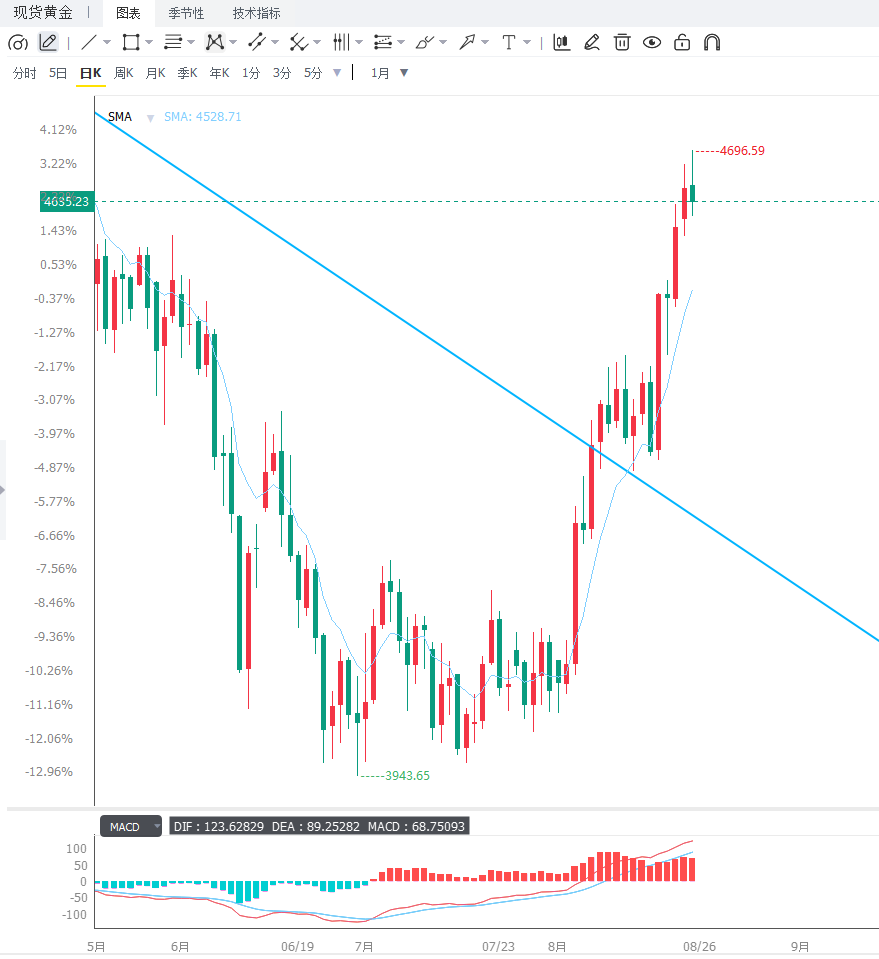 Editor's Summary: Gold's medium-term bullish structure remains intact despite the rebound in the US dollar and US Treasury yields, but it has entered a short-term consolidation phase at high levels. A stronger dollar and rising yields are limiting further upside for gold, while US fiscal risks, geopolitical uncertainties, and inflows into gold ETFs are providing support at the bottom. This week, the core variable for gold has shifted from a simple technical breakout to a complex interplay of "PCE inflation + US Treasury yields + Jackson Hole policy signals." If PCE is moderate, the dollar weakens again, and the Fed releases dovish signals, the probability of gold breaking through $4700 will significantly increase; if inflation exceeds expectations and pushes US Treasury yields higher, gold may further retrace to around $4500 to find support.
One of the direct drivers of this gold price correction is the recent strengthening of the US dollar. The dollar index had previously fallen to a three-month low of around 98.76 before rebounding to around 99, driven by safe-haven demand and position adjustments. A rebounding dollar means higher costs for non-dollar investors to buy gold, and also weakens the willingness of some funds to chase the precious metal. However, the current rise in the dollar is more of a short-term correction and has not completely changed the previously weak medium-term structure. US Treasury yields pose another pressure on gold in the short term. The yield on 10-year US Treasury bonds has recently fluctuated around 4.7%, while the yield on 30-year bonds remains high above 5.2%. Previously, after the US Treasury announced an expansion of its long-term Treasury repurchase operations, yields fell and drove a rapid rise in gold prices, but as the market reassessed the US fiscal deficit, debt size, and long-term maturity premium risk, the decline in US Treasury yields did not continue. This means that gold is currently facing the combined effects of "interest rate pressure" and "fiscal risk premium." If US Treasury yields continue to rise, gold will undoubtedly face greater pressure in the short term; however, if the rise in yields stems from market concerns about the sustainability of US fiscal policy and the long-term credit of the US dollar, then gold may instead attract new safe-haven and store-of-value demand. The US Treasury's expansion of long-term Treasury bond repurchase operations has become a significant market variable recently. The US Treasury previously announced that starting in September, it would increase the scale of long-term Treasury bond repurchases to at least $4 billion per transaction, and the market is still assessing the impact of the Treasury's general account funds potentially being used to support these operations. While this measure helps improve liquidity in the long-term bond market, market concerns about high US debt and long-term fiscal deficits have not disappeared. Looking at the previous logic behind gold's rise, fiscal risk has actually become one of the new core drivers. After breaking through the 200-day moving average, gold has continued to receive inflows, and gold ETFs have recently shown significant allocation demand. Market data shows that North American and European gold ETFs recorded inflows of approximately 46.7 tons in the previous week, indicating that institutional investors' interest in medium- to long-term gold allocation is increasing. At the same time, there is still considerable disagreement in the market regarding US monetary policy. July's relatively mild US inflation data eased investors' concerns about a rapid tightening of the Federal Reserve's policy in the short term. However, fluctuations in energy prices and geopolitical risks could lead to renewed fluctuations in inflation. As a non-interest-bearing asset, gold is highly sensitive to changes in real interest rates; therefore, the US PCE data in the coming days will be crucial in determining gold's short-term direction. If PCE inflation remains moderate, the market may raise expectations for future policy easing, putting pressure on US yields and the dollar, while gold may regain upward momentum. Conversely, if inflation is significantly higher than expected, the market may re-priced in a higher interest rate path, causing the dollar and US Treasury yields to rise in tandem, and gold may experience further profit-taking in the short term. The Jackson Hole Economic Symposium will also be a core event for global financial markets this week. Investors are particularly focused on the policy statements of Federal Reserve Chairman Kevin Warsh. With forward guidance still limited, any statements regarding inflation risks, interest rate paths, or financial conditions could quickly alter market pricing of the dollar and US Treasury yields. Notably, the European bond market was relatively stable on Tuesday. Eurozone government bond yields generally declined at the open, after US Treasury yields rose in the Asian session before stabilizing. The yield on German 10-year government bonds fell by about 1.1 basis points to 3.241%, with similar declines observed in other major Eurozone 10-year bond yields. Germany also planned to issue €5 billion in short-term bonds maturing in September 2028 that day. The decline in Eurozone bond yields is somewhat related to weaker oil prices, as lower energy prices alleviate market concerns about European inflation and reduce pressure on the European Central Bank to continue tightening policy. However, the decline in European bond yields does not mean that the risks in the global bond market have been eliminated. Global long-term yields have remained relatively high recently, with the yield on German 30-year government bonds even reaching its highest level since 2011, reflecting that investors are reassessing fiscal spending, energy costs, and long-term inflation risks. From an asset linkage perspective, the relationship between gold, the US dollar, and global bond yields is becoming more complex. In the past, gold price increases often relied on a weaker dollar and lower real interest rates, but recently gold has remained strong even in the face of higher long-term US Treasury yields, indicating that the market is increasingly pricing in fiscal risk, currency purchasing power, and geopolitical risk. If gold can maintain its strength in a high-yield environment, it will mean that market focus is shifting from simple expectations of Fed rate cuts to longer-term fiscal and credit risks. From a daily technical perspective, gold has already broken through the important technical zone around $4500 and is above the 200-day moving average, maintaining a complete bullish structure. On Monday, gold reached a high of $4680.70 before falling back to close around $4640, indicating significant profit-taking around $4700. Currently, the first resistance level to watch is the $4680-$4700 area. If it can effectively break through $4700 and form a daily confirmation, the next target could be around $4769; stronger resistance lies around $4960. On the downside, watch for levels around $4600 and $4500, with $4500 being a significant technical support level formed by the previous breakout. A break below $4500 would warrant caution, as this rapid upward trend could enter a deeper correction phase. From the 4-hour chart, gold is currently in a pullback phase after a period of high-level consolidation. The area around $4650 is currently a battleground between bulls and bears. If the price can regain a foothold above $4680, the bulls may attempt to break through $4700 again in the short term. If it falls below $4600, the correction may extend to the $4550-$4500 range. The short-term MACD momentum needs to be monitored to see if the bearish bars continue to expand. If the RSI falls from its high but remains above 50, it is more likely to be a strong consolidation; if it falls below 50, the short-term downward pressure may increase further. Editor's Summary: Gold's medium-term bullish structure remains intact despite the rebound in the US dollar and US Treasury yields, but it has entered a short-term consolidation phase at high levels. A stronger dollar and rising yields are limiting further upside for gold, while US fiscal risks, geopolitical uncertainties, and inflows into gold ETFs are providing support at the bottom. This week, the core variable for gold has shifted from a simple technical breakout to a complex interplay of "PCE inflation + US Treasury yields + Jackson Hole policy signals." If PCE is moderate, the dollar weakens again, and the Fed releases dovish signals, the probability of gold breaking through $4700 will significantly increase; if inflation exceeds expectations and pushes US Treasury yields higher, gold may further retrace to around $4500 to find support.
- Risk Warning and Disclaimer
- The market involves risk, and trading may not be suitable for all investors. This article is for reference only and does not constitute personal investment advice, nor does it take into account certain users’ specific investment objectives, financial situation, or other needs. Any investment decisions made based on this information are at your own risk.