US Treasury intervention sparks criticism; gold prices consolidate after hitting new highs.
2026-08-25 17:57:03
On Tuesday (August 25), safe-haven assets collectively strengthened in early trading, with spot gold surging to nearly $4,700 per ounce, a three-month high. Gold prices subsequently retreated from their intraday high to $4,649 per ounce. In stark contrast, despite the US announcement of increased sanctions against Iran and continued tensions in the Middle East, international oil prices continued their weak correction, with Brent crude falling to $91.41 per barrel, demonstrating a failure to rise despite bullish news. This strong breakout in gold prices was not solely driven by safe-haven demand, but rather a result of multiple factors converging: turmoil in the US Treasury market, pressure on US fiscal credit, inflationary uncertainty, and global asset valuation risks. Currently, gold prices are consolidating at high levels after a significant short-term price increase, awaiting new marginal factors influencing prices, such as tomorrow's US PCE data and the central bank annual meeting this weekend. 
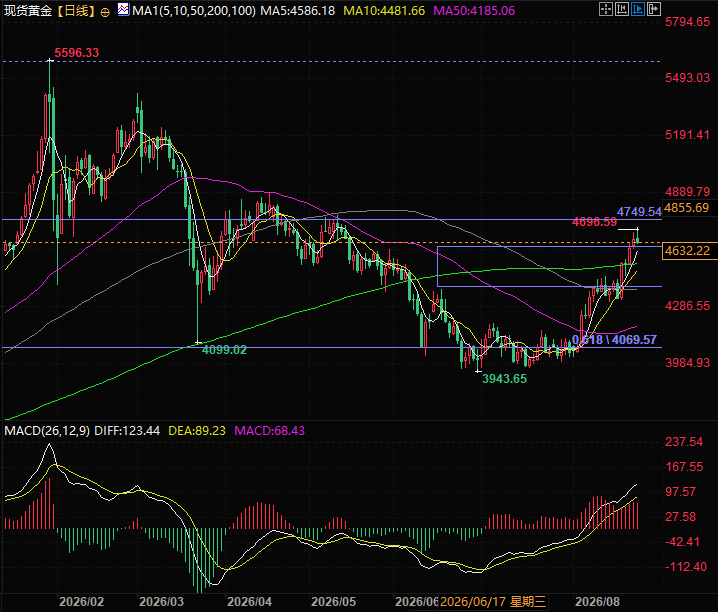 (Spot gold daily chart, source: EasyTrade) At 17:51 Beijing time, spot gold is currently trading at $4,641 per ounce.
US Treasury intervention sparks market controversy; weakening dollar credibility solidifies gold price floor.
The core trigger for this round of gold price increases was the US Treasury's intervention in the bond market. To stabilize the volatile US Treasury market and lower long-term borrowing costs, Treasury official Bessant announced a doubling of the upper limit for repurchase agreements of medium- and long-term US Treasury bonds, from $2 billion to $4 billion, attempting to suppress yield increases by increasing long-term bond holdings and supporting bond prices. This measure slightly lowered long-term US Treasury yields in the short term, but market sentiment did not stabilize, and the intervention's effect quickly backfired, with yields rebounding rapidly, thoroughly exposing the deep-seated problems in the US bond market. This counter-cyclical intervention was publicly and severely criticized by legendary Wall Street investor Druckenmiller, Bessant's former mentor. He stated in an article that artificially intervening in the bond market and forcibly suppressing yields is an extremely risky and erroneous operation. He emphasized that long-term US Treasury yields are the core anchor for global asset pricing and the only remaining fiscal constraint tool for the US; the current rise in yields is a reasonable market price for the massive US debt. The US national debt has surpassed $40 trillion, and the annual fiscal deficit is approaching $2 trillion. The two parties' long-term disorderly expansion of fiscal spending and disregard for debt risks, coupled with reliance on bond repurchase agreements as a mere stopgap measure, will ultimately fail to address the root causes of the problem. The government's deliberate efforts to stabilize the bond market while failing to address the underlying fiscal deficit have significantly increased market skepticism regarding the credibility of the US dollar and the safety of US Treasury assets. Gold, as a hard currency with no interest and no credit risk, has become the optimal choice for funds to hedge against the risks of the US debt system. This is the key reason why gold prices have broken away from the traditional interest rate framework and strengthened against the trend in this round of market fluctuations.The convergence of three safe-haven factors is supporting the continued rise in gold prices.
In response to the recent surge in gold prices, Credit Suisse senior analyst Ipek Ozkadeskaja outlined a complete pricing logic, clarifying that gold has become a comprehensive hedging tool in the market, with multiple positive factors providing strong support. First, it hedges against US fiscal uncertainty and the risk of a debt crisis. The US military spending continues to climb, coupled with years of excessive spending, leading to a continuously expanding debt. However, the market has extreme doubts about the US government's ability to tighten fiscal policy and control debt. This disorderly expansion of the fiscal structure weakens the safe-haven appeal of the dollar, benefiting gold. Second, it hedges against persistent inflationary risks. Currently, the market widely questions the Federal Reserve's ability to independently and effectively suppress inflation. The certainty of a decline in inflation is insufficient, and long-term inflation stickiness remains, making gold's anti-inflationary properties a key focus for investment again. Finally, it hedges against the risk of a global risk asset correction. Currently, global stock markets and the AI sector have high valuations, and large-scale financing expansion in these industries has created a complex funding loop, highlighting the risk of asset bubbles. Funds are allocating funds to gold in advance to hedge against the systemic risk of a future collective correction in risk assets. Funding also released strong bullish signals. Data from the World Gold Council showed that gold ETFs saw a net inflow of 46.7 tons last week, corresponding to a fund size of $6.4 billion, marking the strongest single-week net inflow record in nearly 10 months. North American and European gold funds were the main drivers of the inflow, with concentrated institutional investment providing a solid foundation for rising gold prices. The core driving forces behind this round of gold price surge exceeding 5% in a single week, besides the US Treasury repurchase policy, included the continued weakening of the US dollar, which hit a multi-month low. This improved the cost-effectiveness of dollar-denominated gold for overseas buyers, significantly stimulating global allocation demand.Geopolitical conditions are highly divergent, and the weakening oil price further highlights the advantage of gold.
The core highlight of this round of market activity lies in the structural failure of geopolitical risks, completely shattering the traditional logic that "geopolitical tensions = general commodity price increases." Currently, the US has launched ultimate sanctions against Iran, threatening to sanction all entities engaged in trade with Iran. Traffic in the Strait of Hormuz has plummeted, with only two merchant ships entering the Persian Gulf on Monday, the lowest level since May. Iran has also blacklisted 45 illegal oil tankers and issued punitive threats. Energy supply-side risks should have continued to escalate. However, the crude oil market completely ignored the geopolitical benefits, continuing its downward trend. The core reason is that the US-Iran rivalry has long since shifted from military confrontation to an economic war of attrition. Both sides are deliberately controlling the intensity of the conflict, maintaining only rhetoric and economic maneuvering, with no risk of large-scale military conflict. Simultaneously, the global economic slowdown and limited refinery operations have led to weak crude oil demand, completely offsetting supply-side risks, and the geopolitical premium has completely subsided. In contrast, gold, with its pricing characteristics that do not rely on supply and demand fundamentals but are anchored only to credit and risk, has shown independent movement in this complex market, creating a stark contrast with the weak performance of crude oil.Market Outlook: Focus on US Inflation and Federal Reserve Policy Signals
Market sentiment is gradually becoming more cautious, making this week a crucial window for gold price movements. Short-term price action will focus on multiple significant events. The market is awaiting Wednesday's US Personal Consumption Expenditures (PCE) inflation data – a key inflation indicator favored by the Federal Reserve – and closely watching Friday's keynote speech by Fed Chairman Warsh at the Jackson Hole Economic Symposium to glean the latest signals on Fed interest rate policy and bond market regulation, thus determining the direction of US Treasury yields and the tone of US monetary policy. In addition, monetary policy speeches from the US and Japanese central banks this week will also continue to influence gold prices. Overall, the multiple factors contributing to the current gold price rally – US fiscal turmoil, the risks in the US debt system, inflation uncertainty, and global asset bubbles – have not subsided, and the core support for this round of gold price increases remains solid. Short-term gold prices may experience consolidation following the data release, but the medium-term uptrend is unlikely to reverse. Going forward, close attention should be paid to fluctuations in US Treasury yields and the latest developments in US fiscal policy. Technical Analysis: Spot gold rebounded to around 4700, and has now formed a double top pattern on the daily candlestick chart over the past two days. Gold prices are seeing profit-taking and awaiting new catalysts. Support lies at the upper edge of the trading range and the 5-day moving average, while resistance is at the 0.786 Fibonacci retracement level. Furthermore, given that the extreme correction in this round of gold prices occurred around the 0.618 Fibonacci retracement level, it suggests that the long-term trend for gold prices remains bullish with more upside than downside. (Spot gold daily chart, source: EasyTrade) At 17:51 Beijing time, spot gold is currently trading at $4,641 per ounce.
- Risk Warning and Disclaimer
- The market involves risk, and trading may not be suitable for all investors. This article is for reference only and does not constitute personal investment advice, nor does it take into account certain users’ specific investment objectives, financial situation, or other needs. Any investment decisions made based on this information are at your own risk.