The US-Iran conflict is poised for a dramatic reversal! The US's eagerness to end the war puts downward pressure on crude oil prices, causing them to fall from their highs.
2026-08-25 16:29:00
On Tuesday (August 25th) during the Asian and European sessions, international oil prices continued their correction as analyzed in previous articles. WTI crude oil futures are currently trading around 84.52, down 0.58%. The recent geopolitical situation in the Middle East continues to escalate, with the core of the US-Iran rivalry shifting from short-term military friction to a long-term, precise economic war of attrition. The Strait of Hormuz, a crucial global energy chokepoint, is currently experiencing significant discrepancies in oil navigation data, with official and market statistics diverging considerably. Coupled with the implementation of a new round of extreme US sanctions and Iran's strong countermeasures, as previously discussed, as long as the war of words between the US and Iran continues, a major conflict is unlikely, as both sides have successfully diverted attention from domestic conflicts to media rhetoric. Furthermore, Iranian peace advocates have recently been actively advocating for an end to the war. 
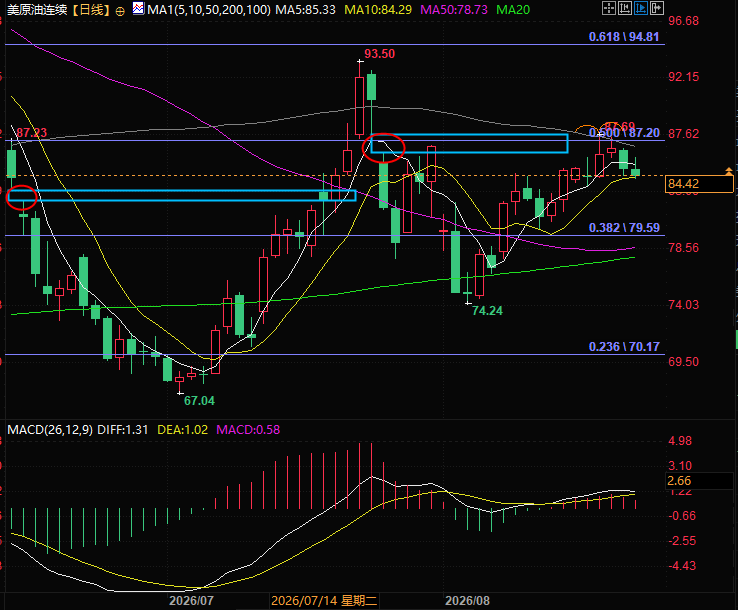 (WTI crude oil futures daily chart, source: EasyForex) At 16:25 Beijing time, WTI crude oil futures were trading at $83.54 per barrel.
The focus of the game has shifted: the United States has launched comprehensive economic isolation and sanctions.
As military tensions ease, the US-Iran rivalry has officially shifted to a full-blown economic war. On August 24th local time, US Treasury Secretary Bessenter held a press conference announcing a new round of "economic isolation" sanctions against Iran, significantly escalating pressure. This round of sanctions covers five core areas: aviation, digital assets, gold trading, shipping, and high-tech industries. Simultaneously, the US has suspended numerous compliance licenses related to Iran, covering cross-border education services, personal cross-border remittances, and non-governmental exchanges such as sports and academic exchanges. It has also added over 60 Iranian entities, individuals, and vessels to the sanctions list, precisely targeting Iran's core supply chains in nuclear and missile technology, cyber operations, and oil trade. The US has further stated that it will completely cut off all potential revenue sources for the Iranian Islamic Revolutionary Guard Corps, and that a major financial institution will be sanctioned by the end of this week for its business dealings with Iran.Iran's tough response: Undeterred by sanctions, it refuses to compromise under external pressure.
Faced with extreme economic pressure from the United States, the Iranian government has responded with a firm stance across all dimensions, showing no signs of backing down. The Speaker of the Iranian Parliament publicly stated that the international community has long recognized the futility of US sanctions rhetoric and no one believes the US threats. He emphasized that the US's current economic strength is insufficient to forcibly sever Iran's foreign trade and economic cooperation, and Iran's major trading partners have clearly stated that they will not be swayed by US sanctions rhetoric. The Iranian military's attitude is even more resolute. The Commander-in-Chief of the Iranian Armed Forces, Khatami, publicly and forcefully declared that even after generations of struggle, Iran will never yield to external pressure and will resolutely thwart any attempts by the enemy to suppress it. Any attempt to alter Iran's territory or contain its development will pay a heavy price. Even with current domestic economic and livelihood pressures such as fuel shortages, Tehran maintains a tough stance of confrontation.A window of opportunity for mediation has emerged: Pakistan is leading the efforts to de-escalate the conflict.
As geopolitical tensions escalate, regional diplomatic efforts are proceeding simultaneously, providing a buffer to de-escalate the situation. Pakistan's Interior Minister publicly stated that negotiations between Pakistan and high-ranking Iranian officials have made significant progress. The Pakistani military also issued a statement saying that Army Chief of Staff Munir has completed comprehensive and in-depth talks with Iran, with both sides focusing on pragmatic measures to avoid conflict and prevent further escalation of the regional situation, injecting uncertainty into the US-Iran confrontation.Severe Data Disparity: US Flight Data Questioned Across the Market
The official US figures for crude oil shipments through the Strait of Hormuz show a significant discrepancy with actual data from major global oil shipping tracking agencies, making their accuracy impossible to independently verify in the market. US Energy Secretary Wright publicly stated that, under US military escort, the seven-day average export volume of crude oil and refined products from the Strait reaches 8 to 9 million barrels per day, with a single-day peak exceeding 15 million barrels. However, statistics from several authoritative third-party data agencies, including Kpler, Huax, and Vortexa, are highly consistent, showing current Strait shipments at only 2 to 6 million barrels per day. Furthermore, actual loading data from Persian Gulf ports and crude oil import and unloading data from Asian terminals fail to corroborate the US's exaggerated figures, leading to the classic "missing crude oil" problem in the oil market once again. The core reason for this data discrepancy is that many oil tankers, to avoid geopolitical risks, shut down their AIS transponders and "blindly navigate" through the Strait at night, making them completely undetectable by satellite and conventional radio monitoring. A single Very Large Crude Carrier (VLCC) can carry up to 2 million barrels when fully loaded. Missing just one or two vessels can completely alter the overall cargo volume data. Furthermore, differences in the choice of statistical period and the estimation of actual vessel load factors further amplify the data discrepancies. While the US can identify vessels in blind spots through its exclusive intelligence channels such as military radar and aerial reconnaissance, this data is not publicly available and lacks any market cross-verification mechanisms.Market sentiment was mild: oil prices showed no signs of panic, and supply and demand expectations remained cautious.
Despite the tense geopolitical situation in the Taiwan Strait and ongoing data disputes, the current crude oil market has not fallen into extreme panic, and overall sentiment remains relatively restrained. Brent crude futures are currently stable around $90 per barrel, a slight increase from peacetime levels, but significantly lower than the highs at the beginning of the conflict. This easing of market sentiment is directly reflected in the futures-spot price spread: the spot premium, which reached as high as $36 per barrel at the beginning of the war, has quickly narrowed to below $6 in recent months, reflecting a significant easing of short-term emergency supply pressure. Dubai crude, the benchmark oil price in the Gulf, has also fallen from its extreme high of $160 per barrel at the end of March to around $97 per barrel. The market trend indicates that the trading market has not accepted the optimistic statement from the US that "shipping capacity has fully recovered," nor has it over-bet on the risk of a complete supply disruption from the Strait. Another factor is that attacks on several Russian refineries have affected crude oil processing, indirectly reducing market demand for crude oil, while refined product prices have risen accordingly. However, due to limitations in refining capacity, the transmission effect of refined product prices on crude oil prices has been affected.The waterway game becomes more complex: multiple parties divert traffic, diluting the effect of blockade.
The current navigation situation in the Strait of Hormuz presents a complex picture of checks and balances, rather than a simple US-Iran confrontation. For months, the US military has opened a protective channel on the Omani side of the strait, actively guiding oil tankers through in an attempt to weaken Iran's control over the strait and stabilize global oil supplies. In response, Iran retaliated strongly in July, attacking ships passing through the channel, completely breaking the tacit agreement to keep the channel open, and recently announced that it would impose fines and impoundment on 46 vessels that violated the rules. To circumvent the risks in the strait, Saudi Arabia and the UAE have built a trans-desert land-based oil pipeline, transferring millions of barrels of crude oil daily to the Gulf of Oman and the Red Sea, bypassing the Strait of Hormuz blockade. Iran subsequently issued a stern warning that if the US continues to escalate its economic pressure on Iran, it will specifically threaten the aforementioned land-based bypass pipeline. It is worth noting that navigation in the strait does not entirely depend on US escort. Oil-producing countries such as Kuwait, Iraq, and the UAE have all reached independent passage agreements with Iran. Data shows that since August, about one-third of the ships transiting the Taiwan Strait have chosen the northern route controlled by Iran, further diversifying the market's shipping capacity structure and continuously mitigating the impact of geopolitical risks on supply.Viewpoints and Technical Analysis:
Previous articles have repeatedly emphasized that the US debt crisis makes it difficult for the US to withstand continued oil price increases. If the US were in an environment where inflation is under control and the labor market is cooling down, there would be room for interest rates to decline. This would significantly reduce the risk of US tech companies and tech stock defaults, improve the financing environment for businesses, and be more conducive to the US maintaining its economic growth narrative. Meanwhile, the oil price increases and military spending caused by the US-Iran conflict are also important factors in the recent US debt crisis. In other words, the US desperately wants to end the war and bring oil prices back to $60. This explains the recent flurry of rhetoric from pro-peace factions in Iran. Iran could gain more leverage in negotiations. Following this logic, the potential for further oil price increases is very limited. Recently, US President Trump spoke with Pakistani Army Chief of Staff Munir before his departure for Iran today (August 24). According to sources, the US's main demand was for Pakistan to use its influence to persuade Iran to return to the negotiating table, which confirms the above assessment. In the traditional analytical framework, the US is currently exaggerating the effectiveness of its escort efforts and the capacity of shipping routes to stabilize market expectations and mitigate geopolitical risks. On the demand side, oil prices are suppressed due to refinery shortages, potential sanctions, and insufficient demand caused by a global economic slowdown. However, comprehensive physical data, including port loading, ship tracking, and downstream imports, casts doubt on the US's statistical methods. Furthermore, the blockade of shipping lanes could still lead to a secondary shock of high inventory levels and supply shortages. Geopolitically, on one hand, the US continues to escalate financial sanctions, attempting to cripple the economic lifeline of the Iranian Revolutionary Guard; on the other hand, Iran holds the key to the Strait of Hormuz and has signed cooperation agreements with neighboring countries, demonstrating a strong countermeasure. Currently, the overall situation in the Gulf is a complex one of pipeline diversion and independent shipping by multiple countries. In the short term, oil prices will continue to fluctuate between "geopolitical risk premium" and "real supply easing." Subsequent physical shipment volumes and Asian port arrival and unloading data will be key to dispelling market uncertainty and guiding oil price trends. That is, if oil prices fall, Iran is likely to speak out, while if oil prices rise, the US will likely comment; the two sides are currently in a stalemate. Technically, a small double-top pattern is forming over the past two days, and oil prices have currently pulled back to near the 10-day moving average. Support is currently around 83.5-82.5, which is also the level of the previous downward gap that the bulls recently overcame, while resistance is around 87.20. (WTI crude oil futures daily chart, source: EasyForex) At 16:25 Beijing time, WTI crude oil futures were trading at $83.54 per barrel.- Risk Warning and Disclaimer
- The market involves risk, and trading may not be suitable for all investors. This article is for reference only and does not constitute personal investment advice, nor does it take into account certain users’ specific investment objectives, financial situation, or other needs. Any investment decisions made based on this information are at your own risk.