













Rising US Treasury yields signal an undervalued global macroeconomic shift.
2026-08-25 18:09:00
In the past two years, the global market has exhibited a set of significant structural characteristics: equity market volatility has intensified, international gold prices have continued to rise, and the yield on long-term US Treasury bonds has continued to climb, remaining firmly above 4% for an extended period and reaching a more than ten-year high. The mainstream market view largely attributes the rise in yields to the Federal Reserve's monetary tightening and high inflation stickiness. However, this explanation only applies to short-term cyclical fluctuations and fails to explain the core contradiction: against the backdrop of rising expectations of Fed rate cuts and gradually declining inflation, long-term US Treasury yields remain rigid, more prone to rising than falling.  Essentially, this round of long-term interest rate increases is not a short-term policy disturbance, but a structural restructuring of the global capital pricing system. Over the past two decades, the globalization system has fostered a global savings glut, continuously suppressing global risk-free interest rates; currently, high-quality long-term capital globally has entered a scarcity cycle, and US Treasury bonds are undergoing a systemic repricing. Understanding this fundamental paradigm shift allows for a clear grasp of the pricing logic of global stocks, bonds, currencies, and gold, and can also provide a long-term reference for ordinary investors' asset allocation. I. Market Anomalies: The Traditional Pricing Framework Has Structurally Failed Looking at core data, during the 2020 pandemic, the 10-year US Treasury yield fell to a low of 0.5%. By 2024, its central level had steadily risen to 4.2%–4.5%, an increase of nearly 400 basis points over four years, indicating a significant rise in the central interest rate. Reviewing historical trends, a stable hedging pattern exists in the capital market: rising US Treasury yields mean increased returns on risk-free assets, which will suppress the valuation of gold, which has zero-interest income; the two show a significant negative correlation. However, since 2023, a clear divergence has emerged in the market: international gold prices and long-term US Treasury yields have risen in tandem. While gold prices broke through the $3,000/ounce mark, US Treasury yields remained consistently high. This anomaly fully demonstrates that the core variable driving this round of interest rate increases has departed from the US domestic monetary cycle, stemming from profound changes in the global macroeconomic structure: the passive allocation willingness of global capital to US Treasuries has weakened, while the demand for diversified safe-haven assets has increased, forcing US Treasuries to raise their risk compensation levels. In short, the global capital landscape has shifted: from passively absorbing US Treasuries due to past surplus savings to actively attracting capital by raising yields. II. Capital Supply Contraction: The Triple Ebb of the Global Cheap Capital System The core support for the global low-interest-rate environment of the past two decades was the efficient circulation of cross-border capital driven by the dividends of globalization. The massive savings accumulated by global surplus economies flowed continuously and frictionlessly into the US Treasury market, constituting a long-term suppressive force on long-term interest rates. This mature cheap capital supply system is now continuously disintegrating from three dimensions. 1. The Ebb of Globalization: The Efficiency of Cross-Border Capital Circulation Continues to Decline At the height of globalization, East Asian manufacturing economies and Middle Eastern oil-exporting countries accumulated huge foreign exchange reserves through trade surpluses. Against the backdrop of a limited global asset portfolio, US Treasury bonds became the core allocation target, forming a stable closed loop of "trade surplus—reserve accumulation—increased holdings of US Treasury bonds." This was also the core cause of the "Greenspan Conundrum" from 2004 to 2006. In recent years, intensified geopolitical competition, the restructuring of global supply chains, and rising trade protectionism have significantly increased the frictional costs of cross-border capital flows. The capital allocation logic of various countries has shifted from "yield priority" to "security and self-control priority," leading to a continuous contraction in the passive demand for US Treasury bonds. Looking at holdings data, China's holdings of US Treasury bonds have fallen from a historical peak of $1.32 trillion in 2013 to around $770 billion in 2024. Middle Eastern sovereign wealth funds have also continuously reduced their allocation to US Treasury bonds, shifting capital towards domestic industrial upgrading, new energy, and investment in Asian real assets. Against the backdrop of continued fiscal expansion and a significant increase in the supply of US Treasury bonds, there has been a persistent shortage of new external funds to absorb these investments globally. This supply-demand mismatch has directly driven a passive rise in long-term yields. 2. Global Aging: Reversal in Savings Structure Compresses Loanable Funds Traditional market perception holds that aging will increase risk appetite and benefit bond assets. However, this logic ignores the systemic impact of population structure on the total global capital volume. Current reality is diametrically opposed to traditional theory. Major economies such as China, Japan, and Europe have fully entered a stage of deep aging, with a continuous decline in the proportion of the working-age population, a systemic drop in the national savings rate, and a continuous contraction in the market's available loanable funds. Simultaneously, the global pension system has officially transitioned from an asset accumulation phase to a payment and expenditure phase, significantly weakening the market supply capacity of long-term capital. Taking the Japan Pension Investment Fund (GPIF), the world's largest pension fund, as an example, it has been continuously reducing its holdings of overseas bond assets in recent years to recoup liquidity and match domestic pension payment needs. At the same time, the surge in rigid fiscal expenditures on healthcare and pensions brought about by aging is forcing countries to expand debt issuance, further crowding out existing market capital. The divergence between contracting capital supply and expanding debt supply continues to push up the pricing center of global long-term capital, driving up long-term interest rates. 3. Normalization of Yen Policy: The Collapse of the Global Carry Trade System For over a decade, Japan maintained negative interest rates and yield curve control policies, creating massive amounts of low-cost yen carry trade funds. Carry trade, where the market borrowed yen at zero cost and exchanged it for US dollars to invest in US Treasuries, became a significant, albeit invisible, force suppressing global long-term interest rates. The Bank of Japan's termination of negative interest rates and reduction in government bond purchases in 2024 marked the complete end of this long-running global carry trade system. Rising yen financing costs and increased exchange rate hedging costs led Japanese financial institutions to significantly reduce their US Treasury holdings, with some institutions continuing to reduce their holdings. Japan's approximately $1.1 trillion in US Treasuries, through marginal adjustments, exerts sustained upward pressure on global long-term interest rates. III . Expansion of Capital Demand: The AI and Fiscal-Driven Battle for Funds In addition to the continued contraction of global capital supply, the rigid demand for long-term capital continues to expand, further tightening the supply-demand balance. Two core incremental demands have jointly driven up the pricing level of global long-term capital. 1. AI Industry Iteration: Capital-Intensive Model Drives Financing Demand Compared to the asset-light, low-capital-investment development characteristics of the internet era, this round of AI technological revolution is highly capital-intensive. Computing infrastructure, data centers, high-end chip manufacturing, and upgrades to supporting power facilities all require long-term capital investments in the hundreds of billions. The combined capital expenditures of the seven major US tech giants exceeded $200 billion in 2024 and are expected to approach $300 billion in 2025, with a large portion of these expenditures financed through the bond market. Large-scale financing for the technology industry and real infrastructure has intensified competition for long-term capital in the market. In an environment of capital scarcity, real financing interest rates have systematically risen, forcing US Treasury bonds, as the global asset pricing anchor, to raise yields to maintain their asset attractiveness. 2. US Fiscal Easing: Debt Risk Forces Term Premium Correction
 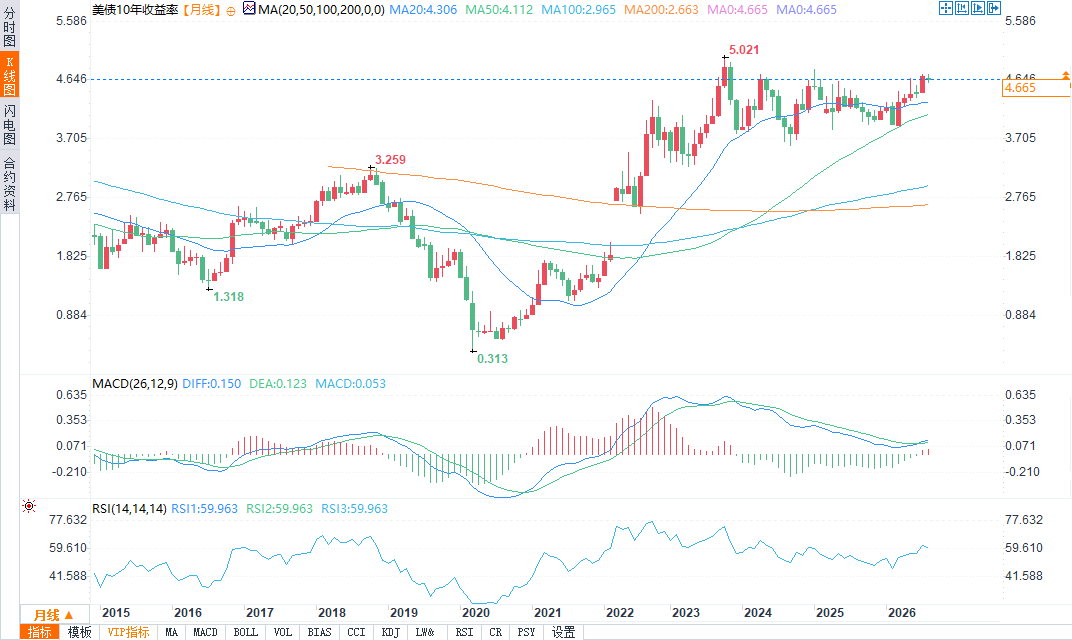 (10-year US Treasury yield monthly chart source: EasyTrade) The US fiscal deficit has shifted from cyclical fluctuations to structural expansion, with fiscal sustainability continuously weakening. Currently, the federal fiscal deficit ratio has remained above 6% for a long time, significantly deviating from the international safe threshold of 3%. In 2024, US Treasury interest payments will exceed $1 trillion, surpassing defense spending to become a core fiscal expenditure item. Previously, the market viewed the US fiscal deficit as a short-term cyclical phenomenon; now, investors have formed a long-term pessimistic expectation. In response to the current situation of continuously expanding US debt and accumulating fiscal risks, the market has proactively increased risk compensation, driving the US Treasury term premium to continue to recover and turn positive. This is the core structural driver of the rise in long-term yields. IV. Safe-haven Asset Restructuring: Gold's Rise Weakens US Treasury Monopoly The current sustained strength of gold is not simply due to geopolitical safe-haven demand or inflation hedging, but rather a core signal of the restructuring of global reserve assets. For a long time, US Treasury bonds, with their high liquidity and low volatility, have monopolized the global safe-haven asset track. However, with the disorderly expansion of US debt and the restructuring of the global geopolitical landscape, the "risk-free" attribute of US Treasury bonds has continued to weaken, and global capital has begun to seek diversified safe-haven assets as alternatives. From 2022 to 2024, global central banks' annual gold purchases exceeded 1,000 tons for three consecutive years, upgrading gold from a marginal hedging tool to a core strategic reserve asset for central banks around the world. The reallocation of global reserve funds has continuously diverted demand for US Treasury bonds, further strengthening the upward pressure on long-term interest rates. The "de-dollarization" hotly debated in the market is not a rapid collapse of the dollar system, but rather a shift in global reserve assets from a reliance on US Treasury bonds to a diversified and balanced allocation, with the exclusive pricing power and asset attractiveness of US Treasury bonds continuing to weaken. V. Market Outlook and Investor Allocation Strategies In summary, the Fed's monetary policy and economic cycle fluctuations will only bring short-term volatility in US Treasury yields. The retreat of globalization, the reversal of population structure, the rigid demand for AI capital, and the restructuring of safe-haven assets are all long-term trends. The era of low interest rates on US Treasury bonds has completely ended, and a systemic upward shift in the central level of long-term yields is a foregone conclusion. The future market is likely to present three scenarios: Baseline Scenario (50% probability): A soft landing for the economy, moderate and sticky inflation, and the 10-year US Treasury yield fluctuating at a high level of 4.0%–4.5% for an extended period. Upside Risk (30% probability): A second wave of inflation, continued fiscal expansion, and escalating geopolitical conflicts pushing up energy costs, potentially pushing yields above 5.0%. Downside Risk (20% probability): A rapid economic recession forcing the Federal Reserve to cut interest rates significantly, causing yields to temporarily fall back to 3.0%–3.5%, but this is only a temporary correction and cannot reverse the long-term upward trend. Based on the above judgment, ordinary investors can refer to three allocation strategies: First, optimize the fixed-income duration structure. With the volatility and risk premium of long-term US Treasuries continuing to rise, the cost-effectiveness of long-term holding has decreased. It is recommended to focus on medium- and short-term fixed-income assets to avoid the risk of long-term interest rate volatility. Second, construct a diversified hedging portfolio. Against the backdrop of weakened US Treasury safety and increased global uncertainty, a combination of "fixed income + gold" can be used to hedge debt risk and exchange rate fluctuations, improving portfolio stability. Third, adapt to a high-interest-rate market environment. With high interest rates at their core, growth assets continue to face valuation pressure, making a broad-based market rally unlikely. Structural market movements are becoming the norm, and investment should focus on asset value and risk control. Conclusion This round of rising US Treasury yields represents a paradigm shift in global capital, moving from a state of "excess savings" to one of "capital scarcity." The fading of globalization dividends, a reversal in demographic structure, the intensive expansion of AI capital, and the restructuring of safe-haven assets are four core forces that have fundamentally rewritten the underlying pricing logic of US Treasury bonds. While US Treasury bonds remain a core cornerstone of the global financial system, the era of long-term low-volatility, stable-return investments has ended. Only by recognizing this long-term structural change and moving beyond short-term market noise can investors adapt to the new global asset pricing landscape and build a more robust long-term investment system. Rate and review this version.
Essentially, this round of long-term interest rate increases is not a short-term policy disturbance, but a structural restructuring of the global capital pricing system. Over the past two decades, the globalization system has fostered a global savings glut, continuously suppressing global risk-free interest rates; currently, high-quality long-term capital globally has entered a scarcity cycle, and US Treasury bonds are undergoing a systemic repricing. Understanding this fundamental paradigm shift allows for a clear grasp of the pricing logic of global stocks, bonds, currencies, and gold, and can also provide a long-term reference for ordinary investors' asset allocation. I. Market Anomalies: The Traditional Pricing Framework Has Structurally Failed Looking at core data, during the 2020 pandemic, the 10-year US Treasury yield fell to a low of 0.5%. By 2024, its central level had steadily risen to 4.2%–4.5%, an increase of nearly 400 basis points over four years, indicating a significant rise in the central interest rate. Reviewing historical trends, a stable hedging pattern exists in the capital market: rising US Treasury yields mean increased returns on risk-free assets, which will suppress the valuation of gold, which has zero-interest income; the two show a significant negative correlation. However, since 2023, a clear divergence has emerged in the market: international gold prices and long-term US Treasury yields have risen in tandem. While gold prices broke through the $3,000/ounce mark, US Treasury yields remained consistently high. This anomaly fully demonstrates that the core variable driving this round of interest rate increases has departed from the US domestic monetary cycle, stemming from profound changes in the global macroeconomic structure: the passive allocation willingness of global capital to US Treasuries has weakened, while the demand for diversified safe-haven assets has increased, forcing US Treasuries to raise their risk compensation levels. In short, the global capital landscape has shifted: from passively absorbing US Treasuries due to past surplus savings to actively attracting capital by raising yields. II. Capital Supply Contraction: The Triple Ebb of the Global Cheap Capital System The core support for the global low-interest-rate environment of the past two decades was the efficient circulation of cross-border capital driven by the dividends of globalization. The massive savings accumulated by global surplus economies flowed continuously and frictionlessly into the US Treasury market, constituting a long-term suppressive force on long-term interest rates. This mature cheap capital supply system is now continuously disintegrating from three dimensions. 1. The Ebb of Globalization: The Efficiency of Cross-Border Capital Circulation Continues to Decline At the height of globalization, East Asian manufacturing economies and Middle Eastern oil-exporting countries accumulated huge foreign exchange reserves through trade surpluses. Against the backdrop of a limited global asset portfolio, US Treasury bonds became the core allocation target, forming a stable closed loop of "trade surplus—reserve accumulation—increased holdings of US Treasury bonds." This was also the core cause of the "Greenspan Conundrum" from 2004 to 2006. In recent years, intensified geopolitical competition, the restructuring of global supply chains, and rising trade protectionism have significantly increased the frictional costs of cross-border capital flows. The capital allocation logic of various countries has shifted from "yield priority" to "security and self-control priority," leading to a continuous contraction in the passive demand for US Treasury bonds. Looking at holdings data, China's holdings of US Treasury bonds have fallen from a historical peak of $1.32 trillion in 2013 to around $770 billion in 2024. Middle Eastern sovereign wealth funds have also continuously reduced their allocation to US Treasury bonds, shifting capital towards domestic industrial upgrading, new energy, and investment in Asian real assets. Against the backdrop of continued fiscal expansion and a significant increase in the supply of US Treasury bonds, there has been a persistent shortage of new external funds to absorb these investments globally. This supply-demand mismatch has directly driven a passive rise in long-term yields. 2. Global Aging: Reversal in Savings Structure Compresses Loanable Funds Traditional market perception holds that aging will increase risk appetite and benefit bond assets. However, this logic ignores the systemic impact of population structure on the total global capital volume. Current reality is diametrically opposed to traditional theory. Major economies such as China, Japan, and Europe have fully entered a stage of deep aging, with a continuous decline in the proportion of the working-age population, a systemic drop in the national savings rate, and a continuous contraction in the market's available loanable funds. Simultaneously, the global pension system has officially transitioned from an asset accumulation phase to a payment and expenditure phase, significantly weakening the market supply capacity of long-term capital. Taking the Japan Pension Investment Fund (GPIF), the world's largest pension fund, as an example, it has been continuously reducing its holdings of overseas bond assets in recent years to recoup liquidity and match domestic pension payment needs. At the same time, the surge in rigid fiscal expenditures on healthcare and pensions brought about by aging is forcing countries to expand debt issuance, further crowding out existing market capital. The divergence between contracting capital supply and expanding debt supply continues to push up the pricing center of global long-term capital, driving up long-term interest rates. 3. Normalization of Yen Policy: The Collapse of the Global Carry Trade System For over a decade, Japan maintained negative interest rates and yield curve control policies, creating massive amounts of low-cost yen carry trade funds. Carry trade, where the market borrowed yen at zero cost and exchanged it for US dollars to invest in US Treasuries, became a significant, albeit invisible, force suppressing global long-term interest rates. The Bank of Japan's termination of negative interest rates and reduction in government bond purchases in 2024 marked the complete end of this long-running global carry trade system. Rising yen financing costs and increased exchange rate hedging costs led Japanese financial institutions to significantly reduce their US Treasury holdings, with some institutions continuing to reduce their holdings. Japan's approximately $1.1 trillion in US Treasuries, through marginal adjustments, exerts sustained upward pressure on global long-term interest rates. III . Expansion of Capital Demand: The AI and Fiscal-Driven Battle for Funds In addition to the continued contraction of global capital supply, the rigid demand for long-term capital continues to expand, further tightening the supply-demand balance. Two core incremental demands have jointly driven up the pricing level of global long-term capital. 1. AI Industry Iteration: Capital-Intensive Model Drives Financing Demand Compared to the asset-light, low-capital-investment development characteristics of the internet era, this round of AI technological revolution is highly capital-intensive. Computing infrastructure, data centers, high-end chip manufacturing, and upgrades to supporting power facilities all require long-term capital investments in the hundreds of billions. The combined capital expenditures of the seven major US tech giants exceeded $200 billion in 2024 and are expected to approach $300 billion in 2025, with a large portion of these expenditures financed through the bond market. Large-scale financing for the technology industry and real infrastructure has intensified competition for long-term capital in the market. In an environment of capital scarcity, real financing interest rates have systematically risen, forcing US Treasury bonds, as the global asset pricing anchor, to raise yields to maintain their asset attractiveness. 2. US Fiscal Easing: Debt Risk Forces Term Premium Correction (10-year US Treasury yield monthly chart source: EasyTrade) The US fiscal deficit has shifted from cyclical fluctuations to structural expansion, with fiscal sustainability continuously weakening. Currently, the federal fiscal deficit ratio has remained above 6% for a long time, significantly deviating from the international safe threshold of 3%. In 2024, US Treasury interest payments will exceed $1 trillion, surpassing defense spending to become a core fiscal expenditure item. Previously, the market viewed the US fiscal deficit as a short-term cyclical phenomenon; now, investors have formed a long-term pessimistic expectation. In response to the current situation of continuously expanding US debt and accumulating fiscal risks, the market has proactively increased risk compensation, driving the US Treasury term premium to continue to recover and turn positive. This is the core structural driver of the rise in long-term yields. IV. Safe-haven Asset Restructuring: Gold's Rise Weakens US Treasury Monopoly The current sustained strength of gold is not simply due to geopolitical safe-haven demand or inflation hedging, but rather a core signal of the restructuring of global reserve assets. For a long time, US Treasury bonds, with their high liquidity and low volatility, have monopolized the global safe-haven asset track. However, with the disorderly expansion of US debt and the restructuring of the global geopolitical landscape, the "risk-free" attribute of US Treasury bonds has continued to weaken, and global capital has begun to seek diversified safe-haven assets as alternatives. From 2022 to 2024, global central banks' annual gold purchases exceeded 1,000 tons for three consecutive years, upgrading gold from a marginal hedging tool to a core strategic reserve asset for central banks around the world. The reallocation of global reserve funds has continuously diverted demand for US Treasury bonds, further strengthening the upward pressure on long-term interest rates. The "de-dollarization" hotly debated in the market is not a rapid collapse of the dollar system, but rather a shift in global reserve assets from a reliance on US Treasury bonds to a diversified and balanced allocation, with the exclusive pricing power and asset attractiveness of US Treasury bonds continuing to weaken. V. Market Outlook and Investor Allocation Strategies In summary, the Fed's monetary policy and economic cycle fluctuations will only bring short-term volatility in US Treasury yields. The retreat of globalization, the reversal of population structure, the rigid demand for AI capital, and the restructuring of safe-haven assets are all long-term trends. The era of low interest rates on US Treasury bonds has completely ended, and a systemic upward shift in the central level of long-term yields is a foregone conclusion. The future market is likely to present three scenarios: Baseline Scenario (50% probability): A soft landing for the economy, moderate and sticky inflation, and the 10-year US Treasury yield fluctuating at a high level of 4.0%–4.5% for an extended period. Upside Risk (30% probability): A second wave of inflation, continued fiscal expansion, and escalating geopolitical conflicts pushing up energy costs, potentially pushing yields above 5.0%. Downside Risk (20% probability): A rapid economic recession forcing the Federal Reserve to cut interest rates significantly, causing yields to temporarily fall back to 3.0%–3.5%, but this is only a temporary correction and cannot reverse the long-term upward trend. Based on the above judgment, ordinary investors can refer to three allocation strategies: First, optimize the fixed-income duration structure. With the volatility and risk premium of long-term US Treasuries continuing to rise, the cost-effectiveness of long-term holding has decreased. It is recommended to focus on medium- and short-term fixed-income assets to avoid the risk of long-term interest rate volatility. Second, construct a diversified hedging portfolio. Against the backdrop of weakened US Treasury safety and increased global uncertainty, a combination of "fixed income + gold" can be used to hedge debt risk and exchange rate fluctuations, improving portfolio stability. Third, adapt to a high-interest-rate market environment. With high interest rates at their core, growth assets continue to face valuation pressure, making a broad-based market rally unlikely. Structural market movements are becoming the norm, and investment should focus on asset value and risk control. Conclusion This round of rising US Treasury yields represents a paradigm shift in global capital, moving from a state of "excess savings" to one of "capital scarcity." The fading of globalization dividends, a reversal in demographic structure, the intensive expansion of AI capital, and the restructuring of safe-haven assets are four core forces that have fundamentally rewritten the underlying pricing logic of US Treasury bonds. While US Treasury bonds remain a core cornerstone of the global financial system, the era of long-term low-volatility, stable-return investments has ended. Only by recognizing this long-term structural change and moving beyond short-term market noise can investors adapt to the new global asset pricing landscape and build a more robust long-term investment system. Rate and review this version.
- Risk Warning and Disclaimer
- The market involves risk, and trading may not be suitable for all investors. This article is for reference only and does not constitute personal investment advice, nor does it take into account certain users’ specific investment objectives, financial situation, or other needs. Any investment decisions made based on this information are at your own risk.

