Pakistan's mediation efforts have drawn market attention; what challenges does the crude oil risk premium face?
2026-08-25 18:53:03
On Tuesday, August 25th, the international crude oil market was reassessing the risk premium brought about by changes in the Middle East situation. Pakistan signaled diplomatic efforts, with its army leader visiting Tehran and reportedly bringing with him a plan to ease tensions and resume negotiations, increasing market expectations for a de-escalation of the regional situation. Following the news, crude oil prices came under pressure, with Brent crude currently fluctuating around $89.5, down about 2.8% on the day. Market focus shifted from supply disruption risks back to whether diplomatic progress could alter expectations for energy flows.  Looking at the 10-minute chart of Brent crude oil, the price has experienced a rapid decline, with the Bollinger Band middle line continuing to move downwards and the price trading in the lower half of the band. The MACD indicator is in negative territory, and the low-level changes in the indicator also reflect that the short-term volatility structure is changing.
 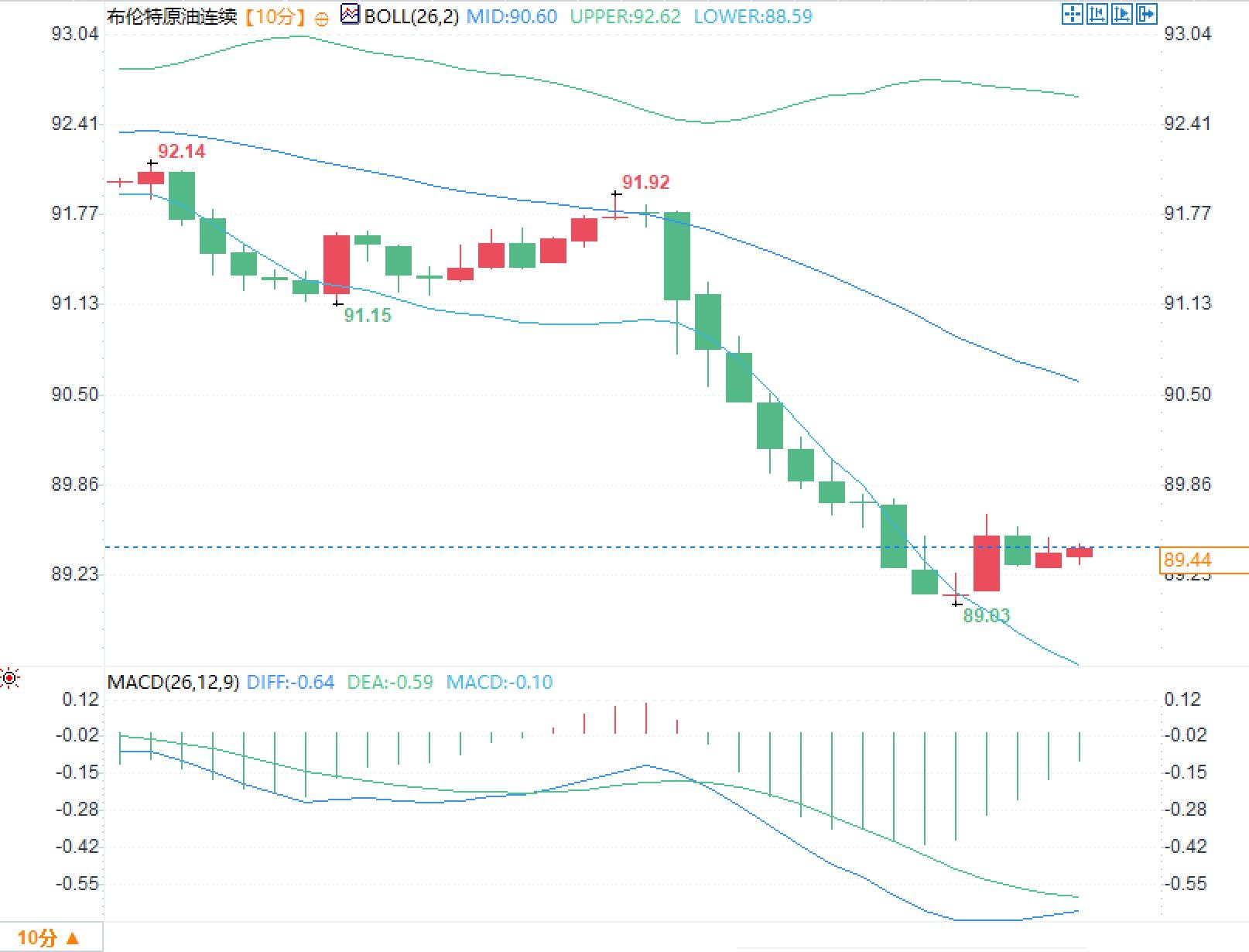 The core of this market reaction is not a single piece of news, but rather investors' reassessment of future energy supply risks. Previously, tensions surrounding key energy transport routes drove a rapid increase in crude oil risk premiums, with the market concerned about supply chain disruptions; therefore, crude oil prices contained a significant geopolitical element. Pakistan's participation in these communications is seen by the market as an important signal of renewed activity in regional diplomatic channels. Reports indicate that Pakistani officials stated the talks made progress, with discussions focusing on reducing regional tensions and restoring communication mechanisms. For the energy market, diplomatic news primarily affects risk premiums, rather than immediately altering actual supply and demand. The global crude oil supply system involves multiple aspects, including production, inventory, transportation, insurance costs, and trade flows; therefore, even with market expectations of easing, supply-side recovery still requires observation of specific follow-up measures. From a technical perspective, Brent crude oil's recent price movement reflects a clear sentiment-driven characteristic. Charts show a continuous decline from highs, with the candlestick pattern showing a series of corrective movements. Regarding the moving average system, medium-term trend indicators remain in a corrective phase, with a deviation between the price and the medium-term moving averages, reflecting the lingering impact of previous capital outflows from risk assets. MACD data shows that the fast and slow lines are in the low range, and the histogram has converged after a period of sustained expansion, indicating a change in market momentum, but the balance of power between bulls and bears is still in the process of rebalancing. A key characteristic of the current technical environment is the high degree of intertwining between fundamental news and technical structure. Diplomatic developments can quickly alter market sentiment, while inventory data, production changes, and transportation conditions determine whether price fluctuations will have a longer-term impact. Although diplomatic news has helped the market lower some risk expectations, the crude oil market still faces multiple uncertainties. First, whether diplomatic communication can be transformed into a formal mechanism requires verification through subsequent actions. Second, the recovery of energy transportation remains a crucial variable affecting supply expectations. Market data shows that crude oil prices have fallen due to diplomatic news, but investors have not completely ignored regional risks. Previously, Brent crude oil prices rose significantly due to escalating tensions, but subsequently retreated as expectations of easing tensions increased. Furthermore, changes in global energy demand, inventory cycles, and policy adjustments in major oil-producing regions will also affect medium-term price formation. The market is currently gradually shifting from "supply disruption risk trading" to "actual supply change trading," a transition process typically accompanied by higher volatility. From an asset linkage perspective, changes in crude oil prices not only affect the energy sector but also impact a wider market through inflation expectations, transportation costs, and corporate profit expectations. The decline in oil prices due to diplomatic news reflects the market's reduction of the probability of some extreme scenarios. However, a decrease in risk premiums does not mean that risks have completely disappeared. Historical experience shows that market pricing in geopolitical events typically goes through multiple stages, including rapid risk escalation, sentiment release, news verification, and fundamental repricing. The current stage is closer to the news verification period, and it is necessary to observe whether the diplomatic outcomes are sustainable. For the market, future focus may concentrate on three areas: first, whether there has been a real improvement in regional supply; second, whether major oil-producing countries have adjusted their supply strategies; and third, whether changes in global demand match current supply expectations.
Looking at the 10-minute chart of Brent crude oil, the price has experienced a rapid decline, with the Bollinger Band middle line continuing to move downwards and the price trading in the lower half of the band. The MACD indicator is in negative territory, and the low-level changes in the indicator also reflect that the short-term volatility structure is changing. The core of this market reaction is not a single piece of news, but rather investors' reassessment of future energy supply risks. Previously, tensions surrounding key energy transport routes drove a rapid increase in crude oil risk premiums, with the market concerned about supply chain disruptions; therefore, crude oil prices contained a significant geopolitical element. Pakistan's participation in these communications is seen by the market as an important signal of renewed activity in regional diplomatic channels. Reports indicate that Pakistani officials stated the talks made progress, with discussions focusing on reducing regional tensions and restoring communication mechanisms. For the energy market, diplomatic news primarily affects risk premiums, rather than immediately altering actual supply and demand. The global crude oil supply system involves multiple aspects, including production, inventory, transportation, insurance costs, and trade flows; therefore, even with market expectations of easing, supply-side recovery still requires observation of specific follow-up measures. From a technical perspective, Brent crude oil's recent price movement reflects a clear sentiment-driven characteristic. Charts show a continuous decline from highs, with the candlestick pattern showing a series of corrective movements. Regarding the moving average system, medium-term trend indicators remain in a corrective phase, with a deviation between the price and the medium-term moving averages, reflecting the lingering impact of previous capital outflows from risk assets. MACD data shows that the fast and slow lines are in the low range, and the histogram has converged after a period of sustained expansion, indicating a change in market momentum, but the balance of power between bulls and bears is still in the process of rebalancing. A key characteristic of the current technical environment is the high degree of intertwining between fundamental news and technical structure. Diplomatic developments can quickly alter market sentiment, while inventory data, production changes, and transportation conditions determine whether price fluctuations will have a longer-term impact. Although diplomatic news has helped the market lower some risk expectations, the crude oil market still faces multiple uncertainties. First, whether diplomatic communication can be transformed into a formal mechanism requires verification through subsequent actions. Second, the recovery of energy transportation remains a crucial variable affecting supply expectations. Market data shows that crude oil prices have fallen due to diplomatic news, but investors have not completely ignored regional risks. Previously, Brent crude oil prices rose significantly due to escalating tensions, but subsequently retreated as expectations of easing tensions increased. Furthermore, changes in global energy demand, inventory cycles, and policy adjustments in major oil-producing regions will also affect medium-term price formation. The market is currently gradually shifting from "supply disruption risk trading" to "actual supply change trading," a transition process typically accompanied by higher volatility. From an asset linkage perspective, changes in crude oil prices not only affect the energy sector but also impact a wider market through inflation expectations, transportation costs, and corporate profit expectations. The decline in oil prices due to diplomatic news reflects the market's reduction of the probability of some extreme scenarios. However, a decrease in risk premiums does not mean that risks have completely disappeared. Historical experience shows that market pricing in geopolitical events typically goes through multiple stages, including rapid risk escalation, sentiment release, news verification, and fundamental repricing. The current stage is closer to the news verification period, and it is necessary to observe whether the diplomatic outcomes are sustainable. For the market, future focus may concentrate on three areas: first, whether there has been a real improvement in regional supply; second, whether major oil-producing countries have adjusted their supply strategies; and third, whether changes in global demand match current supply expectations.
- Risk Warning and Disclaimer
- The market involves risk, and trading may not be suitable for all investors. This article is for reference only and does not constitute personal investment advice, nor does it take into account certain users’ specific investment objectives, financial situation, or other needs. Any investment decisions made based on this information are at your own risk.