Gold has entered a consolidation phase after four consecutive days of strong gains.
2026-08-25 20:11:01
On Tuesday (August 25), gold prices retreated after rising for four consecutive days, accumulating a gain of approximately $350. It reached a three-month high near $4,700 before consolidating. Recent investor demand has returned: gold ETF holdings increased by approximately 60 tons in August; hedge funds pushed their net long positions in COMEX gold futures to an 11-month high.  This rebound was driven by multiple factors: technical momentum buying, coupled with renewed concerns about US fiscal and debt issues, geopolitical uncertainty, central bank gold purchases, and the potential for a further weakening of the US dollar. After this significant rise, the market is now consolidating, which is a healthy trend. The next major resistance level is at $4770; the 200-day moving average at around $4519 provides initial support. During the Asian trading session, spot gold surged to nearly $4700, hitting a three-month high; after rising by approximately $350 over four consecutive days, gold prices began to stabilize and fluctuate. Past market performance is not a reliable indicator of future market trends. Today's slight weakening in gold prices was mainly due to profit-taking after the previous surge, while the continued strengthening of the US dollar also exerted downward pressure. The US dollar had fallen sharply after the US Treasury announced its buyback program last week, but the dollar index has now recovered more than half of its losses. US Treasury Secretary Bessant stated that the US will seek to sever Iran's ties with the global financial system, which further boosted the dollar. This event highlights the central role of the US dollar in the global trade and financial system and reinforces its traditional safe-haven asset status. Investment demand for gold has surged significantly. So far this month, global gold ETF holdings have increased by approximately 60 tons, and August is expected to see the strongest monthly inflow since September of last year. Simultaneously, hedge funds have increased their net long positions in COMEX gold futures to an 11-month high; if "other reporting accounts" are included, the long position size reaches its highest level since January of this year. These two data points clearly demonstrate that the restart of upward momentum, the technical breakout, and heightened concerns about political, fiscal, and financial risks will quickly translate into demand for physical gold. The core drivers pushing traders and investors to increase their gold holdings have not disappeared and are expected to continue supporting gold prices in the coming months, including the sustainability of US fiscal policy and high debt risk, the possibility of a renewed weakening of the US dollar, continued gold purchases by central banks, and geopolitical uncertainties. However, the short-term market focus may shift to consolidation. The trend of US Treasury yields and the upcoming Jackson Hole global central bank symposium will indicate the future direction of gold prices. The Jackson Hole Economic Symposium will be held from August 27-29, with Chairman Warsh delivering his first keynote address since taking office on Friday, August 28. The theme of this year's symposium is "Financial Innovation: Implications for Payments and Policy." The market expects the speech to discuss the application of stablecoins in the financial system infrastructure; however, the market is more focused on the Federal Reserve's interest rate policy stance.
 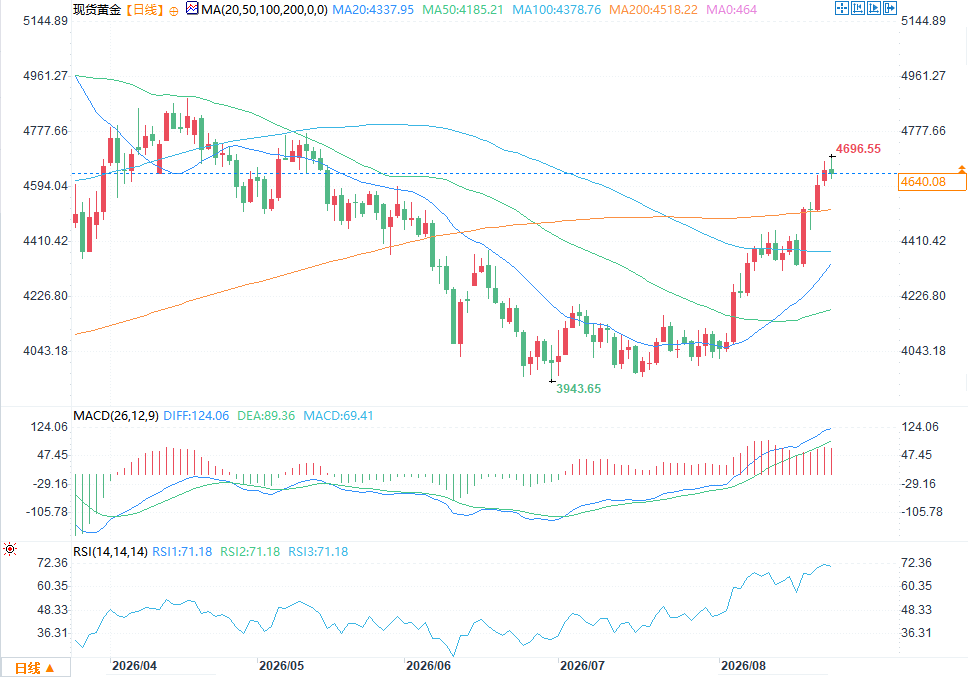 (Spot gold daily chart source: FX678) After this rapid rise in gold prices, orderly consolidation is healthier than another violent surge. During consolidation, investors and traders can adjust their positions at their own pace without being forced to chase the highs. Straight-line surges often lead to hasty trading and overcrowding of speculative positions; once the upward momentum fades, a deep correction is easily triggered. From a technical perspective, $4770 is a key resistance level, which is also the 50% retracement level of the January-June decline and the May high. Initial support is at the 200-day moving average, currently around $4519, with the next support level at $4410. What factors could undermine the bullish logic for gold? The current strong performance of gold is not without risk. If the US dollar continues to strengthen, it will directly weaken a major support for gold prices. Furthermore, if the Jackson Hole symposium releases more hawkish signals than the market expects, the market lowers its expectations for future Fed rate cuts, or concerns about US fiscal policy ease, all of these could trigger profit-taking after the surge. Easing geopolitical tensions will reduce safe-haven buying of gold. Furthermore, current speculative positions are already crowded, and even a slight shift in the macroeconomic environment could trigger a deep correction. From a technical perspective, if gold prices fail to hold the upward trend established by this breakout, especially if prices fall back below the 200-day moving average ($4519), the current upward momentum will be weakened.
This rebound was driven by multiple factors: technical momentum buying, coupled with renewed concerns about US fiscal and debt issues, geopolitical uncertainty, central bank gold purchases, and the potential for a further weakening of the US dollar. After this significant rise, the market is now consolidating, which is a healthy trend. The next major resistance level is at $4770; the 200-day moving average at around $4519 provides initial support. During the Asian trading session, spot gold surged to nearly $4700, hitting a three-month high; after rising by approximately $350 over four consecutive days, gold prices began to stabilize and fluctuate. Past market performance is not a reliable indicator of future market trends. Today's slight weakening in gold prices was mainly due to profit-taking after the previous surge, while the continued strengthening of the US dollar also exerted downward pressure. The US dollar had fallen sharply after the US Treasury announced its buyback program last week, but the dollar index has now recovered more than half of its losses. US Treasury Secretary Bessant stated that the US will seek to sever Iran's ties with the global financial system, which further boosted the dollar. This event highlights the central role of the US dollar in the global trade and financial system and reinforces its traditional safe-haven asset status. Investment demand for gold has surged significantly. So far this month, global gold ETF holdings have increased by approximately 60 tons, and August is expected to see the strongest monthly inflow since September of last year. Simultaneously, hedge funds have increased their net long positions in COMEX gold futures to an 11-month high; if "other reporting accounts" are included, the long position size reaches its highest level since January of this year. These two data points clearly demonstrate that the restart of upward momentum, the technical breakout, and heightened concerns about political, fiscal, and financial risks will quickly translate into demand for physical gold. The core drivers pushing traders and investors to increase their gold holdings have not disappeared and are expected to continue supporting gold prices in the coming months, including the sustainability of US fiscal policy and high debt risk, the possibility of a renewed weakening of the US dollar, continued gold purchases by central banks, and geopolitical uncertainties. However, the short-term market focus may shift to consolidation. The trend of US Treasury yields and the upcoming Jackson Hole global central bank symposium will indicate the future direction of gold prices. The Jackson Hole Economic Symposium will be held from August 27-29, with Chairman Warsh delivering his first keynote address since taking office on Friday, August 28. The theme of this year's symposium is "Financial Innovation: Implications for Payments and Policy." The market expects the speech to discuss the application of stablecoins in the financial system infrastructure; however, the market is more focused on the Federal Reserve's interest rate policy stance. (Spot gold daily chart source: FX678) After this rapid rise in gold prices, orderly consolidation is healthier than another violent surge. During consolidation, investors and traders can adjust their positions at their own pace without being forced to chase the highs. Straight-line surges often lead to hasty trading and overcrowding of speculative positions; once the upward momentum fades, a deep correction is easily triggered. From a technical perspective, $4770 is a key resistance level, which is also the 50% retracement level of the January-June decline and the May high. Initial support is at the 200-day moving average, currently around $4519, with the next support level at $4410. What factors could undermine the bullish logic for gold? The current strong performance of gold is not without risk. If the US dollar continues to strengthen, it will directly weaken a major support for gold prices. Furthermore, if the Jackson Hole symposium releases more hawkish signals than the market expects, the market lowers its expectations for future Fed rate cuts, or concerns about US fiscal policy ease, all of these could trigger profit-taking after the surge. Easing geopolitical tensions will reduce safe-haven buying of gold. Furthermore, current speculative positions are already crowded, and even a slight shift in the macroeconomic environment could trigger a deep correction. From a technical perspective, if gold prices fail to hold the upward trend established by this breakout, especially if prices fall back below the 200-day moving average ($4519), the current upward momentum will be weakened.
- Risk Warning and Disclaimer
- The market involves risk, and trading may not be suitable for all investors. This article is for reference only and does not constitute personal investment advice, nor does it take into account certain users’ specific investment objectives, financial situation, or other needs. Any investment decisions made based on this information are at your own risk.