Despite the implementation of heavy US sanctions against Iran, oil prices fell instead of rising.
2026-08-25 21:01:01
In recent articles, I have consistently and boldly predicted that oil prices would be difficult to rise, and indeed, oil prices have fallen. But are there any new driving factors behind this? Recently, the United States launched the largest financial sanctions in history against Iran, attempting to sever Iran's global trade links and end regional conflicts through comprehensive economic containment. After this round of sanctions took effect, oil prices actually came under pressure and fell in the short term. What concerns do investors have behind this? 
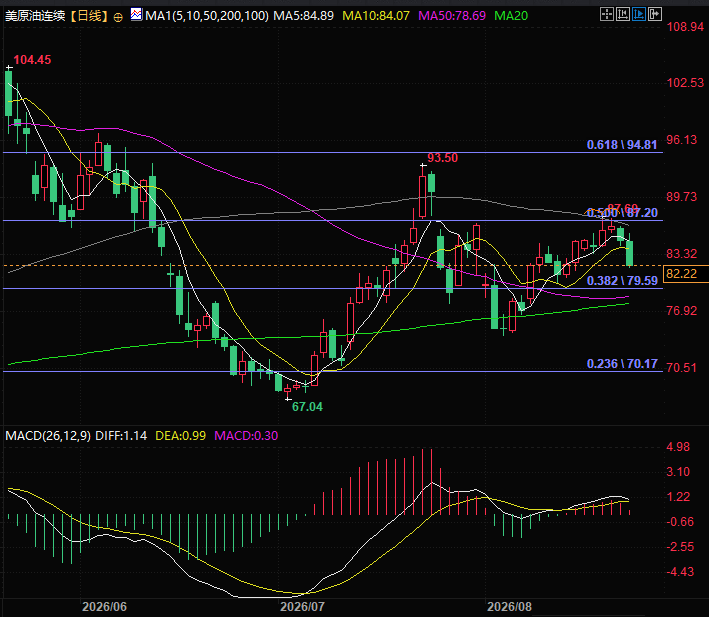 (WTI crude oil futures daily chart, source: EasyTrade) At 20:58 Beijing time, WTI crude oil futures were trading at $82.26 per barrel.
The United States imposed comprehensive sanctions on Iran, pressuring the world to sever cooperation.
This latest escalation of US sanctions against Iran goes beyond traditional list-based penalties, covering five core areas: digital assets, technology, gold, aviation, and shipping. It targets nearly 60 related entities, individuals, and vessels with precise sanctions, while simultaneously investigating Iranian oil smuggling and financial channels and networks used to circumvent sanctions. The US has issued a strong statement warning all countries, institutions, and companies engaged in trade and financial cooperation with Iran that failure to sever ties will result in their inclusion in the sanctions and isolation efforts. The US president will also personally contact world leaders to pressure them to end cooperation with Iran, aiming to completely cut off Iran's sources of revenue and oil income.Sanctions implemented, but why are oil prices under short-term pressure and falling?
Following the implementation of these significant sanctions, international oil prices did not continue their previous upward trend but instead experienced a short-term decline. The core reason for this limited effectiveness of the sanctions likely lies in the fact that Iran's key trading partners have not compromised. Iran's Ministry of Economy officially stated that the country is fully prepared and has a two-year contingency plan to address the impact of the sanctions. Both China and Russia do not recognize the unilateral sanctions imposed by the US and continue to maintain normal economic and trade cooperation with Iran. Data shows that approximately 90% of Iran's crude oil exports go to China. China has consistently refused to recognize the illegal unilateral sanctions imposed by the US and insists on conducting compliant energy trade, thus stabilizing the fundamentals of Iran's crude oil exports at this core point. Meanwhile, neighboring countries such as Pakistan, Turkey, and Iraq, due to their geo-economic interdependence, are also unable to completely sever their economic and trade ties with Iran, further weakening the actual power of the US sanctions. Only a few countries, such as the UAE, have announced the suspension of financial transactions with Iran, with limited overall impact. This widespread refusal to cooperate with the sanctions ultimately stabilized the fundamentals of Iran's crude oil exports.Iran's strong countermeasures and shipping risks in the Taiwan Strait are supporting oil prices.
Compared to short-term sanctions disruptions, Iran's strong countermeasures are the core risk anchor supporting high oil prices in the medium to long term. In response to the comprehensive economic encirclement by the US, Iran has repeatedly issued stern warnings that if the US-Iran conflict continues and sanctions escalate, it will completely cut off regional oil exports and block the Strait of Hormuz. As a vital global energy transport artery, the Strait of Hormuz carries one-fifth of the world's oil and gas trade. Since the outbreak of the US-Iran conflict at the end of February, the efficiency of this waterway has been significantly limited, continuously providing a risk premium for international oil prices. Currently, Iran's renewed ban on unlicensed vessels passing through the strait further exacerbates the uncertainty of the global crude oil supply chain.Geopolitical tensions continue to escalate, increasing global energy and inflationary pressures.
The ongoing US-Iran standoff has had a widespread impact on the global energy market and inflation. Geopolitical conflict coupled with ongoing sanctions has continuously pushed up global oil costs, leading to a significant year-on-year increase in refined oil prices worldwide. In the US, gasoline prices have surpassed $4 per gallon, and rising living costs have become a core issue in the US midterm elections. The US's previous bond buyback program to stabilize prices has only provided a short-term boost; long-term financing pressures and the risk of energy inflation remain. Therefore, rising oil prices are a major headache for the US Treasury, and they strongly oppose such price increases.Market Outlook: Short-term easing, medium- to long-term oil prices to fluctuate at high levels.
In the short term, support from major trading partners has prevented a precipitous decline in Iranian crude oil exports, and the market supply and demand situation remains temporarily stable. The severity of sanctions is likely to be less than expected, while profit-taking has led to a correction in oil prices. However, in the medium to long term, the unresolved US-Iran conflict, the high shipping risks in the Strait of Hormuz, the low elasticity of global crude oil supply, and the repeated disturbances from geopolitical conflicts will ensure that the risk premium for crude oil prices will persist, providing a clear safety net for any potential price correction. (WTI crude oil futures daily chart, source: EasyTrade) At 20:58 Beijing time, WTI crude oil futures were trading at $82.26 per barrel.
- Risk Warning and Disclaimer
- The market involves risk, and trading may not be suitable for all investors. This article is for reference only and does not constitute personal investment advice, nor does it take into account certain users’ specific investment objectives, financial situation, or other needs. Any investment decisions made based on this information are at your own risk.