Crude oil trading alert: Progress on the temporary shipping route through the Strait of Hormuz eases supply risk expectations and drives oil prices sharply lower.
2026-08-26 09:47:01
WTI crude oil continued its decline in Asian trading on Wednesday, with prices falling to around $80.10 per barrel, marking the third consecutive trading day of losses. The core reason for this price adjustment was not a sudden deterioration in demand expectations, but rather that the market is reassessing the shipping risks in the Strait of Hormuz, with the extreme scenario of supply disruptions showing marginal easing. Iran and Oman have recently begun discussions on establishing a temporary joint maritime passage, and their technical teams will continue consultations on long-term arrangements. The relevant mechanism may involve strait management, information sharing, vessel traffic control, and maritime security services.  The Strait of Hormuz is a crucial node in global energy transportation, and any sustained disruption to shipping could rapidly alter the global crude oil supply and demand balance. Therefore, even progress in discussions regarding establishing a temporary passage is being interpreted by the market as a sign of reduced supply risk. As shipping efficiency is expected to improve, premiums for crude oil transport insurance, vessel scheduling, and delivery risks are likely to gradually decrease, squeezing out some of the risk premiums previously accumulated in oil prices due to supply concerns. Simultaneously, regional diplomatic activities are accelerating. Senior Pakistani military officials recently visited Tehran to support existing diplomatic efforts; Qatar has also confirmed it is actively pursuing related mediation work. This multi-party communication has strengthened market expectations for a long-term return to stable shipping through the Strait of Hormuz. For crude oil, the impact of such changes in expectations often precedes the actual recovery of supply in futures prices. Expectations regarding US policy have also been a significant factor weighing on oil prices recently. Washington has recently intensified economic pressure on Iran, but the actual measures have fallen short of some market participants' expectations, particularly in terms of whether to expand secondary sanctions against related trading partners. The market has therefore reassessed the possibility of further compression of Iranian crude oil exports, leading to a decline in the previously high supply risk premium. However, the current drop in oil prices cannot be simply interpreted as a return to normal global crude oil supply. According to TD Securities, crude oil flows remain significantly restricted, and the refined product market continues to tighten, with no clear signs of easing on the supply side in the short term. This means that the current price decline reflects more of a decrease in the risk premium than a resurgence of fundamental oversupply. From the perspective of the global crude oil market, the real factor determining the next stage of WTI's direction remains the contest between the "actual speed of supply recovery" and "demand resilience." If the temporary passage through the Strait of Hormuz eventually establishes a stable operating mechanism and ship passage efficiency continues to recover, the premium accumulated due to transportation risks may further diminish, and WTI may continue to seek a new supply-demand balance at lower levels. Conversely, if technical negotiations stall or the maritime security situation deteriorates again, the market may quickly re-induce the risk of transportation disruptions, and oil prices may rebound rapidly. Currently, the market also needs to pay attention to changes in US crude oil inventories and refined product inventories. Previously, US commercial crude oil inventories had already fluctuated significantly, indicating that the domestic supply and demand relationship in the US was not entirely loose. If inventories continue to decline while refinery operating rates remain high, the actual resilience of demand may limit the decline in WTI crude oil prices; conversely, if crude oil inventories accumulate rapidly again, it means that supply pressure may regain dominance. Uncertainty also exists on the demand side. High oil prices have already suppressed fuel consumption in some regions, and while the current decline in WTI crude oil prices can alleviate energy cost pressures, it also reflects the market's assessment of a decrease in the future supply risk premium. Global economic growth, US manufacturing activity, and energy consumption in major Asian economies will continue to determine whether crude oil demand can maintain its resilience. It is worth noting that the current decline in oil prices is relatively mild, without the sharp collapse that would occur after the supply risk was eliminated. This indicates that the market does not fully believe that the shipping risk in the Strait of Hormuz has disappeared. The area around $80 remains a crucial psychological level for both bulls and bears; whether oil prices can effectively break through this level will directly affect the market's pricing of subsequent supply risks. If oil prices can stabilize around $80, the market may refocus on actual inventory and supply data. Tightening supply could push WTI to retest the $82-$84 area. If $80 is breached and prices close below that level for several consecutive days, the risk premium is likely to continue declining, and WTI may seek support in the $78 or even $75 area. From a longer-term perspective, the crude oil market is currently in a unique phase characterized by both high risk premiums and fundamental supply constraints. Any changes in shipping arrangements in the Strait of Hormuz could quickly alter price direction. Therefore, investors need to pay attention not only to diplomatic developments but also to whether actual ship traffic, crude oil exports, US inventories, and global refined product crack spreads improve in tandem. Only with a sustained recovery in actual supply can the downward trend in oil prices gain stronger fundamental confirmation. Looking at the daily chart, WTI has weakened for three consecutive trading days, with short-term highs gradually declining and prices approaching the $80 mark again, indicating that the previous upward momentum is clearly weakening. If $80 is decisively broken, bears may further test the support around $78, followed by the $75-$76 area. If significant buying pressure emerges around $80, it indicates the market still accepts the supply-side risk premium, and oil prices may rebound to around $82, further testing the previous resistance area of $84. The biggest variable in the current daily chart is whether $80 can form effective support, rather than whether it briefly breaks below it intraday. From a momentum perspective, the short-term upward structure of WTI has weakened, with continuous declines causing market sentiment to gradually shift from supply concerns to a contraction in the risk premium. However, as long as oil prices remain above the important medium-term moving average support area, it cannot be simply confirmed that the trend has completely turned bearish. If $82 can be recovered in the next few trading days, the current pullback may just be a technical correction after the rise; conversely, if prices continue to trade below $80, the daily bearish structure may be further strengthened. From the 4-hour chart, WTI currently shows a relatively obvious short-term weak structure, with prices constantly facing upward pressure during rebounds, and bearish momentum holding a certain advantage. $80 is the most important short-term watershed in the near term. If the 4-hour chart shows consecutive closes below $80, the downside potential may open up further, with the first target at $78, followed by the $76 area. If the $80 support holds and a significant volume rebound occurs, then $82 will become the first resistance level. Only after breaking through this level will there be a chance to move back towards the $84 or even $86 area. Currently, the 4-hour chart is more suitable for focusing on "whether $80 is breached and confirmation after the breakout," rather than chasing highs and lows before the release of key data and events.
 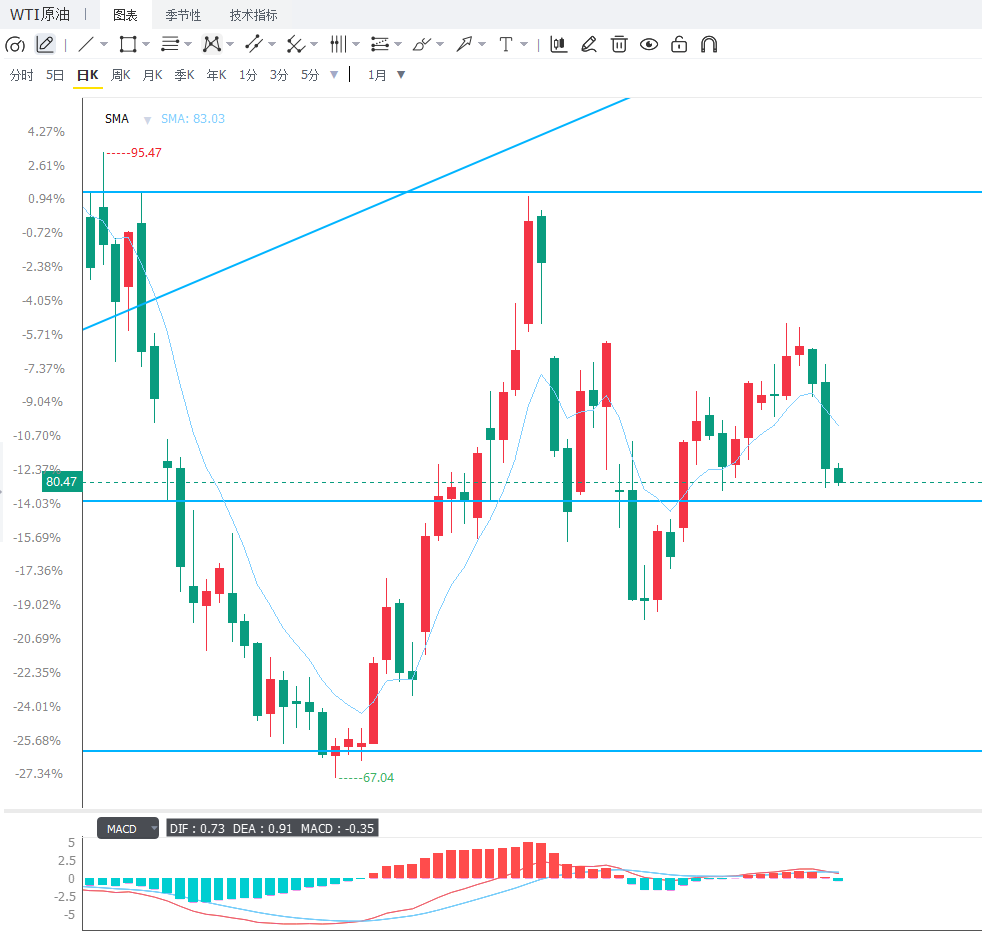 The editor summarizes that WTI crude oil fell for the third consecutive trading day to around $80, mainly reflecting the market's repricing of the risk of supply disruptions in the Strait of Hormuz. The progress of negotiations between Iran and Oman on a temporary joint shipping route, coupled with escalating regional diplomatic activity, has led the market to lower its pricing of extreme supply disruption scenarios. Meanwhile, the latest US economic measures against Iran, weaker than some market expectations, have also reduced concerns about further contraction in Iranian crude oil supply. However, the current price decline cannot yet be considered an end to the supply crisis. Actual crude oil flows remain constrained, and the refined product market continues to tighten, meaning that the supply side still has strong potential for a rebound. Therefore, WTI's future price movement is likely to revolve around $80, with bulls and bears battling it out. In the short term, if the shipping arrangements in the Strait of Hormuz continue to make substantial progress, and US inventories increase, WTI may find support at $78 and $75 after falling below $80. If actual supply recovery falls short of expectations, or shipping security risks escalate again, oil prices may regain a risk premium and rebound to $82-$84. Going forward, we should focus on the actual navigation situation in the Taiwan Strait, global crude oil flows, US inventories, and the tightness of the refined oil market. These indicators will be more indicative of the true direction of oil prices in the next stage than purely diplomatic news.
The Strait of Hormuz is a crucial node in global energy transportation, and any sustained disruption to shipping could rapidly alter the global crude oil supply and demand balance. Therefore, even progress in discussions regarding establishing a temporary passage is being interpreted by the market as a sign of reduced supply risk. As shipping efficiency is expected to improve, premiums for crude oil transport insurance, vessel scheduling, and delivery risks are likely to gradually decrease, squeezing out some of the risk premiums previously accumulated in oil prices due to supply concerns. Simultaneously, regional diplomatic activities are accelerating. Senior Pakistani military officials recently visited Tehran to support existing diplomatic efforts; Qatar has also confirmed it is actively pursuing related mediation work. This multi-party communication has strengthened market expectations for a long-term return to stable shipping through the Strait of Hormuz. For crude oil, the impact of such changes in expectations often precedes the actual recovery of supply in futures prices. Expectations regarding US policy have also been a significant factor weighing on oil prices recently. Washington has recently intensified economic pressure on Iran, but the actual measures have fallen short of some market participants' expectations, particularly in terms of whether to expand secondary sanctions against related trading partners. The market has therefore reassessed the possibility of further compression of Iranian crude oil exports, leading to a decline in the previously high supply risk premium. However, the current drop in oil prices cannot be simply interpreted as a return to normal global crude oil supply. According to TD Securities, crude oil flows remain significantly restricted, and the refined product market continues to tighten, with no clear signs of easing on the supply side in the short term. This means that the current price decline reflects more of a decrease in the risk premium than a resurgence of fundamental oversupply. From the perspective of the global crude oil market, the real factor determining the next stage of WTI's direction remains the contest between the "actual speed of supply recovery" and "demand resilience." If the temporary passage through the Strait of Hormuz eventually establishes a stable operating mechanism and ship passage efficiency continues to recover, the premium accumulated due to transportation risks may further diminish, and WTI may continue to seek a new supply-demand balance at lower levels. Conversely, if technical negotiations stall or the maritime security situation deteriorates again, the market may quickly re-induce the risk of transportation disruptions, and oil prices may rebound rapidly. Currently, the market also needs to pay attention to changes in US crude oil inventories and refined product inventories. Previously, US commercial crude oil inventories had already fluctuated significantly, indicating that the domestic supply and demand relationship in the US was not entirely loose. If inventories continue to decline while refinery operating rates remain high, the actual resilience of demand may limit the decline in WTI crude oil prices; conversely, if crude oil inventories accumulate rapidly again, it means that supply pressure may regain dominance. Uncertainty also exists on the demand side. High oil prices have already suppressed fuel consumption in some regions, and while the current decline in WTI crude oil prices can alleviate energy cost pressures, it also reflects the market's assessment of a decrease in the future supply risk premium. Global economic growth, US manufacturing activity, and energy consumption in major Asian economies will continue to determine whether crude oil demand can maintain its resilience. It is worth noting that the current decline in oil prices is relatively mild, without the sharp collapse that would occur after the supply risk was eliminated. This indicates that the market does not fully believe that the shipping risk in the Strait of Hormuz has disappeared. The area around $80 remains a crucial psychological level for both bulls and bears; whether oil prices can effectively break through this level will directly affect the market's pricing of subsequent supply risks. If oil prices can stabilize around $80, the market may refocus on actual inventory and supply data. Tightening supply could push WTI to retest the $82-$84 area. If $80 is breached and prices close below that level for several consecutive days, the risk premium is likely to continue declining, and WTI may seek support in the $78 or even $75 area. From a longer-term perspective, the crude oil market is currently in a unique phase characterized by both high risk premiums and fundamental supply constraints. Any changes in shipping arrangements in the Strait of Hormuz could quickly alter price direction. Therefore, investors need to pay attention not only to diplomatic developments but also to whether actual ship traffic, crude oil exports, US inventories, and global refined product crack spreads improve in tandem. Only with a sustained recovery in actual supply can the downward trend in oil prices gain stronger fundamental confirmation. Looking at the daily chart, WTI has weakened for three consecutive trading days, with short-term highs gradually declining and prices approaching the $80 mark again, indicating that the previous upward momentum is clearly weakening. If $80 is decisively broken, bears may further test the support around $78, followed by the $75-$76 area. If significant buying pressure emerges around $80, it indicates the market still accepts the supply-side risk premium, and oil prices may rebound to around $82, further testing the previous resistance area of $84. The biggest variable in the current daily chart is whether $80 can form effective support, rather than whether it briefly breaks below it intraday. From a momentum perspective, the short-term upward structure of WTI has weakened, with continuous declines causing market sentiment to gradually shift from supply concerns to a contraction in the risk premium. However, as long as oil prices remain above the important medium-term moving average support area, it cannot be simply confirmed that the trend has completely turned bearish. If $82 can be recovered in the next few trading days, the current pullback may just be a technical correction after the rise; conversely, if prices continue to trade below $80, the daily bearish structure may be further strengthened. From the 4-hour chart, WTI currently shows a relatively obvious short-term weak structure, with prices constantly facing upward pressure during rebounds, and bearish momentum holding a certain advantage. $80 is the most important short-term watershed in the near term. If the 4-hour chart shows consecutive closes below $80, the downside potential may open up further, with the first target at $78, followed by the $76 area. If the $80 support holds and a significant volume rebound occurs, then $82 will become the first resistance level. Only after breaking through this level will there be a chance to move back towards the $84 or even $86 area. Currently, the 4-hour chart is more suitable for focusing on "whether $80 is breached and confirmation after the breakout," rather than chasing highs and lows before the release of key data and events. The editor summarizes that WTI crude oil fell for the third consecutive trading day to around $80, mainly reflecting the market's repricing of the risk of supply disruptions in the Strait of Hormuz. The progress of negotiations between Iran and Oman on a temporary joint shipping route, coupled with escalating regional diplomatic activity, has led the market to lower its pricing of extreme supply disruption scenarios. Meanwhile, the latest US economic measures against Iran, weaker than some market expectations, have also reduced concerns about further contraction in Iranian crude oil supply. However, the current price decline cannot yet be considered an end to the supply crisis. Actual crude oil flows remain constrained, and the refined product market continues to tighten, meaning that the supply side still has strong potential for a rebound. Therefore, WTI's future price movement is likely to revolve around $80, with bulls and bears battling it out. In the short term, if the shipping arrangements in the Strait of Hormuz continue to make substantial progress, and US inventories increase, WTI may find support at $78 and $75 after falling below $80. If actual supply recovery falls short of expectations, or shipping security risks escalate again, oil prices may regain a risk premium and rebound to $82-$84. Going forward, we should focus on the actual navigation situation in the Taiwan Strait, global crude oil flows, US inventories, and the tightness of the refined oil market. These indicators will be more indicative of the true direction of oil prices in the next stage than purely diplomatic news.
- Risk Warning and Disclaimer
- The market involves risk, and trading may not be suitable for all investors. This article is for reference only and does not constitute personal investment advice, nor does it take into account certain users’ specific investment objectives, financial situation, or other needs. Any investment decisions made based on this information are at your own risk.