Is there a turning point in the US-Iran stalemate? Iran and the UAE jointly open a temporary shipping route, the US sends personnel back to the Middle East, and oil prices plummet to a near two-week low.
2026-08-26 09:51:00
As the military standoff in the Strait of Hormuz showed subtle signs of easing, US President Trump declared on Tuesday that all mines in the strategic waterway's international waters had been cleared or detonated, while the State Department began redeploying personnel to some diplomatic missions in the Middle East. This series of actions marks a limited de-escalation of US-Iran tensions since February, but a diplomatic solution remains stalled. On Tuesday (August 25), Brent crude futures closed down $3.59, or 3.9%, settling at $88.58 per barrel, a new low since August 14. US crude futures fell $2.65, or 3.1%, settling at $82.36 per barrel, a new low since August 13. On Wednesday (August 26) in early Asian trading, international oil prices continued their decline, with US crude falling as much as 2.46% to $80.33 per barrel and Brent crude falling as much as 1.89% to $85.14 per barrel, both hitting near two-week lows. 
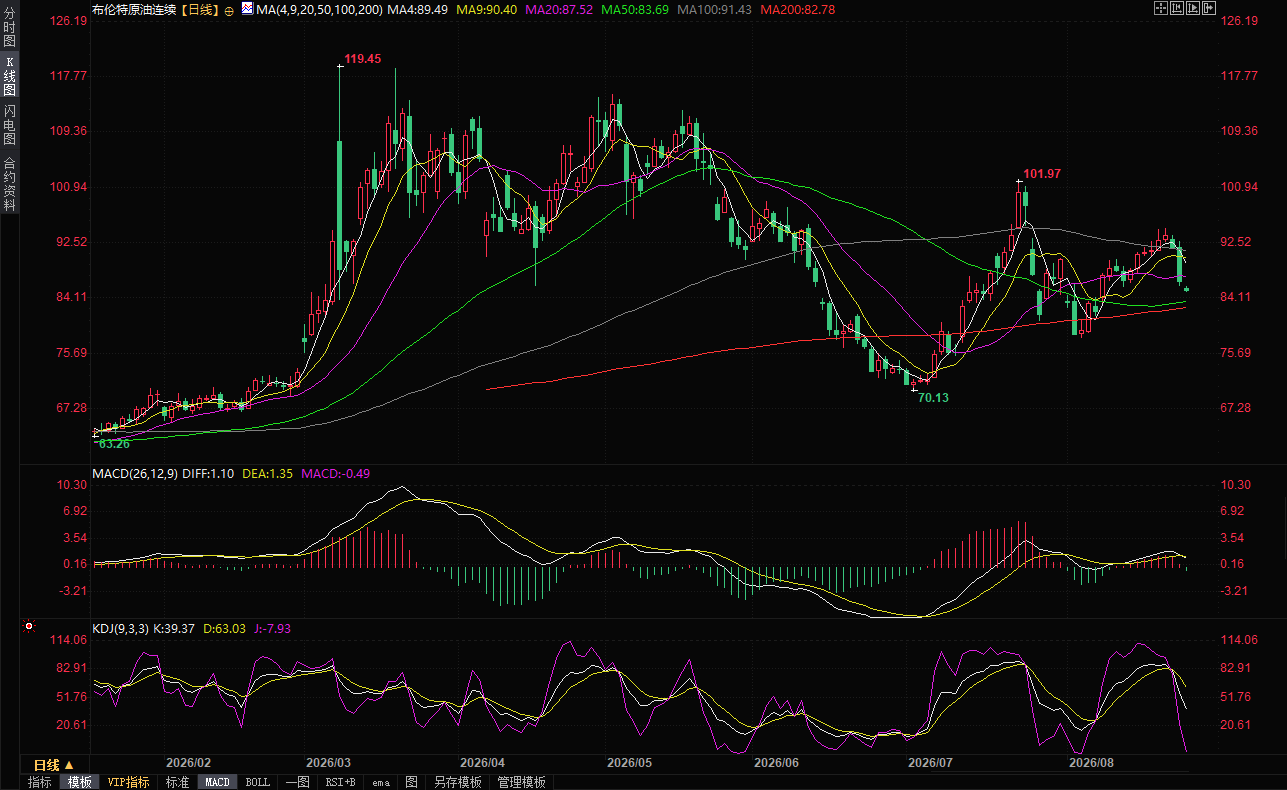 (Brent crude oil daily chart, source: EasyForex)
Mine Clearance and Temporary Navigation Channel Initiative
In a statement on Tuesday, Trump said all mines in the international waters of the Strait of Hormuz had been cleared and warned Iran against redeploying them, or any ships that did so would be destroyed. This statement echoes the previous agreement reached between Iran and Oman for joint action. Iran confirmed that it had resumed consultations with neighboring Oman, discussing the establishment of a "joint temporary passage" through the Strait of Hormuz and agreeing to cooperate in clearing mines from the strait. For weeks, Iran and Oman have held intermittent negotiations on the management of shipping through this most sensitive global energy artery. The Strait of Hormuz handles about one-third of the world's seaborne oil trade; any obstruction to its passage would directly impact international energy supplies.The return of diplomatic personnel to their posts sends a signal
According to two sources familiar with the matter, the United States has initiated the process of repatriating personnel to some of its Middle Eastern diplomatic missions. This repatriation involves diplomatic missions in Lebanon, Israel, Saudi Arabia, and Baghdad, Iraq. Families who were previously evacuated have also been allowed to return to the U.S. mission in Riyadh, Saudi Arabia. Sources said that some embassies will initially operate at no more than 85% of their authorized staffing levels, with adjustments made gradually depending on the security situation. The New York Times reported that U.S. embassies in Jordan, Oman, Kuwait, and Qatar are also expected to increase staffing levels. According to the plan, the embassies in Israel, Jordan, and Oman will eventually return to full capacity; diplomatic missions in the UAE, Saudi Arabia, Qatar, and Lebanon will initially be limited to 85% staffing; and those in Iraq, Kuwait, and Bahrain will be limited to 75%. A State Department spokesperson stated via email that the State Department continuously assesses the security situation at diplomatic missions around the world, and personnel decisions depend on the evolving security environment. Ensuring the safety of diplomats and their families remains a top priority. This round of staff reductions began in February of this year, when Washington authorized the voluntary evacuation of non-essential staff and their families from the mission in Israel due to tensions with Iran. U.S. Secretary of State Marco Rubio recently informed several allied foreign ministers that the United States will not launch a new round of military strikes against Iran "for the time being," and will instead resort to other pressure tactics. This contrasts with the Trump administration's previous threats of "massive bombing" of Iran, further confirming that the U.S. currently prefers to control the intensity of the conflict.Tanker attacks and lingering navigational risks
Despite signs of easing diplomatic tensions, the actual safety of navigation through the Strait of Hormuz remains a serious concern. The UK Maritime Trade Operations Office (UKMTO) reported on Tuesday that an oil tanker was struck by an unidentified projectile approximately 9 nautical miles (17 kilometers) northeast of Ashhisha, Oman, rendering it unable to navigate. The incident occurred near the entrance to the Strait of Hormuz. This incident highlights the substantial threat that commercial shipping through this waterway remains under threat even after the temporary easing of open hostilities between the US and Iran.Iran's propaganda war and sanctions struggle overlap
While the military standoff has cooled, the media battle and the economic sanctions contest continue to escalate. The U.S. Secret Service stated on Tuesday that it was aware of a three-minute video broadcast on Iranian state television discussing a potential assassination plot against Barron Trump, son of U.S. President Donald Trump. The video claimed the 20-year-old was being monitored and alleged a $10 million bounty on his life. This news adds a new element of unpredictability to the tense relationship. In the economic sphere, the U.S. earlier this week threatened to punish countries that continue to do business with Iran, further weakening the Iranian economy, but stated it would not immediately implement sanctions. Iran condemned the U.S. approach of isolating its economy as "blatantly illegal" and expressed confidence that most countries would not join this pressure campaign. Notably, international oil prices fell for the second consecutive day following the latest U.S. sanctions threat, indicating that traders have not factored the impact of U.S. sanctions into short-term pricing.Editor's Summary
The statement on mine clearance in the Strait of Hormuz and consultations on a temporary navigation route, coupled with the return of US diplomats to their posts and Rubio's statement suspending a new round of military strikes, signal a temporary easing of the US-Iran standoff. However, the tanker attack and the video of assassination discussions broadcast by Iranian state media remind all parties that the risks to navigation safety in the Strait and hostage-style political games have not been eradicated. While the US maintains its sanctions pressure framework as its personnel return to their posts, Iran continues its public relations counterattack against the US while seeking cooperation on navigation management. Both sides retain leverage for future escalation amid limited de-escalation. International oil prices have reacted mildly to the threat of sanctions, reflecting the market's continued wait-and-see attitude towards the future direction of the US-Iran conflict. The focus now lies in whether the temporary navigation agreement brokered by Oman can be implemented, and whether the conciliatory signals from the returning US diplomats can translate into broader diplomatic engagement. (Brent crude oil daily chart, source: EasyForex)Frequently Asked Questions
Q: How does the temporary navigation channel in the Strait of Hormuz differ from the existing one? What are the main considerations behind Iran and Oman's push for this initiative? A: The temporary navigation channel refers to an alternative route agreed upon by Iran and Oman, separate from the existing routes in the Strait of Hormuz. Its aim is to reduce the risk of targeted attacks on ships in fixed routes. Iran and Oman's push for this initiative reflects Tehran's real need to maintain order in the strait and avoid escalating military conflict under the current heavy pressure of sanctions; while Oman, as a long-time mediator between the US and Iran, provides an informal communication channel for both sides. Q: Does the return of US personnel to Middle Eastern diplomatic missions signify a fundamental shift in the assessment of the Iranian threat? A: The return of personnel signals Washington's assessment that the risk of short-term escalation has decreased, but it does not represent a fundamental shift. Initially keeping some embassy staff at 75% to 85% indicates that the US still maintains a security redundancy. The personnel evacuation in February was a preventative measure; the current return is closer to a normalization adjustment after a lowered risk threshold, rather than a policy shift. Q: Does the fact that an oil tanker was hit by an unidentified projectile at the entrance to the Strait of Hormuz mean that the mine clearance statement lacks practical effectiveness? A: The two incidents are different in nature. Mines are pre-laid, large-area blockade weapons that require systematic mine-clearing operations; while the oil tanker being hit by a projectile is more likely a tactical attack launched by a speedboat or unmanned surface vessel, which is both accidental and targeted. Mine clearance reduces the risk of large-scale waterway blockage, but harassment tactics targeting specific merchant ships are still difficult to completely eliminate. Q: What is the intention behind the timing of the Iranian state television broadcasting a video discussing an assassination plot against Trump's son? A: The timing of this video's broadcast coincides with signs of limited easing in US-Iranian diplomatic contacts. Its intention may be to send a signal to the US that "Iran possesses asymmetric retaliatory means," thereby offsetting the domestic political pressure brought about by diplomatic concessions. The US Secret Service has publicly confirmed that it is aware of the matter, meaning that the video has been included in the US intelligence and security assessment system, but at this stage it should not be over-interpreted as a direct trigger for a policy shift. Q: Why have international oil prices continued to fall after the US increased its sanctions threats? A: The decline in oil prices reflects the market's current assessment of the trajectory of the US-Iran conflict. Firstly, Rubio's statement suspending a new round of military strikes reduced the geopolitical risk premium; secondly, the market has become somewhat accustomed to the pattern of "sanctions threats without immediate implementation," viewing such statements more as tools for negotiating pressure; thirdly, weak global macroeconomic expectations are suppressing demand. Overall, traders believe that current sanctions are insufficient to cause significant supply disruptions in the short term. At 09:45 Beijing time, Brent crude oil was trading at $85.37 per barrel.- Risk Warning and Disclaimer
- The market involves risk, and trading may not be suitable for all investors. This article is for reference only and does not constitute personal investment advice, nor does it take into account certain users’ specific investment objectives, financial situation, or other needs. Any investment decisions made based on this information are at your own risk.