With the US PCE data approaching and US Treasury yields declining, the USD/CAD pair is maintaining a slight range, awaiting a directional move.
2026-08-26 10:03:00
The USD/CAD pair edged higher in early Asian trading on Wednesday, with the spot price holding near 1.3850, but remaining within the previous trading range. The market currently lacks clear direction, with investors focusing on the US Personal Consumption Expenditures (PCE) price index data. As one of the key inflation indicators monitored by the Federal Reserve, the PCE could be a significant catalyst for repricing US interest rate expectations and determine whether the USD/CAD can continue its recent rebound from the lows near 1.3730.  Recent US inflation data has shown signs of cooling, significantly reducing market expectations for further tightening by the Federal Reserve in the short term. The market now leans more towards believing that the Fed will maintain interest rates at its September 15-16 policy meeting rather than immediately taking further rate hikes. This shift in US interest rate expectations from hawkish to wait-and-see is one of the key reasons for the recent pressure on the US dollar. If the upcoming PCE data continues to show easing inflationary pressures, the dollar may further lose its interest rate advantage, limiting the upside potential of USD/CAD. Changes in the US bond market further reinforce this logic. The US Treasury previously announced an expansion of its long-term Treasury repurchase program, and the market has recently begun discussing the possibility that the Treasury may use nearly $1 trillion in fiscal account funds to partially support the increased long-term Treasury repurchases. As the market reassesses the supply and demand relationship for long-term Treasury bonds, US Treasury yields have further declined, thus affecting the interest rate attractiveness of dollar assets. This factor is particularly important for USD/CAD, as the dollar has not recently established a sustained interest rate advantage. As long as US long-term yields continue to decline, it will be difficult for dollar bulls to establish a stable trend. In this context, even if the USD/CAD pair experiences a short-term rebound, it is more likely to be a technical correction rather than a trend reversal. Energy prices are also a significant variable affecting exchange rates. Recently, market expectations for a diplomatic easing of tensions between the US and Iran have strengthened, increasing the likelihood of the Strait of Hormuz reopening and pushing down oil risk premiums, with WTI oil prices falling to recent lows. For Canada, crude oil is a major export commodity; generally, rising oil prices benefit the Canadian dollar, while falling prices weaken its commodity currency support. However, the Canadian dollar is not currently driven solely by oil prices. The escalating tariff friction between the US and Canada continues to put pressure on Canada's economic and trade prospects. Canada recently announced new tariffs on some US goods in response to the previous 50% tariffs imposed by the US on approximately $20 billion worth of Canadian goods. Further expansion of tariffs between the two sides could increase pressure on Canadian economic growth and reduce market confidence that the Bank of Canada will maintain high interest rates. Therefore, the USD/CAD pair currently faces a complex fundamental combination: weakening US interest rate expectations are suppressing the US dollar, while Canadian trade risks and falling oil prices are limiting the Canadian dollar's appreciation potential. This offsetting force explains why the exchange rate hasn't formed a clear one-sided trend recently. From the US dollar's perspective, the market is currently awaiting PCE data to provide a new direction. If core PCE is lower than market expectations, it means US inflation is cooling further, increasing the probability that the Fed will maintain interest rates, while US Treasury yields may continue to decline, potentially causing USD/CAD to retest recent lows around 1.38 or even 1.3730. Conversely, if core inflation is significantly higher than expected, the market may re-increase expectations for US interest rates to remain high or even tighten further, potentially leading to a simultaneous rebound in US Treasury yields and the US dollar. In this scenario, USD/CAD may regain upward momentum and challenge 1.39 and higher levels. However, even with strong PCE data, the upside for USD/CAD will be somewhat limited. On the one hand, the market has already experienced a significant repricing of the US dollar; on the other hand, if diplomatic progress between the US and Iran continues to improve and energy prices further decline, while this would weaken the commodity currency support for the Canadian dollar, it could also reduce the risk of US inflation, thereby limiting the Fed's room for further hawkish policy shifts. From a daily chart perspective, USD/CAD previously rebounded from a three-month low near 1.3730, but the rebound has been limited, and the price remains under pressure from the medium-term downtrend structure. The first support level to watch is the psychological level of 1.3800. If this level is breached, the exchange rate may retest the recent low near 1.3730; a further break below this level could see the bears target the area around 1.3650. On the upside, the key area to watch is 1.3900-1.3920, which is not only a significant resistance level near the psychological level but also the location of the 100-period moving average on the 4-hour chart. Only a decisive break and hold above this level could allow the recent rebound to gradually evolve into a stronger corrective move. From a technical momentum perspective, USD/CAD is currently in a rebound phase after a period of weakness, and the price has not yet formed a clear high-point structure, so a trend reversal cannot be confirmed prematurely. If the PCE is lower than expected and pushes the US dollar weaker, the exchange rate may seek support below 1.38 again; if the data is significantly stronger, a break above 1.3920 will be an important signal for the bulls to further expand their gains. From the 4-hour chart, USD/CAD maintains a bearish short-term technical tone, with the current price still trading below the 100-period simple moving average around 1.3912. This moving average is currently the most important dynamic resistance level, and the market may still regard it as a selling area after the rebound until the exchange rate breaks through effectively. If the price encounters resistance again near 1.3912 and falls below 1.3800, the short-term bears may regain control and move further towards 1.3730. Conversely, if the PCE data is unexpectedly strong and pushes the exchange rate above 1.3912, the short-term technical structure will improve, and the resistance levels around 1.3950 and 1.4000 should be monitored. Therefore, 1.3912 is not only a technical resistance level but also a crucial watershed for determining whether the short-term trend of USD/CAD can shift from weak to strong.
 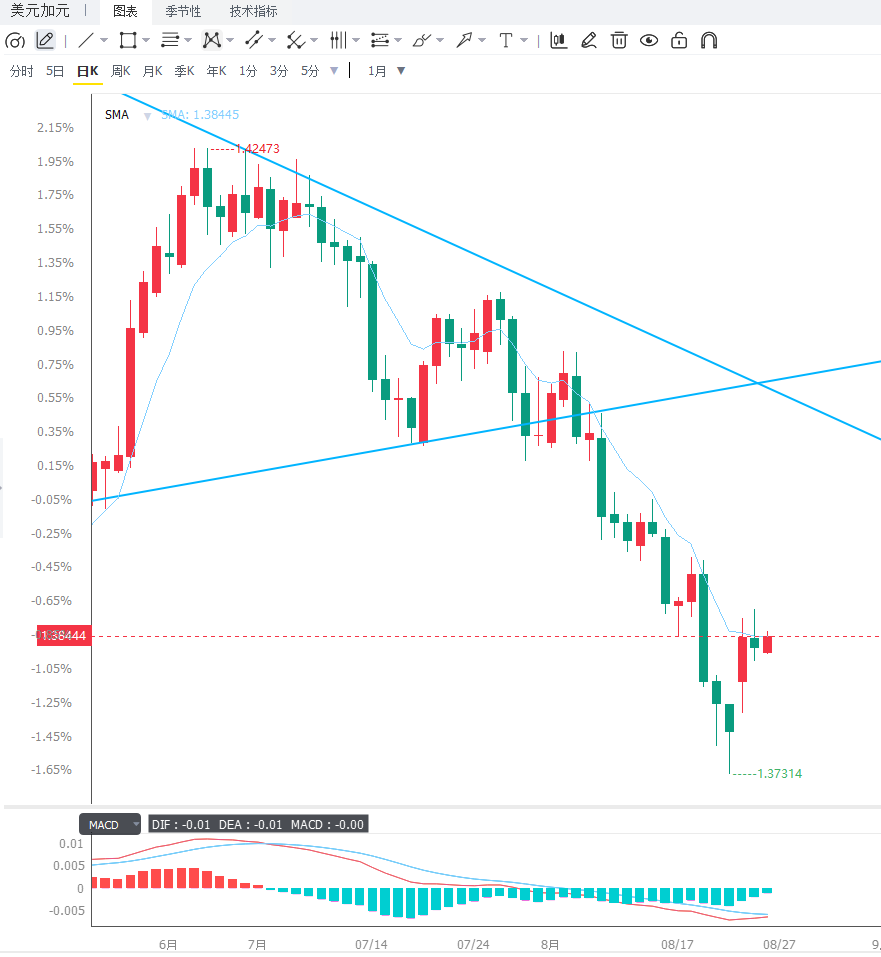 Editor's Summary: The USD/CAD pair is currently in a clear tug-of-war between fundamentals. Cooling US inflation, declining US Treasury yields, and weakened expectations of a near-term Fed rate hike are putting pressure on the US dollar; meanwhile, falling oil prices and escalating tariff tensions between the US and Canada are weakening the Canadian dollar's fundamental advantages. In the short term, US PCE data will be the core variable determining the next direction of the exchange rate. If inflation continues to cool, USD/CAD may retest the lows around 1.3730; if the data shows renewed inflation stickiness, the US dollar may receive support from interest rate expectations, and the exchange rate could rebound towards the 1.3910-1.3920 area. From a medium-term perspective, 1.3730 and 1.3912 constitute the most important range between bulls and bears. A downward break would further confirm the weak structure of USD/CAD, while a sustained move above 1.3912 would suggest that the previous downtrend may be entering a phase of correction. Going forward, in addition to monitoring the PCE, it is also important to observe US Treasury yields, WTI oil prices, and changes in US-Canada tariff policies, as the interplay of these three factors will determine the strength difference between the US dollar and the Canadian dollar.
Recent US inflation data has shown signs of cooling, significantly reducing market expectations for further tightening by the Federal Reserve in the short term. The market now leans more towards believing that the Fed will maintain interest rates at its September 15-16 policy meeting rather than immediately taking further rate hikes. This shift in US interest rate expectations from hawkish to wait-and-see is one of the key reasons for the recent pressure on the US dollar. If the upcoming PCE data continues to show easing inflationary pressures, the dollar may further lose its interest rate advantage, limiting the upside potential of USD/CAD. Changes in the US bond market further reinforce this logic. The US Treasury previously announced an expansion of its long-term Treasury repurchase program, and the market has recently begun discussing the possibility that the Treasury may use nearly $1 trillion in fiscal account funds to partially support the increased long-term Treasury repurchases. As the market reassesses the supply and demand relationship for long-term Treasury bonds, US Treasury yields have further declined, thus affecting the interest rate attractiveness of dollar assets. This factor is particularly important for USD/CAD, as the dollar has not recently established a sustained interest rate advantage. As long as US long-term yields continue to decline, it will be difficult for dollar bulls to establish a stable trend. In this context, even if the USD/CAD pair experiences a short-term rebound, it is more likely to be a technical correction rather than a trend reversal. Energy prices are also a significant variable affecting exchange rates. Recently, market expectations for a diplomatic easing of tensions between the US and Iran have strengthened, increasing the likelihood of the Strait of Hormuz reopening and pushing down oil risk premiums, with WTI oil prices falling to recent lows. For Canada, crude oil is a major export commodity; generally, rising oil prices benefit the Canadian dollar, while falling prices weaken its commodity currency support. However, the Canadian dollar is not currently driven solely by oil prices. The escalating tariff friction between the US and Canada continues to put pressure on Canada's economic and trade prospects. Canada recently announced new tariffs on some US goods in response to the previous 50% tariffs imposed by the US on approximately $20 billion worth of Canadian goods. Further expansion of tariffs between the two sides could increase pressure on Canadian economic growth and reduce market confidence that the Bank of Canada will maintain high interest rates. Therefore, the USD/CAD pair currently faces a complex fundamental combination: weakening US interest rate expectations are suppressing the US dollar, while Canadian trade risks and falling oil prices are limiting the Canadian dollar's appreciation potential. This offsetting force explains why the exchange rate hasn't formed a clear one-sided trend recently. From the US dollar's perspective, the market is currently awaiting PCE data to provide a new direction. If core PCE is lower than market expectations, it means US inflation is cooling further, increasing the probability that the Fed will maintain interest rates, while US Treasury yields may continue to decline, potentially causing USD/CAD to retest recent lows around 1.38 or even 1.3730. Conversely, if core inflation is significantly higher than expected, the market may re-increase expectations for US interest rates to remain high or even tighten further, potentially leading to a simultaneous rebound in US Treasury yields and the US dollar. In this scenario, USD/CAD may regain upward momentum and challenge 1.39 and higher levels. However, even with strong PCE data, the upside for USD/CAD will be somewhat limited. On the one hand, the market has already experienced a significant repricing of the US dollar; on the other hand, if diplomatic progress between the US and Iran continues to improve and energy prices further decline, while this would weaken the commodity currency support for the Canadian dollar, it could also reduce the risk of US inflation, thereby limiting the Fed's room for further hawkish policy shifts. From a daily chart perspective, USD/CAD previously rebounded from a three-month low near 1.3730, but the rebound has been limited, and the price remains under pressure from the medium-term downtrend structure. The first support level to watch is the psychological level of 1.3800. If this level is breached, the exchange rate may retest the recent low near 1.3730; a further break below this level could see the bears target the area around 1.3650. On the upside, the key area to watch is 1.3900-1.3920, which is not only a significant resistance level near the psychological level but also the location of the 100-period moving average on the 4-hour chart. Only a decisive break and hold above this level could allow the recent rebound to gradually evolve into a stronger corrective move. From a technical momentum perspective, USD/CAD is currently in a rebound phase after a period of weakness, and the price has not yet formed a clear high-point structure, so a trend reversal cannot be confirmed prematurely. If the PCE is lower than expected and pushes the US dollar weaker, the exchange rate may seek support below 1.38 again; if the data is significantly stronger, a break above 1.3920 will be an important signal for the bulls to further expand their gains. From the 4-hour chart, USD/CAD maintains a bearish short-term technical tone, with the current price still trading below the 100-period simple moving average around 1.3912. This moving average is currently the most important dynamic resistance level, and the market may still regard it as a selling area after the rebound until the exchange rate breaks through effectively. If the price encounters resistance again near 1.3912 and falls below 1.3800, the short-term bears may regain control and move further towards 1.3730. Conversely, if the PCE data is unexpectedly strong and pushes the exchange rate above 1.3912, the short-term technical structure will improve, and the resistance levels around 1.3950 and 1.4000 should be monitored. Therefore, 1.3912 is not only a technical resistance level but also a crucial watershed for determining whether the short-term trend of USD/CAD can shift from weak to strong. Editor's Summary: The USD/CAD pair is currently in a clear tug-of-war between fundamentals. Cooling US inflation, declining US Treasury yields, and weakened expectations of a near-term Fed rate hike are putting pressure on the US dollar; meanwhile, falling oil prices and escalating tariff tensions between the US and Canada are weakening the Canadian dollar's fundamental advantages. In the short term, US PCE data will be the core variable determining the next direction of the exchange rate. If inflation continues to cool, USD/CAD may retest the lows around 1.3730; if the data shows renewed inflation stickiness, the US dollar may receive support from interest rate expectations, and the exchange rate could rebound towards the 1.3910-1.3920 area. From a medium-term perspective, 1.3730 and 1.3912 constitute the most important range between bulls and bears. A downward break would further confirm the weak structure of USD/CAD, while a sustained move above 1.3912 would suggest that the previous downtrend may be entering a phase of correction. Going forward, in addition to monitoring the PCE, it is also important to observe US Treasury yields, WTI oil prices, and changes in US-Canada tariff policies, as the interplay of these three factors will determine the strength difference between the US dollar and the Canadian dollar.
- Risk Warning and Disclaimer
- The market involves risk, and trading may not be suitable for all investors. This article is for reference only and does not constitute personal investment advice, nor does it take into account certain users’ specific investment objectives, financial situation, or other needs. Any investment decisions made based on this information are at your own risk.