US and Canada impose tariffs on each other! Abnormal market movements expose the most intractable hidden inflation in the US.
2026-08-26 17:57:00
In late August 2026, the protracted trade negotiations between the US and Canada broke down, and the two countries launched large-scale bilateral tariffs, abruptly cooling the once closest bilateral economic and trade relations in the world. Unlike the single market reaction to conventional trade frictions, this round of US-Canada tariff games has shown multiple divergences: the US dollar index remained flat, the Canadian dollar plummeted against the trend, oil prices fell but US Treasury yields rose. Through subtle differences in asset prices, the market is pricing in the implicit inflationary pressure on the US domestic market brought about by the tariff war. 
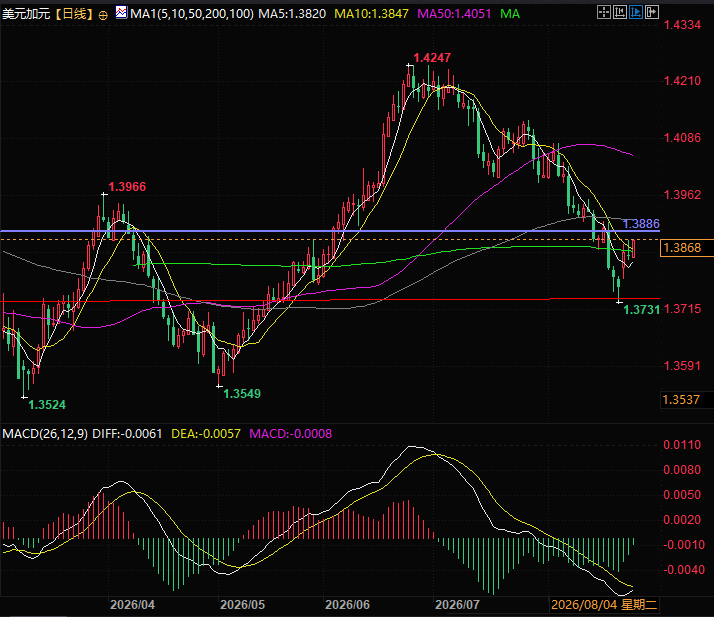 (USD/CAD daily chart, source: EasyForex)
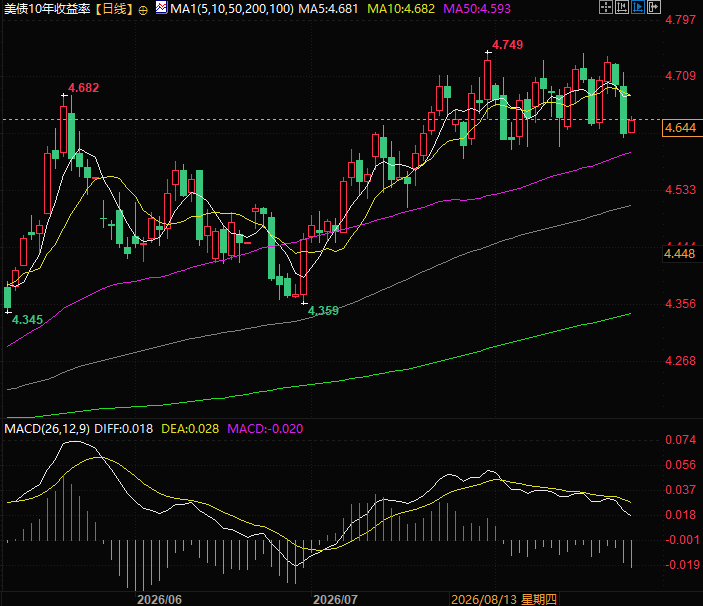 (Daily chart of 10-year US Treasury yield, source: EasyTrade)
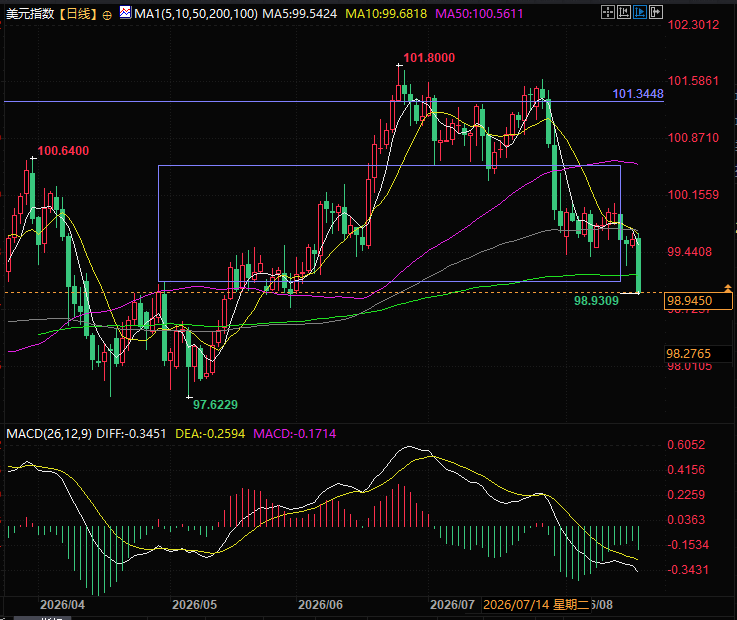 (US Dollar Index Daily Chart, Source: EasyTrade) At 17:52 Beijing time, the US Dollar Index is currently at 98.96.
The implementation of bilateral tariff sanctions between the US and Canada highlights the targeted nature of this strategic game.
This round of trade conflict was initiated by the US. After trade negotiations collapsed, the US imposed new tariffs on $20 billion worth of Canadian goods over the weekend, covering core industrial and infrastructure categories such as hockey equipment, cement, paper products, and chemical raw materials, focusing on Canada's advantageous industries and major exports to the US. The White House publicly accused Canada of long-term "profiteering from US trade," stating that the US had granted Canada the best market access globally and significantly reduced tariffs on core categories such as steel, aluminum, automobiles, and timber, but Canada repeatedly made unreasonable demands and overturned the consensus reached in negotiations, ultimately leading to the breakdown of talks. Trump even publicly criticized Canada as the most difficult trading partner to communicate with, and even threatened to rename Lake Ontario (where the US-Canada border is located) to "Lake America," escalating bilateral tensions. In response to the US sanctions, Canada quickly introduced reciprocal and more strategic retaliatory measures, announcing that starting September 8, it would impose retaliatory tariffs of up to 50% on approximately 700 US goods, also covering $20 billion worth of US-made goods, accounting for 7% of Canada's total imports from the US. This round of tariffs precisely targets key swing states and Republican strongholds in the November US midterm elections, including processed cheese in Wisconsin, seafood in Maine, and household appliances in Kentucky—products relevant to daily life and industry. Notably, tariffs on US steel and aluminum products, previously at 25%, have been doubled to 50%, directly impacting traditional US industries. This game is not simply a reciprocal tariff increase, but a precise application of both political and economic pressure. Most of the goods targeted by Canada can be replaced by domestic production or imports from China and Mexico, limiting the impact on its own supply chain while precisely targeting the economies of US electoral districts, forcing the Trump administration to compromise. Simultaneously, a "good cop, bad cop" dynamic has emerged within Canadian politics: Prime Minister Carney maintains a rational negotiating stance, clearly stating that dialogue can be restarted, but firmly rejecting the US's stance of treating Canada as a "subordinate economy" and suppressing Canada's core automotive, steel, and aluminum industries; while Ontario Premier Ford takes a hard line, publicly criticizing Trump and sending an extremely tough signal. Although his tone has softened somewhat since then, he remains steadfast in his opposition to trade agreements detrimental to Canada, becoming a key force in Canada's assertive foreign policy.Rare currency divergence: The US dollar index did not rise, while USD/CAD strengthened significantly.
This round of trade war has given rise to a highly representative exchange rate divergence, breaking the conventional pricing logic of the US dollar. In normal market conditions, the rise and fall of the USD/CAD exchange rate usually fluctuates in tandem with the US dollar index. However, the current market shows a clear divergence: the global US dollar index has not risen significantly, and there is no logic for a broad-based strengthening of the US dollar; yet, the USD/CAD exchange rate has risen sharply, and the Canadian dollar has continued to depreciate deeply. The core root cause of this divergence is not the strength of the US dollar, but the extreme deterioration of Canada's economic fundamentals. As the US's second-largest trading partner (after Mexico), the Canadian economy is highly dependent on trade with the US. The impact of this round of bilateral tariffs on Canada is far greater than on the US. Institutional estimates suggest that Canada's retaliatory tariffs will directly push up its domestic inflation by 0.2 percentage points. Currently, Canada's inflation is already at a high level of 3%, coupled with rising energy prices and the risk of economic slowdown caused by the trade conflict, leading to a sharp increase in stagflation pressure on the Canadian economy. More importantly, tariffs are essentially a hidden tax on domestic consumers. Whether it's tariffs on imported US goods or the industrial impact of US sanctions, the costs will ultimately be passed on to Canadian residents, increasing the cost of living and suppressing economic activity. Multiple negative factors combined to trigger a large-scale sell-off of the Canadian dollar. Even without global speculation on a strong US dollar or a general upward trend, the extreme weakness of the Canadian dollar still drove a significant appreciation of the US dollar against the Canadian dollar. This confirms that the core of this round of market movements is the weakness of the Canadian dollar, rather than the strength of the US dollar. (USD/CAD daily chart, source: EasyForex)Bond market signals reveal the core truth: the tariff war is driving up implicit inflation expectations in the United States.
If the exchange rate divergence reflects Canada's economic predicament, then the abnormal trend in the US Treasury market precisely exposes the hidden impact of this round of trade war on US inflation, which is also the core pricing logic of the current macro market. Recently, a seemingly contradictory combination has emerged in the market: international oil prices have continued to fall, which should have significantly alleviated inflationary pressures on the US energy side and lowered overall inflation expectations; however, US nominal Treasury yields have risen against the trend, failing to follow the decline in oil prices. Dissecting the pricing structure of US Treasury bonds reveals the essence: while nominal yields have risen, TIPS real interest rates have continued to decline. According to the Fisher effect formula: nominal yield = real interest rate + inflation expectations, given the decline in real interest rates and the fact that economic growth expectations are not overheated, the only explanation for the rise in nominal yields is a significant increase in market inflation expectations. This data thoroughly explains the core impact of this round of US-Canada tariff war: the energy inflation dividend brought by the decline in oil prices has been completely offset by the supply-side inflation risks brought about by the US imposing tariffs on Canadian industrial products and raw materials. Canada is a core source of imports for the United States, including steel, aluminum, chemicals, building materials, and auto parts. The high tariffs imposed by the US will directly increase costs across the entire US industrial chain, including production, infrastructure, and auto manufacturing, creating sustained inflationary pressure on core commodities. Unlike volatile energy inflation, the supply-side cost increases brought about by tariffs are long-term and rigid, and will not subside with a short-term drop in oil prices. The market has already priced in this: even if energy prices cool down, core inflation in the US will be difficult to decline quickly, and high inflation stickiness will continue to strengthen. This is the core underlying logic behind the counter-trend rise in US Treasury yields. (Daily chart of 10-year US Treasury yield, source: EasyTrade)Going forward with core macroeconomic and market outlook
The current trade dispute between the US and Canada has entered a deep tug-of-war, and the negative impact of the conflict has spread from bilateral trade to multiple dimensions, including exchange rates, bond markets, and inflation. For the market going forward, the key focus, besides short-term oil price fluctuations, will be the pace of the implementation and transmission of US-Canada tariffs: First, the Canadian dollar's continued weakness is likely to persist, with Canada facing greater stagflation risks than the US, supporting the strength of USD/CAD; Second, the risk of implicit inflation in the US will continue to disrupt the Federal Reserve's policy expectations, and high inflation stickiness may delay the pace of interest rate cuts, supporting high US Treasury yields; Third, the biggest market lesson from this round of trade conflict is that supply-side inflation caused by geopolitical trade frictions, coupled with short-term energy fluctuations, has become a core variable affecting US inflation and macroeconomic policy. Overall, the timing of Canada's countermeasures was delicate. The US probably didn't expect Canada to be so assertive this time. Canada dealt a heavy blow to the US Treasury market amid the US debt crisis and soaring yields, which indirectly raised US inflation expectations. Global asset pricing will continue to be readjusted around this implicit inflation variable. The US will likely look for opportunities to TACO (Tax-Based Investment) in the future, or it will need to find other ways to compensate, otherwise the pressure of US inflation will continue to be transmitted to Treasury bonds. (US Dollar Index Daily Chart, Source: EasyTrade) At 17:52 Beijing time, the US Dollar Index is currently at 98.96.
- Risk Warning and Disclaimer
- The market involves risk, and trading may not be suitable for all investors. This article is for reference only and does not constitute personal investment advice, nor does it take into account certain users’ specific investment objectives, financial situation, or other needs. Any investment decisions made based on this information are at your own risk.