Crude oil futures prices fell further due to hopes for a diplomatic solution to the Middle East situation.
2026-08-26 20:25:01
On Wednesday (August 26), crude oil prices fell for the third consecutive day, with West Texas Intermediate (WTI) crude oil prices dropping below the $80 mark. WTI crude oil traded around $80.61 during the session, a decrease of 2.12%.  News that Iran and Oman are discussing a temporary reopening plan for the Strait of Hormuz continues to weigh on oil prices. Oman's news agency reported on Tuesday that Oman and Iran are holding technical talks aimed at finalizing a permanent maritime corridor; Oman's foreign minister expressed hope for a swift official announcement of the temporary passage route. However, Tehran reiterated that free navigation in the Strait of Hormuz will only be allowed if the United States lifts its maritime blockade of Iranian ports. Signs of progress in diplomatic efforts in the Middle East have partially absorbed the risk premium in oil prices caused by supply concerns. Besides the Iran-Aman talks, other signs of progress include: the Pakistani Army Chief of Staff traveling to Tehran to support diplomatic efforts; and Qatar stating that it is continuing its mediation work. The weaker-than-expected new round of US sanctions against Iran also put downward pressure on oil prices. This new sanctions plan has not stopped the decline in oil prices. Market analysts believe that the US move is intended to push Iran back to the negotiating table through other means, having set aside military options, a signal welcomed by the market. Danske Bank strategists pointed out that Washington's latest move to "increase economic pressure on Iran" was less aggressive than the market had previously expected, especially in the absence of secondary sanctions against Iran's trading partners. A more favorable diplomatic outlook overshadowed the latest US economic pressure measures against Iran. Investors believe that economic sanctions pose a much smaller threat to oil supplies than further military escalation. Meanwhile, the market awaits the release of the US Energy Information Administration's (EIA) weekly crude oil inventory report for the week ending August 21, with expectations of a 1.9 million barrel increase; the previous week saw an increase of 4.4 million barrels. If this expectation is met, it will mark the fourth consecutive week of increases in crude oil inventories, temporarily easing market concerns about a shortage of oil supplies. Previously released data showed that US crude oil inventories increased by 4.2 million barrels in the week ending August 21, far exceeding the market's expectation of a 1.2 million barrel increase, reversing the previous week's decrease of 328,000 barrels. For oil prices to continue their decline, the market needs to see clear signals of a genuine improvement in oil supply and distribution, especially an increase in the number of ships passing through the Strait of Hormuz. Conversely, if the conflict escalates again or shipping is disrupted, crude oil prices will quickly re-induce risk premiums. Technical Analysis
 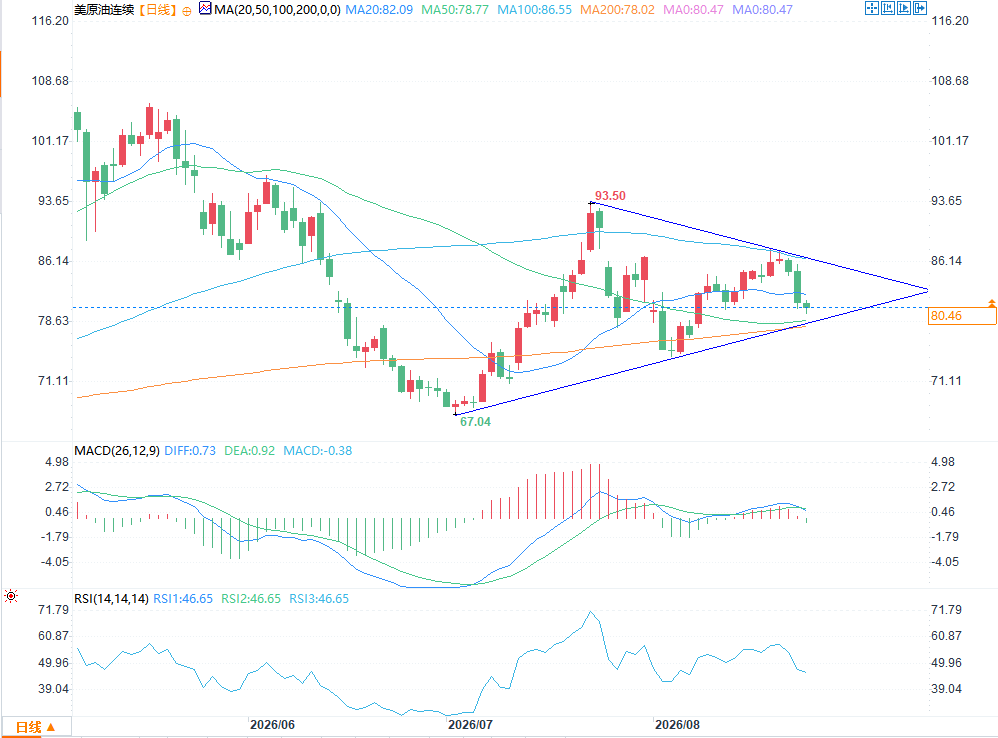 Oil prices are currently trading within a symmetrical triangle pattern. Recently, oil prices encountered resistance near $88, a level that coincides with both a downtrend line and the 50% Fibonacci retracement level from the $55 low to the $120 high. Subsequently, oil prices declined, breaking below the 100-period exponential moving average (100-period moving average), and are currently testing the 50-period moving average at 78.77. The Relative Strength Index (RSI) is below 50, indicating that short-term trading is dominated by sellers. A decisive break below $80 would further solidify the bearish outlook, targeting the August low of $75, followed by the uptrend line around $70. A breach of the $70 level would represent a significant deterioration in the technical pattern, potentially leading to a drop to $60. However, if the 50-period exponential moving average support holds, bulls will first attempt to recover the 20-period exponential moving average near $82.09, before retesting $88. A break above $88 would create a new high for the current phase, targeting $95, and then potentially $100.
News that Iran and Oman are discussing a temporary reopening plan for the Strait of Hormuz continues to weigh on oil prices. Oman's news agency reported on Tuesday that Oman and Iran are holding technical talks aimed at finalizing a permanent maritime corridor; Oman's foreign minister expressed hope for a swift official announcement of the temporary passage route. However, Tehran reiterated that free navigation in the Strait of Hormuz will only be allowed if the United States lifts its maritime blockade of Iranian ports. Signs of progress in diplomatic efforts in the Middle East have partially absorbed the risk premium in oil prices caused by supply concerns. Besides the Iran-Aman talks, other signs of progress include: the Pakistani Army Chief of Staff traveling to Tehran to support diplomatic efforts; and Qatar stating that it is continuing its mediation work. The weaker-than-expected new round of US sanctions against Iran also put downward pressure on oil prices. This new sanctions plan has not stopped the decline in oil prices. Market analysts believe that the US move is intended to push Iran back to the negotiating table through other means, having set aside military options, a signal welcomed by the market. Danske Bank strategists pointed out that Washington's latest move to "increase economic pressure on Iran" was less aggressive than the market had previously expected, especially in the absence of secondary sanctions against Iran's trading partners. A more favorable diplomatic outlook overshadowed the latest US economic pressure measures against Iran. Investors believe that economic sanctions pose a much smaller threat to oil supplies than further military escalation. Meanwhile, the market awaits the release of the US Energy Information Administration's (EIA) weekly crude oil inventory report for the week ending August 21, with expectations of a 1.9 million barrel increase; the previous week saw an increase of 4.4 million barrels. If this expectation is met, it will mark the fourth consecutive week of increases in crude oil inventories, temporarily easing market concerns about a shortage of oil supplies. Previously released data showed that US crude oil inventories increased by 4.2 million barrels in the week ending August 21, far exceeding the market's expectation of a 1.2 million barrel increase, reversing the previous week's decrease of 328,000 barrels. For oil prices to continue their decline, the market needs to see clear signals of a genuine improvement in oil supply and distribution, especially an increase in the number of ships passing through the Strait of Hormuz. Conversely, if the conflict escalates again or shipping is disrupted, crude oil prices will quickly re-induce risk premiums. Technical Analysis Oil prices are currently trading within a symmetrical triangle pattern. Recently, oil prices encountered resistance near $88, a level that coincides with both a downtrend line and the 50% Fibonacci retracement level from the $55 low to the $120 high. Subsequently, oil prices declined, breaking below the 100-period exponential moving average (100-period moving average), and are currently testing the 50-period moving average at 78.77. The Relative Strength Index (RSI) is below 50, indicating that short-term trading is dominated by sellers. A decisive break below $80 would further solidify the bearish outlook, targeting the August low of $75, followed by the uptrend line around $70. A breach of the $70 level would represent a significant deterioration in the technical pattern, potentially leading to a drop to $60. However, if the 50-period exponential moving average support holds, bulls will first attempt to recover the 20-period exponential moving average near $82.09, before retesting $88. A break above $88 would create a new high for the current phase, targeting $95, and then potentially $100.
- Risk Warning and Disclaimer
- The market involves risk, and trading may not be suitable for all investors. This article is for reference only and does not constitute personal investment advice, nor does it take into account certain users’ specific investment objectives, financial situation, or other needs. Any investment decisions made based on this information are at your own risk.