The July core PCE figure was released as expected. What two key signals did the Fed's favorite indicator release?
2026-08-26 20:46:02
On Wednesday (August 26) at 8:30 PM Beijing time, the U.S. Bureau of Economic Analysis released the July Personal Consumption Expenditures (PCE) price index and related data. The data showed that the overall PCE price index rose 0.2% month-on-month in July (expected +0.1%, previous -0.1%), and the core PCE price index rose 0.2% month-on-month (expected +0.2%, previous +0.1%). Year-on-year, overall PCE rose 3.7%, and core PCE rose 3.3%. Personal income rose 0.4% month-on-month (expected +0.2%), and personal spending rose 0.2% month-on-month (expected +0.1%), with real consumption expenditure remaining flat. The personal savings rate was 3.0%. The simultaneously released Q2 GDP annualized growth rate was 1.5%, indicating continued resilience in consumption.  During the Asian and early European sessions, the market was largely in a wait-and-see mode, with the main focus on whether the PCE data would confirm the inflation path and the growth clues provided by the simultaneous release of the final Q2 GDP figures. The Fed's preferred core PCE data became the focus, with the market generally expecting a monthly increase of 0.2%. The overall environment was characterized by narrow-range fluctuations, and US Treasury yields remained relatively stable before the data release. After the data release, the US dollar index initially fell before rising, fluctuating by about 10 points, reaching a high of 98.99. Spot gold fell slightly by $13 from $4628/oz to $4615/oz, after rising by $10 prior to the release.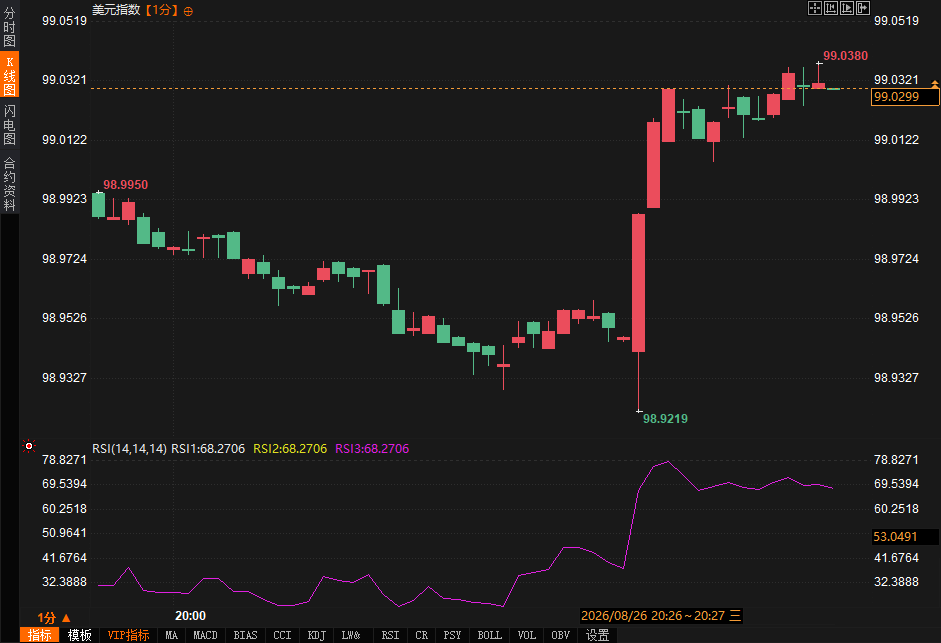
During the Asian and early European sessions, the market was largely in a wait-and-see mode, with the main focus on whether the PCE data would confirm the inflation path and the growth clues provided by the simultaneous release of the final Q2 GDP figures. The Fed's preferred core PCE data became the focus, with the market generally expecting a monthly increase of 0.2%. The overall environment was characterized by narrow-range fluctuations, and US Treasury yields remained relatively stable before the data release. After the data release, the US dollar index initially fell before rising, fluctuating by about 10 points, reaching a high of 98.99. Spot gold fell slightly by $13 from $4628/oz to $4615/oz, after rising by $10 prior to the release. Deep interconnect analysis
From a fundamental perspective, the core PCE monthly rate was entirely in line with expectations, maintaining a year-on-year growth of 3.3%, indicating that price pressures excluding food and energy have not accelerated significantly, nor have they cooled further. Overall PCE slightly exceeded expectations, mainly driven by service spending, while goods spending declined. Income was significantly stronger than expected, supporting consumption, but real consumption remained flat, indicating that nominal spending growth was partially offset by price factors. Compared to historical trends, the core PCE monthly rate in June was only +0.1%, and this rebound to +0.2% is a moderate rebound rather than a significant deviation; the year-on-year growth of 3.3% was unchanged from the previous value, continuing the trend of being above the Fed's 2% target but still relatively stable. Latest quotes show that after the data release, the yield on the 10-year US Treasury note rose slightly before settling at 4.635%, indicating a restrained immediate market reaction. Related interest rate-sensitive instruments saw limited volatility after the data release, without any trend breakout, maintaining a consistent long-term and short-term logic: short-term stability is supported by the core data meeting expectations, while long-term caution remains due to year-on-year stickiness. The contrasting viewpoints are striking. Before the data release, institutional investors mostly emphasized the baseline scenario of a "soft PCE" or "in line with expectations," believing that the core data was unlikely to offer any significant surprises or shocks, and shifted their focus to subsequent employment and information related to the Jackson Hole central bank symposium. Retail investors, on the other hand, expressed more anxiety about the stickiness of inflation, worrying that any unexpected data could push up interest rate expectations. After the release, institutional voices quickly shifted to "core PCE as expected, overall slightly overheated but with limited impact," emphasizing that strong income and moderate spending coexisted, posing no new shock to the policy path. Retail investor discussions were divided, with some focusing on the short-term support for the dollar after a slight reaction in yields, while others remained cautious about flat real consumption. Sentiment shifted from tension during the pre-release period to divergence during the digestion period. The expectation deviation was mainly reflected in the slight over-expectation of the overall PCE, but the anchoring effect of the core data was obvious, and the market did not form a one-sided pricing.Trend Outlook
Overall, the market exhibited a low-volatility consolidation pattern based on the data. Core PCE, meeting expectations, limited the scope for significant interest rate repricing. The 10-year yield, after a brief rise, returned to stability, reflecting a reaffirmation of the inflation path by the market. Going forward, attention will shift to whether real consumption momentum can recover along with improved incomes, and how the stickiness of year-on-year readings will affect medium-term pricing. Overall, the event's impact was mild, and the market is more likely to continue trading within a range, awaiting further data to confirm the consistency between short-term and long-term logic.Frequently Asked Questions
Q: Why was the July core PCE considered in line with expectations rather than exceeding them? The core PCE monthly rate precisely fell within the consensus level of +0.2%, while the year-on-year rate remained unchanged at 3.3%. The market is more sensitive to the core indicators that the Fed focuses on. The slight overshooting of the overall PCE was diluted by the divergence between services and goods, so the immediate reaction was mainly stable. Q: What does the significant increase in personal income but flat real consumption indicate? Income growth was mainly driven by wages and transfer payments. Although nominal spending increased, the flat real amount shows that price factors are still at play. This is consistent with the historical pattern of income leading and consumption lagging, providing neutral support for growth expectations in the short term. Q: Why was there a significant difference in opinions between institutions and retail investors before and after the data release? Institutions focused more on the anchoring role of core indicators and policy paths, with smaller deviations between predictions and results; retail investors were more easily affected by the overall readings and instantaneous fluctuations in yields, with sentiment shifting from pre-release anxiety to divergent results, reflecting different paces of information processing. Q: Why was the impact of this PCE on US Treasury yields limited? The core data did not deviate from expectations, limiting the extent of repricing. After a slight rise, the yield quickly stabilized at 4.635%, indicating that the market views the overall slight overheating as a one-off factor rather than a trend reversal. Q: In historical comparison, what implications does this data have for short-term and long-term logic? Compared to the rebound from the June lows, this is a moderate recovery. Short-term support has been digested smoothly, while the long-term outlook remains cautious as the year-on-year growth is still above the target. There is no significant conflict between these two logics.- Risk Warning and Disclaimer
- The market involves risk, and trading may not be suitable for all investors. This article is for reference only and does not constitute personal investment advice, nor does it take into account certain users’ specific investment objectives, financial situation, or other needs. Any investment decisions made based on this information are at your own risk.