PCE inflation shows stubborn stickiness, and the Federal Reserve stands at a crossroads regarding interest rate hikes.
2026-08-26 21:44:04
The U.S. Commerce Department released the July Personal Consumption Expenditures (PCE) price index. This inflation data, which is of utmost importance to the Federal Reserve, was released on the eve of the Jackson Hole global central bank conference. It painted a picture for the market of stagnant inflation, remaining economic resilience, and increasing policy divergence, causing short-term fluctuations in the dollar, U.S. Treasury bonds, and gold. 
A summary of key PCE data for July
The overall PCE price index rose 0.2% month-over-month in July, compared to -0.1% in June, higher than the market expectation of 0.1%; the year-over-year figure remained at 3.7%, not falling to 3.6% as the market had anticipated. Excluding the more volatile food and energy sectors, the core PCE rose 0.2% month-over-month and 3.3% year-over-year, completely unchanged from June's reading, in line with market consensus. Compared to the more widely known CPI indicator, PCE inflation readings have remained persistently high this year, highlighting the difference between the two statistical methods: while CPI inflation has eased somewhat, the PCE system tracked by the Federal Reserve shows that domestic biological price stickiness is far stronger than imagined, and there is still a significant gap from the 2% inflation target. The stubborn inflation stems from three real-world pressures: the conflict in Iran disrupting energy prices and raising costs; the AI industry boom driving up chip, computing power, and electricity-related spending, pushing up service and goods prices; and the Trump administration's tariff policies continuing to support imported inflation. These multiple factors are intertwined, suppressing the downward trend of inflation.The US economy has not weakened; consumer spending and income have rebounded in tandem.
While inflation remains high, the US economy has shown unexpected resilience. Second-quarter data was revised upwards, with private domestic final sales, excluding government and trade disruptions, revised upwards to 4.2%, indicating stronger endogenous economic momentum than previously estimated. In July, personal consumption expenditures rose 0.2% month-on-month, higher than the expected 0.1%; personal income rose 0.4% month-on-month, a significant acceleration compared to June. The recovery in both household income and consumption suggests that demand has not cooled, which also creates resistance to a decline in inflation. A strong economy coupled with high inflation presents the current dilemma for the Federal Reserve.The Federal Reserve is deeply divided, and expectations for interest rate hikes are being repriced.
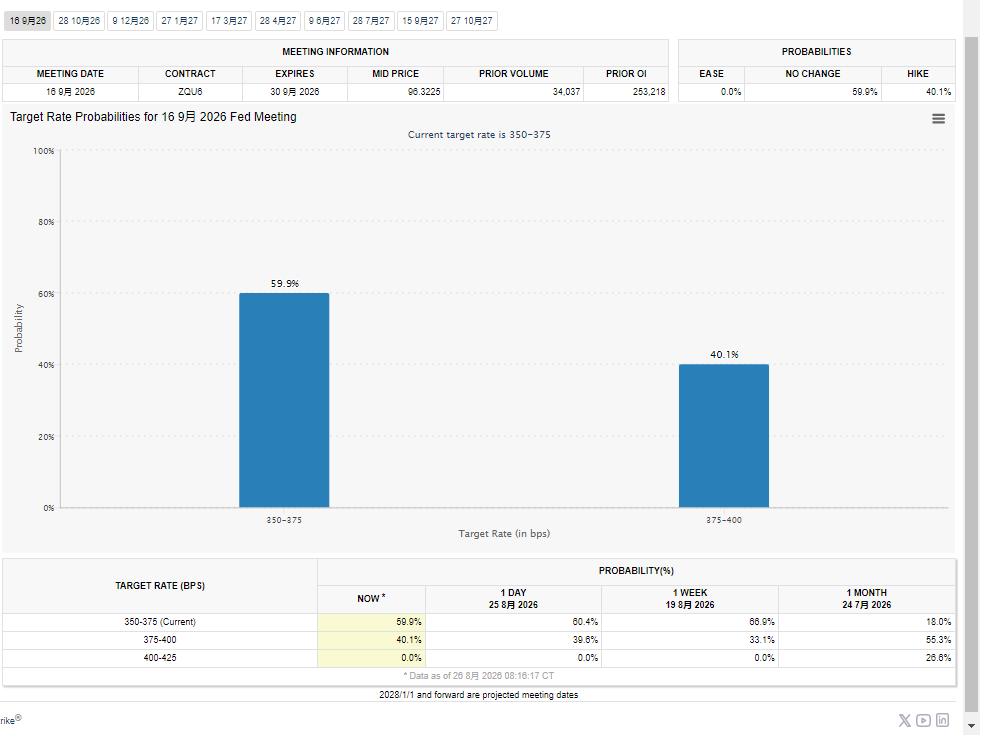
The minutes of the July FOMC meeting reveal significant internal divisions within the Federal Reserve: many members stated that further interest rate hikes would be necessary unless inflation shows a clear downward trend; simultaneously, officials are divided on the path of inflation by the end of the year, with some believing prices will steadily cool, while a considerable number acknowledge the risk of persistently high inflation. The situation in Iran has introduced energy uncertainty, further amplifying the uncertainty surrounding the inflation outlook. Newly appointed Fed Chairman Kevin Warsh has yet to include his personal forecasts in the dot plot, nor has he publicly stated his preference for raising or maintaining interest rates, leaving his policy stance uncertain. The CME FedWatch tool shows that after the data release, the market priced in a 40.4% probability of a September rate hike; by December, the market probability of at least one rate hike this year has climbed to 72.7%. Traders have begun to re-price the possibility of further monetary tightening. Market opinions are also divided: some institutions believe that CPI is moderate and a rate hike is unnecessary; others point out that the strong labor market coupled with persistent inflation makes the logic of not raising rates difficult to justify.Jackson Hole's speech became the biggest short-term indicator.
All eyes are on Warsh this Friday for his crucial public address at the Jackson Hole Economic Symposium, his most important public speaking opportunity since becoming Federal Reserve Chairman. The July PCE data, a sensitive issue, will be the most important backdrop to his speech. If his remarks are hawkish, reinforcing concerns about inflation, the market will further trade on interest rate hikes, leading to higher Treasury yields, a stronger dollar, and pressure on precious metals. Conversely, if the PCE data confirms that US inflation has entered a stubborn long-tail phase, the resilience of the economy will further constrain the Fed's policy choices. For traders, it's unwise to bet solely on the interest rate path. The Jackson Hole speech, subsequent August inflation and employment data, will continue to influence the prices of Treasury bonds, the dollar, and commodities. If Warsh emphasizes waiting for more data to confirm his stance and maintains a wait-and-see attitude, then expectations of interest rate hikes will decline, the dollar will weaken, and assets like gold may gain some breathing room.- Risk Warning and Disclaimer
- The market involves risk, and trading may not be suitable for all investors. This article is for reference only and does not constitute personal investment advice, nor does it take into account certain users’ specific investment objectives, financial situation, or other needs. Any investment decisions made based on this information are at your own risk.