PCE data release comes as Iran situation stabilizes! Gold consolidates strongly.
2026-08-26 21:05:00
On Wednesday (August 26), during the European and American trading sessions, a spokesperson for the Iranian Revolutionary Guard stated that Iran and Oman had reached an agreement on income distribution in the Sea of Hormuz. Although the agreement has not yet been fully finalized, inflation concerns subsided, causing gold prices to rebound. However, subsequent PCE data exceeded market expectations, reigniting inflation concerns and causing gold prices to fall again in the short term. Currently, spot gold is trading around $4622, down 0.79%, but the overall trend remains very strong. In August 2026, the international gold market experienced an extremely strong rebound, with gold prices surging by 15% in a single month, marking the strongest monthly gain in more than four months. This significant recovery completely reversed the previous sluggish trend of continuous price corrections, making it the most eye-catching trading instrument in the commodity market recently. However, from the overall price trend, gold has not yet fully recovered its previous losses. Compared to the historical peak of breaking through $5500/ounce in January of this year, the current price still has about 16% downside potential. The previous low point of gold prices in August once approached $4600/ounce. Looking back at the recent gold price movement, geopolitical tensions had previously exerted significant downward pressure on gold prices. The ongoing conflict in Iran pushed up international oil prices, fueling widespread concerns about persistently high global inflation and creating market expectations of continued interest rate hikes by the Federal Reserve. Fed rate hikes effectively tightened liquidity in the market, causing gold prices and other financial assets to fall. Simultaneously, due to the sharp decline in asset prices caused by the war and disruptions to oil exports, Gulf states and major energy importers like Turkey were forced to sell gold to obtain dollar cash flow. However, in August, the macroeconomic environment shifted dramatically, with multiple positive factors converging to propel a strong rebound in gold prices. 
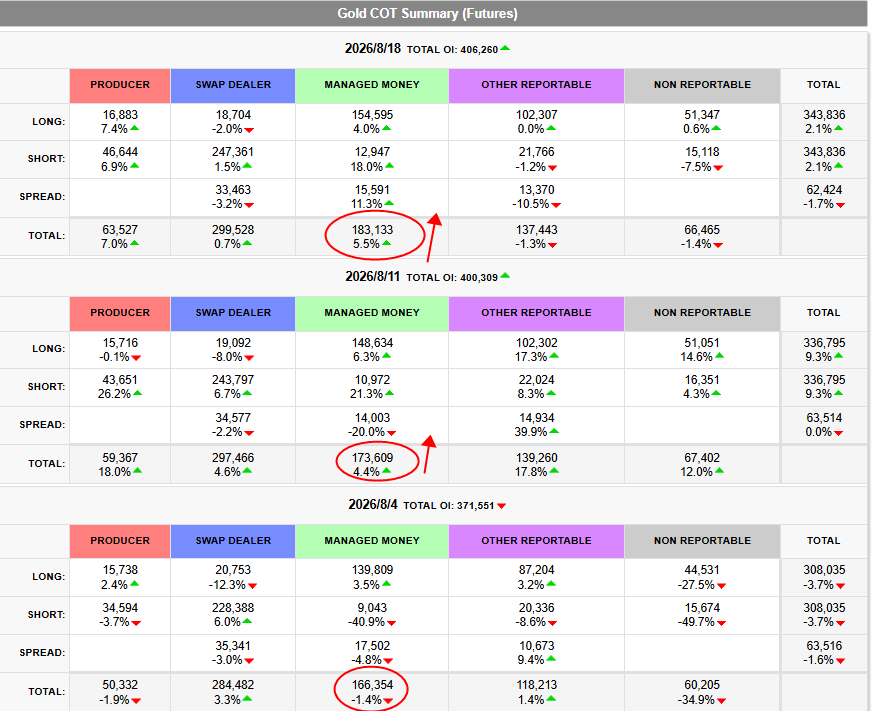 (COT position report released by CFTC, source: CME Group)
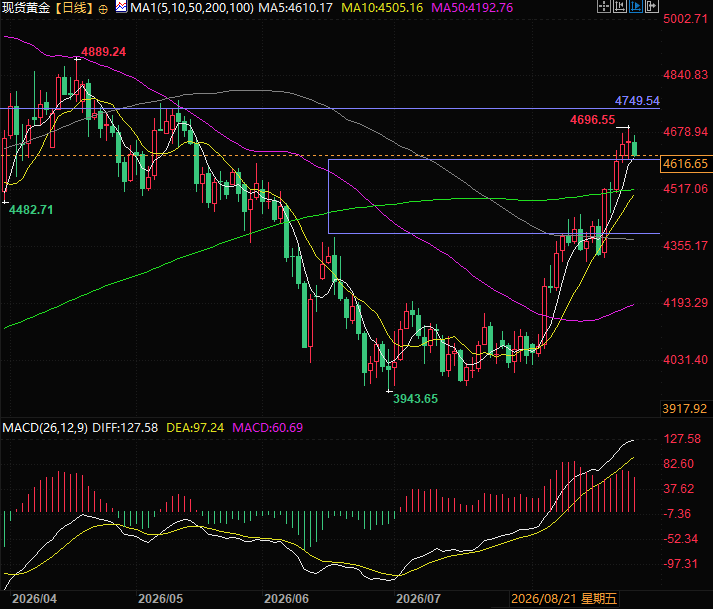 (Spot gold daily chart, source: FX678) At 20:58 Beijing time, spot gold is currently trading at $4,614 per ounce.
A weaker dollar and lower US Treasury yields did not lead to an unexpected rise in PCE.
The weakening of both the US dollar and US Treasury yields is the core macroeconomic logic driving the recent surge in gold prices. The market now widely expects the Federal Reserve to maintain interest rates, completely reversing previous pessimistic expectations of a rate hike. Compared to interest-bearing financial assets, gold's disadvantage as a non-interest-bearing asset has been significantly mitigated, the opportunity cost of holding gold has decreased significantly, and its attractiveness has rapidly rebounded. While today's PCE data showed an overall increase of 0.2% to 3.3%, the core PCE data excluding oil prices remained at 3.3%, without any unexpected rise. Interest rate futures also showed no significant changes, and the probability of a September rate hike remains around 36%. Simultaneously, the US Treasury announced a major policy plan to double the scale of long-term Treasury bond repurchase operations, increasing the size of each operation to at least $4 billion. This policy can effectively smooth out fluctuations in long-term US Treasury yields, suppressing the rise in long-term yields, and indirectly dragging down the dollar's performance. The weaker dollar index significantly reduces the cost of gold for global overseas buyers, further stimulating global gold consumption and investment demand, and continuously pushing up gold prices. In recent geopolitical developments, Iran and Oman appear to be close to finalizing an agreement on the management of the Strait of Hormuz and resolving funding issues, which is expected to positively impact navigation through the strait. This has kept oil prices at recent lows and is also beneficial for gold prices.Global gold ETFs see capital inflows, market sentiment improves.
The continued inflow of investment funds into gold ETFs is a significant and direct driver of the recent gold price rebound. As market risk appetite and macroeconomic expectations reverse, both institutional and retail investors are increasingly allocating more gold assets. According to the latest data released by the World Gold Council, global gold ETF holdings continue to expand, with recent additions reaching 23 tons; since August, the pace of inflows has accelerated further, with the total inflow for the month climbing to 45 tons so far. This sustained net inflow of funds into ETFs directly reflects a significant increase in market demand for gold, providing solid financial support for rising gold prices. (COT position report released by CFTC, source: CME Group)Global central banks continue to buy gold, strengthening the bottom support for gold prices.
Central banks worldwide are routinely increasing their gold reserves, continuously solidifying the long-term value of gold and effectively hedging against market volatility risks. Data shows that global central bank gold purchases reached 288.9 tons in the second quarter of this year, a significant year-on-year increase of 62%, indicating explosive growth in official gold demand. Notably, the Bank of Korea's return to the gold market after a 13-year hiatus further confirms the sustainability of the global central bank gold buying spree. Data from the World Gold Council further highlights this long-term industry trend, with 89% of surveyed institutions expecting continued growth in global gold reserves over the next year, and a record 45% of surveyed central banks explicitly planning to further expand their gold holdings. This long-term, stable, and large-scale gold purchasing behavior by central banks has significantly reduced the downside risk to gold prices, providing a solid support level for the current rebound.Summary and immediate analysis:
This round of 15% monthly surge in gold prices is the result of a confluence of positive factors: capital inflows, official demand, and a shift in macroeconomic monetary policy, marking a temporary reversal in the gold market's trend. However, it's important to note that precious metal prices are highly volatile, and a technical correction may be necessary after the rapid short-term rise. For investors, it's unwise to blindly chase high prices when allocating gold assets. They should make rational decisions based on their financial goals, risk tolerance, and investment horizon, managing their positions appropriately and mitigating the risks of short-term market fluctuations. Technically, spot gold has experienced a slight pullback, with current support at the 5-day moving average and the upper edge of the trading range, and resistance around the 0.786 Fibonacci retracement level near 4749. (Spot gold daily chart, source: FX678) At 20:58 Beijing time, spot gold is currently trading at $4,614 per ounce.
- Risk Warning and Disclaimer
- The market involves risk, and trading may not be suitable for all investors. This article is for reference only and does not constitute personal investment advice, nor does it take into account certain users’ specific investment objectives, financial situation, or other needs. Any investment decisions made based on this information are at your own risk.