A chart shows that the Baltic Dry Index rose for the fifth consecutive trading day, with Capesize crude oil prices hitting their highest point in more than two weeks.
2026-08-26 23:51:00
Latest data shows that the Baltic Dry Index (BDI) reached 3056 points on August 26, 2026, a new high since August 10, 2026, up 4.44% month-on-month, the largest increase since July 8, 2026, and marking the fifth consecutive day of increase (including zero growth). Looking at the short-term charts, the recent 11 BDI data points show: 7 positive increases, 4 negative increases, and 0 zero increases. Specifically, the Panamax Freight Index (BPI) was 2246 points, up 3.69% from the previous value; the Capesize Freight Index (BCI) was 5033 points, up 6.29%; and the Supramax Freight Index (BSI) was 1644 points, up 0.06%. For detailed 720-day and 10-year trend charts of the Baltic Dry Index and its three sub-indices, please refer to the charts specially created by FX678. 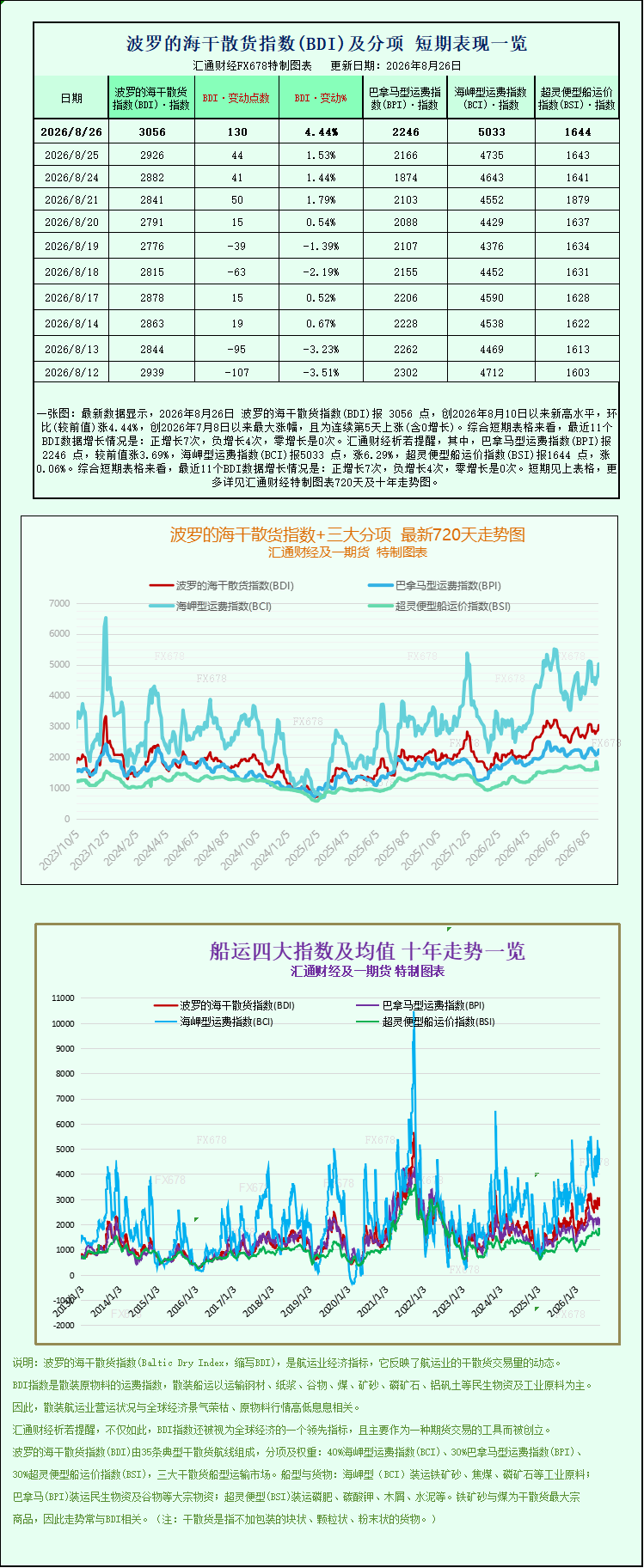 The Baltic Dry Index (BDI), a key indicator of the international shipping market, rose again on Wednesday, marking its fifth consecutive day of gains and forming a sustained upward trend. This surge was driven by a broad-based increase in freight rates across all vessel types, with Capesize vessels, the core of the dry bulk market, performing particularly well. The index reached its highest level in over two weeks, fully reflecting the market situation of recovering global demand for bulk dry bulk shipping and tight short-term shipping capacity. The Baltic Dry Index is the most crucial indicator for global dry bulk shipping, comprehensively weighting the spot freight rates of Capesize, Panamax, and Supramax vessels. It directly reflects the global market conditions for shipping basic commodities such as iron ore, coal, and grain. On Wednesday, the index jumped 130 points, a 4.4% increase, closing at 3056 points, the highest level since August 10th. The continuous rise has reversed the previous period of weak and volatile trading, indicating a significant recovery in market sentiment. The core driving force behind this round of market rally came from the Capesize shipping market. The Capesize index rose 298 points in a single day, a surge of 6.3%, closing at 5033 points, also reaching a high point since August 10th. Capesize vessels are the largest and most important type of vessel in the dry bulk fleet, with a standard deadweight of approximately 150,000 tons. They primarily handle long-distance, high-volume transport of iron ore and coal. These cargoes are directly linked to the industrial supply chains of steel production and thermal power supply, so fluctuations in Capesize freight rates are often seen as a leading indicator of global industrial demand. Data shows that the average daily earnings of Capesize vessels increased by $2706 to $42148, significantly improving shipowners' profit margins. The direct short-term catalyst for this freight rate surge was typhoon disruption. Typhoon Nara continued to affect the South China Sea, causing disruptions to several key shipping routes. Many vessels chose to temporarily detour and wait for the wind and waves to subside before resuming navigation, directly reducing the effective shipping capacity available for transport. The combination of a temporary tightening of shipping capacity and rising spot and futures prices for iron ore has created a positive synergy, continuously pushing up freight costs for long-distance ocean shipping. Iron ore is the primary cargo carried by Cape-class vessels, with trade concentrated in Australia and Brazil, flowing to Asian steel-producing countries like China. The South China Sea is a crucial waterway along this route, and extreme weather disruptions directly impact cargo turnover efficiency. Traders are willing to accept higher freight rates to ensure timely arrival of goods, further fueling the upward trend in freight rates. The Panamax market has also seen a recovery. The Panamax index rose 80 points, or 3.7%, to 2246 points, a new high since August 13th. Panamax vessels typically have a deadweight tonnage of 60,000 to 70,000 tons, suitable for long-distance shipping of commodities such as coal and grain, covering multiple grain export routes in the Atlantic and Pacific Oceans, as well as regional coal trade routes. The corresponding daily earnings per share for Panamax vessels rose by $717, reaching $20,213. Compared to Capesize vessels, Panamax vessels handle more of the demand for grain and regional thermal coal transportation. Their freight rate rebound reflects the simultaneous strengthening of global agricultural trade and regional energy transport demand. In the small and medium-sized vessel sector, Supramax vessels saw relatively flat performance. The Supramax index rose only slightly by 1 point, a 0.06% increase, closing at 1644 points. Supramax vessels are smaller and more flexible, primarily used for short-haul regional bulk cargo transportation, small-batch building materials, and short-haul grain transshipment. The market is fragmented, with smaller order volumes, and their price elasticity is far less than that of large ocean-going vessels. In this round of significant price increases for large vessels, the small vessel market lacked strong drivers, resulting in negligible gains and a clear divergence in market performance between different vessel types. Overall, the five-day consecutive rise in the Baltic Dry Index (BDI) releases multiple market signals. In the short term, extreme weather disruptions to shipping routes have led to temporary capacity shortages, which is the direct driver of the price increase. In the medium to long term, the marginal recovery in trade demand for industrial raw materials such as iron ore and coal, as well as grain, is supporting a rise in dry bulk freight rates. However, market participants remain cautious. This round of price increases is partly driven by short-term weather events. Whether freight rates can continue to rise depends on the speed of capacity recovery after the typhoon's impact subsides, the pace of steel production in China, changes in global grain export orders, and the medium- to long-term supply pressure from new ship deliveries. The dry bulk shipping cycle is inherently highly volatile, and with short-term disturbances intertwined with fundamental changes, the future trend remains uncertain.
The Baltic Dry Index (BDI), a key indicator of the international shipping market, rose again on Wednesday, marking its fifth consecutive day of gains and forming a sustained upward trend. This surge was driven by a broad-based increase in freight rates across all vessel types, with Capesize vessels, the core of the dry bulk market, performing particularly well. The index reached its highest level in over two weeks, fully reflecting the market situation of recovering global demand for bulk dry bulk shipping and tight short-term shipping capacity. The Baltic Dry Index is the most crucial indicator for global dry bulk shipping, comprehensively weighting the spot freight rates of Capesize, Panamax, and Supramax vessels. It directly reflects the global market conditions for shipping basic commodities such as iron ore, coal, and grain. On Wednesday, the index jumped 130 points, a 4.4% increase, closing at 3056 points, the highest level since August 10th. The continuous rise has reversed the previous period of weak and volatile trading, indicating a significant recovery in market sentiment. The core driving force behind this round of market rally came from the Capesize shipping market. The Capesize index rose 298 points in a single day, a surge of 6.3%, closing at 5033 points, also reaching a high point since August 10th. Capesize vessels are the largest and most important type of vessel in the dry bulk fleet, with a standard deadweight of approximately 150,000 tons. They primarily handle long-distance, high-volume transport of iron ore and coal. These cargoes are directly linked to the industrial supply chains of steel production and thermal power supply, so fluctuations in Capesize freight rates are often seen as a leading indicator of global industrial demand. Data shows that the average daily earnings of Capesize vessels increased by $2706 to $42148, significantly improving shipowners' profit margins. The direct short-term catalyst for this freight rate surge was typhoon disruption. Typhoon Nara continued to affect the South China Sea, causing disruptions to several key shipping routes. Many vessels chose to temporarily detour and wait for the wind and waves to subside before resuming navigation, directly reducing the effective shipping capacity available for transport. The combination of a temporary tightening of shipping capacity and rising spot and futures prices for iron ore has created a positive synergy, continuously pushing up freight costs for long-distance ocean shipping. Iron ore is the primary cargo carried by Cape-class vessels, with trade concentrated in Australia and Brazil, flowing to Asian steel-producing countries like China. The South China Sea is a crucial waterway along this route, and extreme weather disruptions directly impact cargo turnover efficiency. Traders are willing to accept higher freight rates to ensure timely arrival of goods, further fueling the upward trend in freight rates. The Panamax market has also seen a recovery. The Panamax index rose 80 points, or 3.7%, to 2246 points, a new high since August 13th. Panamax vessels typically have a deadweight tonnage of 60,000 to 70,000 tons, suitable for long-distance shipping of commodities such as coal and grain, covering multiple grain export routes in the Atlantic and Pacific Oceans, as well as regional coal trade routes. The corresponding daily earnings per share for Panamax vessels rose by $717, reaching $20,213. Compared to Capesize vessels, Panamax vessels handle more of the demand for grain and regional thermal coal transportation. Their freight rate rebound reflects the simultaneous strengthening of global agricultural trade and regional energy transport demand. In the small and medium-sized vessel sector, Supramax vessels saw relatively flat performance. The Supramax index rose only slightly by 1 point, a 0.06% increase, closing at 1644 points. Supramax vessels are smaller and more flexible, primarily used for short-haul regional bulk cargo transportation, small-batch building materials, and short-haul grain transshipment. The market is fragmented, with smaller order volumes, and their price elasticity is far less than that of large ocean-going vessels. In this round of significant price increases for large vessels, the small vessel market lacked strong drivers, resulting in negligible gains and a clear divergence in market performance between different vessel types. Overall, the five-day consecutive rise in the Baltic Dry Index (BDI) releases multiple market signals. In the short term, extreme weather disruptions to shipping routes have led to temporary capacity shortages, which is the direct driver of the price increase. In the medium to long term, the marginal recovery in trade demand for industrial raw materials such as iron ore and coal, as well as grain, is supporting a rise in dry bulk freight rates. However, market participants remain cautious. This round of price increases is partly driven by short-term weather events. Whether freight rates can continue to rise depends on the speed of capacity recovery after the typhoon's impact subsides, the pace of steel production in China, changes in global grain export orders, and the medium- to long-term supply pressure from new ship deliveries. The dry bulk shipping cycle is inherently highly volatile, and with short-term disturbances intertwined with fundamental changes, the future trend remains uncertain.
- Risk Warning and Disclaimer
- The market involves risk, and trading may not be suitable for all investors. This article is for reference only and does not constitute personal investment advice, nor does it take into account certain users’ specific investment objectives, financial situation, or other needs. Any investment decisions made based on this information are at your own risk.