Gold Trading Alert: Gold Prices Plunge Over 1%! After "Neutral to Strong" PCE Data, Can Gold Reach $5,000?
2026-08-27 07:47:00
Global gold markets saw a significant pullback on Wednesday (August 26), with spot gold falling by more than 1% in a single day, halting its previous upward momentum. On the surface, this appeared to be an immediate reaction to US inflation data, but it was actually driven by a complex interplay of factors, including a strengthening dollar, subtle adjustments to Federal Reserve policy expectations, geopolitical uncertainties, and profit-taking. Whether gold prices can regain their footing after this correction, and even return to above $5,000 this year as some analysts predict, has become the market's primary focus. On Thursday (August 27) in early Asian trading, spot gold rebounded after some volatility, currently trading around $4,620 per ounce, up approximately 0.55%. 
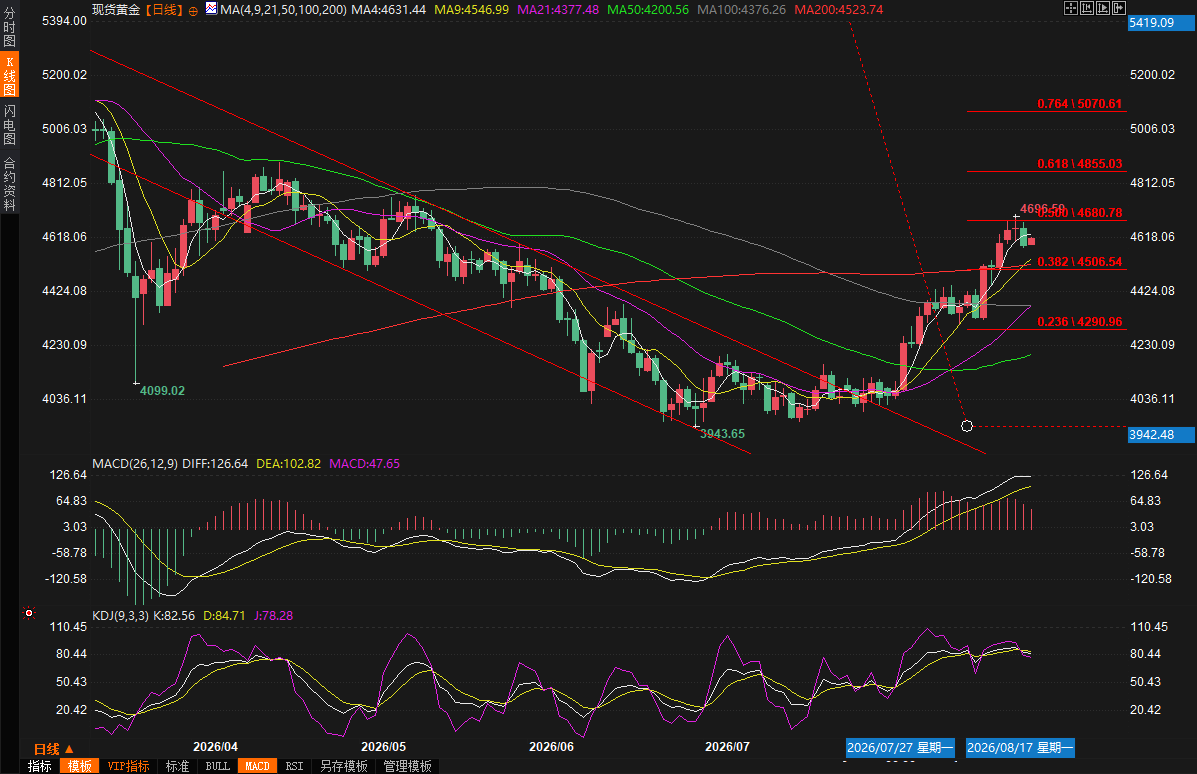 (Spot gold daily chart, source: FX678) At 07:43 Beijing time, spot gold is currently trading at $4622.85 per ounce.
Inflation data was largely in line with expectations, but it was enough to increase bets on interest rate hikes.
The U.S. Commerce Department's July Personal Consumption Expenditures (PCE) price index showed a stable year-on-year increase of 3.7%, slightly higher than the market expectation of 3.6%; the month-on-month increase was 0.2%, also higher than the expected 0.1%. Core PCE's year-on-year increase remained at 3.3%, and the month-on-month increase was also 0.2%. This set of figures neither brought about a significant unexpected acceleration in inflation nor continued the cooling trend of some previous months, presenting an overall "neutral to slightly overheated" characteristic. For gold, this result directly changed the market's pricing of the Federal Reserve's policy path. The CME FedWatch tool showed that traders' probability of a Fed rate hike in September rose from about 36% before the data release to about 40%, while the probability of maintaining the current rate fell accordingly to 60%. In a high-interest-rate environment, gold, which does not generate interest, is naturally at a relative disadvantage, and funds are more likely to flow to dollar assets to obtain higher returns. At the same time, the dollar index rose by about 0.3% that day, further increasing the purchase cost of dollar-denominated gold for non-dollar holders, creating a double pressure on gold prices. Peter Grant, Vice President and Senior Metals Strategist at Zaner Metals, pointed out that gold prices had already seen some profit-taking before the data release. After the PCE results largely met expectations, prices consolidated within the previous day's trading range rather than initiating a new one-sided downward trend. This assessment alleviated market concerns to some extent about a complete weakening of gold prices.Economic resilience and policy maneuvering coexist, and the medium- to long-term narrative for gold remains intact.
Besides the PCE itself, other economic data released on the same day provided the market with a more complete picture. The revised annualized rate of GDP growth in the second quarter remained unchanged at 1.5%, but consumer spending growth was revised upward to 3.4%, indicating that personal consumption, which accounts for about two-thirds of the US economy, maintained considerable resilience in the first half of the year. Significant growth in corporate profits, an upward revision of private domestic final sales growth to 4.2%, and continued strong investment in artificial intelligence all point to a potential acceleration in economic growth in the third quarter. The unexpected halt in the decline of inflation from war-related highs, coupled with new tariff pressures (such as potential tariffs following a breakdown in trade negotiations with Canada), may further intensify the debate within the Federal Reserve regarding whether to raise interest rates or remain on hold. Some officials have clearly stated that unless inflation continues to decline, action needs to be taken as soon as possible. The Federal Reserve Chairman will speak at the Jackson Hole symposium on Friday, and the market is closely awaiting his latest remarks on the commitment to the inflation target, policy communication methods, and macroeconomic shocks. Although most institutions expect the Chairman not to provide clear policy guidance, his wording could still trigger volatility. In this environment, the short-term pressure on gold is not difficult to understand. However, in the medium to long term, as long as the coexistence of high real interest rates and geopolitical risks remains fundamentally unchanged, the underlying logic of gold as a safe-haven and inflation-hedging asset remains valid. Grant explicitly stated that the upward trend in gold is beginning to re-establish itself, and it may return above $5,000 this year, potentially reaching a record high before the second quarter of 2027. This view reflects the continued optimism of some institutions regarding structural demand (including central bank gold purchases and geopolitical hedging).Negotiations on the Strait of Hormuz remain deadlocked, with geopolitical premiums still providing a floor.
On the geopolitical front, negotiations between Iran and Oman over the Strait of Hormuz are still in the details. The Iranian Revolutionary Guard previously stated that the two sides had reached an agreement on waterway sharing and revenue distribution, but senior sources clarified that the agreement has not yet been finalized. The risk of disruption to navigation in the strait remains, with some vessels hesitant due to blacklist issues, and shipping activity has not fully returned to normal. Despite the recent pullback in oil prices, as long as this waterway, which carries approximately one-fifth of the world's oil and liquefied natural gas transport, remains impassable, energy prices and safe-haven demand will be difficult to completely subside, providing potential support for gold.Pay attention to the Jackson Hole Annual Meeting
Federal Reserve Chairman Warsh will deliver a keynote address at the Jackson Hole Economic Symposium on Friday, and the market is eager to see if he can use this opportunity to "reset" his relationship with investors and provide clearer signals on interest rate policy. Since taking office, Warsh has adopted a "listen more, talk less" communication style, emphasizing reduced forward guidance and relying more on hard data rather than official statements to judge policy direction. While this strategy gives the Fed greater policy flexibility, it has also led to continued investor confusion about the interest rate outlook, considered one of the reasons for recent increased volatility in the bond market. Barclays analysts point out that if Warsh can simply and definitively state his willingness to raise rates if necessary, it will help soothe market concerns about the Fed's credibility. Deutsche Bank's chief economist also stated that the speech provides Warsh with an opportunity to clarify some communication errors. However, TD Securities analysts warn that a complete change in strategy is unlikely, and the "risk of market disappointment is high." Warsh may share updates on the five expert working groups he has established, which are studying issues such as the economic impact of artificial intelligence, inflation dynamics, and the Fed's balance sheet. He may use this opportunity to further explain why a "listen more, talk less" communication framework ultimately benefits the economy—he has previously stated that after years of relying on the Fed to "steer" the ship, the market has finally "learned to play the game, instead of staring at the referee." Market opinions are divided. RIA Advisors' chief investment strategist supports reducing guidance, arguing that the bond market has begun trading based on economic data rather than Fed speeches, and that "for the first time in 15 years, bond traders have had to get back to real work." However, Barclays economists warn that a lack of communication could lead to market misunderstandings of the Fed, exacerbating volatility and ultimately pushing up interest rates, arguing that the central bank should explain its reaction function to help "market participants, businesses, and households form expectations for the future." Whether Warsh can address these concerns in his speech on Friday, providing investors with sufficient direction while maintaining his communication philosophy, will directly impact the trajectory of US Treasury yields and market expectations for the Fed's next move, making it a key focus of this year's Jackson Hole symposium.Summarize
In summary, Wednesday's decline in gold prices was more of a technical adjustment and a minor tweak to expectations following the release of data, rather than a signal of a trend reversal. Spot gold closed at around $4,595 per ounce, having touched a low of around $4,583 during the session, still significantly higher than its previous trading range. A stronger dollar, a slightly increased probability of interest rate hikes, and profit-taking created short-term pressure, but the resilience shown in economic data, sticky inflation, the uncertainty surrounding the Jackson Hole speech, and the unresolved situation in the Strait of Hormuz collectively maintain gold's medium- to long-term appeal. The market will now focus on the wording of the Fed Chairman's speech on Friday, subsequent inflation and employment data, and the actual progress of geopolitical negotiations . If inflation becomes more sticky while economic growth remains strong, the Fed's policy path may become more cautious or even hawkish, and gold may continue to fluctuate in the short term. However, if geopolitical risks escalate again or real interest rate expectations ease, the possibility of gold prices retesting higher levels or even moving towards $5,000 remains. The current pullback may provide an observation window for medium- to long-term positioning, rather than a sign of a trend reversal. (Spot gold daily chart, source: FX678) At 07:43 Beijing time, spot gold is currently trading at $4622.85 per ounce.
- Risk Warning and Disclaimer
- The market involves risk, and trading may not be suitable for all investors. This article is for reference only and does not constitute personal investment advice, nor does it take into account certain users’ specific investment objectives, financial situation, or other needs. Any investment decisions made based on this information are at your own risk.