Westpac pours cold water on expectations! July CPI exceeded expectations, but the Reserve Bank of Australia is expected to keep rates steady until the end of the year.
2026-08-27 08:15:03
The Australian dollar edged higher against the US dollar in Asian trading on Thursday (August 27), currently trading around 0.7180, continuing its overnight upward trend and remaining at its highest level since June 4. While inflation data provides ammunition for an interest rate hike, Westpac believes that weakness in the labor market is sufficient to keep the Reserve Bank of Australia (RBA) on hold until the end of the year. Westpac stated that despite higher-than-expected July CPI data, the RBA is likely to keep interest rates unchanged for the remainder of 2026, citing weak labor market and wage data that reduce the likelihood of a November rate hike. 
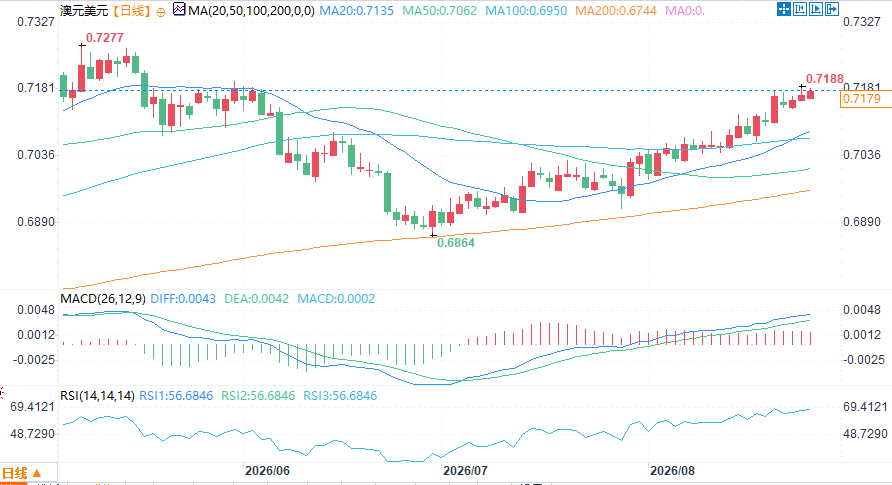 (Australian dollar against US dollar daily chart, source: EasyForex) At 8:05 AM Beijing time on August 27, the Australian dollar was trading at 0.7179/80 against the US dollar.
Westpac: July CPI exceeded expectations, but the Reserve Bank of Australia is expected to keep rates unchanged until the end of the year.
A recent research report from Westpac Bank points out that although the July Consumer Price Index (CPI) data significantly exceeded market expectations, the bank still believes that the Reserve Bank of Australia (RBA) is highly likely to maintain its current interest rate for the remainder of 2026. Data shows that the monthly CPI rose 1.0% month-on-month, and the core revised average rose 0.5%, both exceeding market consensus expectations and briefly triggering a repricing of the probability of a November rate hike. However, Westpac emphasizes that a single month's better-than-expected data does not necessarily translate into a policy shift, especially given the weakening overall economic momentum and labor market. This assessment differs significantly from some of its peers who have shifted their expectations to a September or November rate hike. Westpac believes the RBA is more inclined to adopt a "wait-and-see" approach to short-term fluctuations, avoiding premature tightening of policy amidst data noise. The core logic is that rising inflation is more a reflection of structural or temporal factors than overall overheating demand; at the same time, the policy lag effect is gradually emerging, and the marginal cost of further rate hikes may outweigh the benefits. Therefore, even with increased short-term market volatility, Westpac maintains its baseline scenario of keeping interest rates unchanged until the end of the year and reminds investors to pay attention to how subsequent labor market data validates this assessment.Housing cost inflation is stable, with durable goods and services being the main unexpected drivers of upward movement.
Westpac Bank, after further analyzing the July CPI composition, pointed out that housing cost-related inflation remained relatively stable, becoming a key factor in alleviating overall concerns. New home construction costs and rent increases were largely in line with previous expectations, without significant acceleration. The bank's analysis suggests that the current sluggish housing market and persistent inventory pressure limit developers' ability to smoothly pass on higher building material and trade costs to end buyers, thus suppressing further increases in housing inflation. The main sources of the unexpected data were concentrated in durable consumer goods and some household services. Price increases in durable goods such as automobiles and home furnishings were partly related to sales timing and recent increases in chip-related costs; prices for household services such as catering and domestic tourism also saw significant jumps. Westpac Bank emphasized that these unexpected increases reflect more short-term supply disturbances, misaligned promotional cycles, or cost transmission in specific categories, rather than a widespread and sustained systemic shift in underlying inflationary pressures. In other words, after excluding these short-term factors, the underlying inflationary momentum did not show signs of a comprehensive acceleration. This distinction is crucial for policy judgment: if the unexpected portion is not sustainable, the central bank has more reason to remain patient rather than immediately respond with an interest rate hike.The weakness in the labor market is a key offsetting factor.
Despite service sector inflation remaining significantly above the Reserve Bank of Australia's (RBA) target range, Westpac believes that the weak labor market performance has acted as a key offsetting force, significantly reducing the realistic likelihood of a November rate hike. Recent data shows weaker-than-expected employment growth and signs of slowing wage growth, indicating that overall demand-side support for prices is weakening. The bank points out that the easing in the labor market will gradually transmit to businesses' pricing power and households' willingness to spend, thus putting downward pressure on future inflation. Against this backdrop, Westpac expects the RBA to maintain a cautious tone in its public communications, emphasizing that inflation risks have not completely subsided, but this cautious stance is unlikely to translate into actual rate hikes before the end of the year. Compared to some more hawkish peers, Westpac's assessment of the policy path is more restrained, and the disagreement between the two has itself become a focus of market attention. The upcoming labor market data therefore has a high "market catalyst" attribute: if employment and wage data continue to be weak, it will reinforce Westpac's hold-at-home scenario; if unexpectedly strong, it may push up market pricing in a rate hike before the end of the year and increase the difficulty of internal communication within the central bank. Overall, Westpac views the labor market as a core variable in the current policy game, and its evolution will directly determine whether higher-than-expected inflation will translate into actual tightening measures.Summarize
Westpac stated that while July's CPI exceeded expectations, the Reserve Bank of Australia (RBA) is expected to hold rates steady until the end of the year. Housing cost inflation remained stable, with new home costs and rents in line with expectations; the upside surprise came from durable goods and household services, related to sales timing and chip prices. A weak labor market and slowing wage growth reduced the likelihood of a November rate hike. Disagreements between Westpac and its more hawkish peers increased market volatility risk. (Australian dollar against US dollar daily chart, source: EasyForex) At 8:05 AM Beijing time on August 27, the Australian dollar was trading at 0.7179/80 against the US dollar.
- Risk Warning and Disclaimer
- The market involves risk, and trading may not be suitable for all investors. This article is for reference only and does not constitute personal investment advice, nor does it take into account certain users’ specific investment objectives, financial situation, or other needs. Any investment decisions made based on this information are at your own risk.