USD/CAD continued its rebound, with oil prices and expectations of Federal Reserve policy converging as the pair awaits stress tests.
2026-08-27 10:35:03
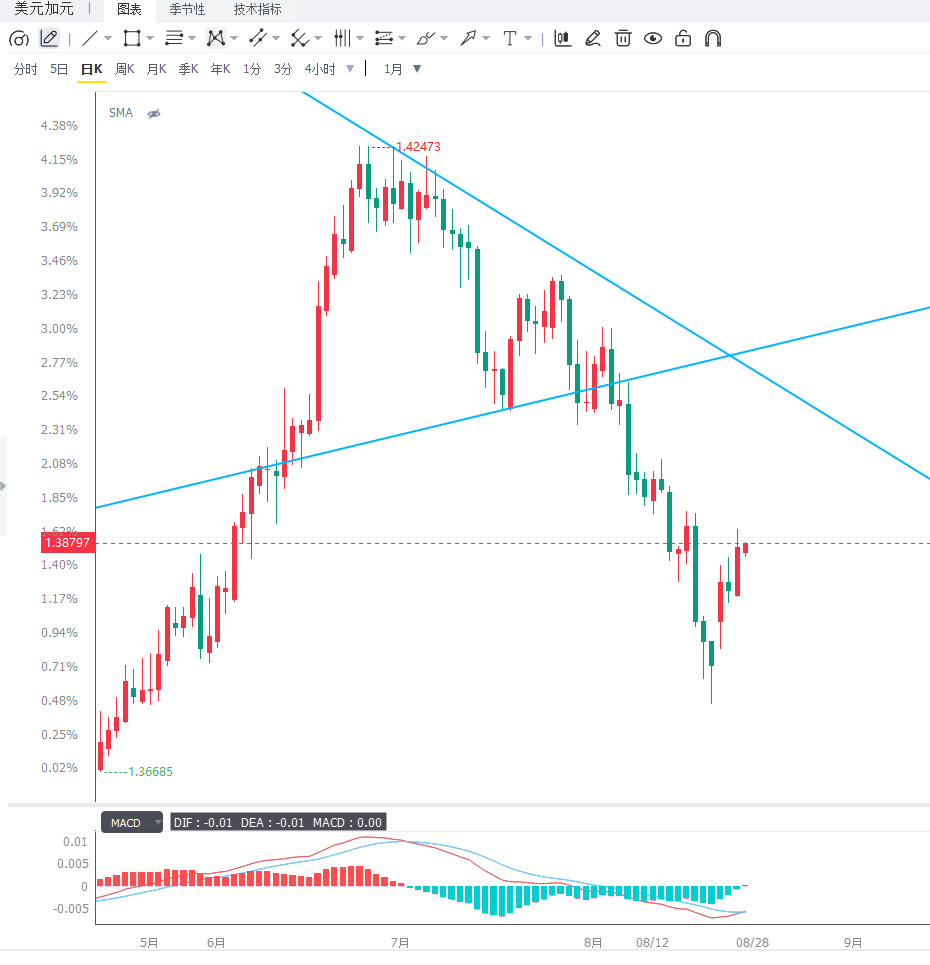
The USD/CAD pair remained near its weekly highs during Thursday's Asian trading session, hovering around the 1.3880 area. The current market fundamentals present a mixed picture: on the one hand, slightly higher-than-expected US inflation data reinforced expectations that the Federal Reserve may maintain its restrictive policy; on the other hand, oil prices were supported by energy supply risks, providing some support for the Canadian dollar, a commodity currency. Therefore, the USD/CAD pair has not yet formed a clear one-sided trend, and investors are more inclined to wait for new policy and economic data catalysts.  Energy market fluctuations are a key factor influencing the Canadian dollar. Recent arrangements between Iran and Oman regarding commercial shipping routes in the Strait of Hormuz have raised market expectations for a gradual resumption of the route, leading to a slight decrease in some of the geopolitical risk premium previously accumulated in the crude oil market. However, Iran has also warned that a full resumption of the route requires further conditions, meaning that global energy transportation risks have not been completely eliminated. Meanwhile, attacks on Russian energy infrastructure have maintained a certain risk premium in the crude oil market. This week, a drone attack caused a fire at a large oil refinery near Nizhny Novgorod, Russia, bringing renewed market attention to uncertainties in energy supply. If further disruptions occur to Russian refineries or crude oil production facilities, international oil prices may regain upward momentum, thus supporting the Canadian dollar through improvements in Canadian export revenue and terms of trade. From the perspective of the US dollar, the latest US inflation data has once again become the focus of the foreign exchange market. Data released by the US Bureau of Economic Analysis shows that the personal consumption expenditure price index rose 3.7% year-on-year in July, unchanged from the previous month but higher than market expectations. This means that US inflation remains relatively sticky and is still significantly away from the Federal Reserve's long-term target of 2%. Core PCE remained at 3.3% year-on-year, while both overall PCE and core PCE rose by approximately 0.2% monthly. The data did not show an extreme re-acceleration of inflation, but neither did it provide a sufficiently strong signal of cooling. Therefore, market expectations for further tightening by the Federal Reserve remain. For USD/CAD, as long as US interest rate expectations remain high, the dollar will have a certain yield advantage, thus limiting the downside potential of the exchange rate. Currently, there is still considerable disagreement in the market regarding the Fed's policy path. Sticky US inflation means policymakers are unlikely to quickly shift to easing, but whether economic growth and the job market can withstand higher interest rates is also a significant constraint on future policy. Investors are therefore reluctant to establish overly aggressive directional positions before the Jackson Hole meeting. Fed Chairman Kevin Warsh's speech at the Jackson Hole meeting on Friday will be a key short-term risk event. If Warsh emphasizes that inflationary pressures remain high and hints that policy needs to remain restrictive, US Treasury yields and the dollar may receive further support, and USD/CAD could break through recent highs. Conversely, if the speech focuses more on slowing economic growth and employment risks, the market may lower its expectations for further interest rate hikes, putting pressure on the dollar and pushing USD/CAD lower. Thursday's US initial jobless claims data may also provide a short-term catalyst for dollar volatility. If the employment data is stronger than expected, it will further support the judgment that US interest rates will remain high; if the job market cools significantly, it may weaken the recent upward momentum of the dollar. Meanwhile, changes in WTI crude oil prices remain an external variable that USD/CAD needs to continue to monitor. From a market sentiment perspective, USD/CAD has recently been consolidating at high levels, and investors have not fully shifted to a dollar bullish stance. Relatively firm oil prices provide some defensive capability for the Canadian dollar; however, sticky US inflation and interest rate expectations limit a significant decline in USD/CAD. Therefore, in the short term, the exchange rate is more likely to fluctuate repeatedly around key technical areas, awaiting a policy signal from the Federal Reserve to break the balance. From a daily chart perspective, USD/CAD has maintained relative strength recently, but upward momentum is not particularly strong. If the exchange rate can effectively break through the 1.3900 area, it will mean that the bulls have regained the initiative, and the next target is the 1.3960 area. If this resistance zone cannot be broken, profit-taking at higher levels may increase, and the exchange rate may fall back to the 1.3850 or even 1.3800 area. From the 4-hour chart, USD/CAD is currently trading below the 100-period simple moving average, which is located near 1.3900, so the short-term technical structure is still slightly bearish. Recently, the price has attempted to break upwards several times, but has been suppressed near 1.3900, indicating that there is significant selling pressure in this area. If the price continues to fail to recover 1.3900, the risk of a short-term pullback remains; if it falls below 1.3850, it may further test the 1.3800 level. Conversely, if the 4-hour chart effectively breaks above 1.3900, accompanied by a renewed upward expansion of the MACD, the short-term bearish structure will weaken, and the exchange rate may recover towards the 1.3960 area. If this area is also broken, further upside potential will be unlocked. Overall, the 4-hour chart remains in a high-level consolidation pattern with a slight downward bias. A break above 1.3900 or a drop below 1.3850 will be crucial technical signals for determining the next phase's direction.
  Editor's Summary: The USD/CAD pair is currently caught in a dual struggle between the US dollar's interest rate advantage and support from Canadian oil prices. The US July PCE rose 3.7% year-on-year, indicating continued inflation stickiness and providing fundamental support for the US dollar. Meanwhile, disruptions to Russian energy facilities and uncertainties surrounding the Strait of Hormuz's navigation have kept oil prices relatively resilient, thus limiting further weakness in the Canadian dollar. The core variables for the market going forward remain the Fed's policy expectations and oil prices. If the Jackson Hole meeting releases hawkish signals, USD/CAD may break upwards again; if Fed policy expectations shift towards easing while oil prices remain strong, the exchange rate may gradually decline. Therefore, it is more appropriate to focus on confirmation of direction after a breakout of key technical levels, rather than excessively chasing highs and lows within the 1.3850-1.3900 trading range.
Energy market fluctuations are a key factor influencing the Canadian dollar. Recent arrangements between Iran and Oman regarding commercial shipping routes in the Strait of Hormuz have raised market expectations for a gradual resumption of the route, leading to a slight decrease in some of the geopolitical risk premium previously accumulated in the crude oil market. However, Iran has also warned that a full resumption of the route requires further conditions, meaning that global energy transportation risks have not been completely eliminated. Meanwhile, attacks on Russian energy infrastructure have maintained a certain risk premium in the crude oil market. This week, a drone attack caused a fire at a large oil refinery near Nizhny Novgorod, Russia, bringing renewed market attention to uncertainties in energy supply. If further disruptions occur to Russian refineries or crude oil production facilities, international oil prices may regain upward momentum, thus supporting the Canadian dollar through improvements in Canadian export revenue and terms of trade. From the perspective of the US dollar, the latest US inflation data has once again become the focus of the foreign exchange market. Data released by the US Bureau of Economic Analysis shows that the personal consumption expenditure price index rose 3.7% year-on-year in July, unchanged from the previous month but higher than market expectations. This means that US inflation remains relatively sticky and is still significantly away from the Federal Reserve's long-term target of 2%. Core PCE remained at 3.3% year-on-year, while both overall PCE and core PCE rose by approximately 0.2% monthly. The data did not show an extreme re-acceleration of inflation, but neither did it provide a sufficiently strong signal of cooling. Therefore, market expectations for further tightening by the Federal Reserve remain. For USD/CAD, as long as US interest rate expectations remain high, the dollar will have a certain yield advantage, thus limiting the downside potential of the exchange rate. Currently, there is still considerable disagreement in the market regarding the Fed's policy path. Sticky US inflation means policymakers are unlikely to quickly shift to easing, but whether economic growth and the job market can withstand higher interest rates is also a significant constraint on future policy. Investors are therefore reluctant to establish overly aggressive directional positions before the Jackson Hole meeting. Fed Chairman Kevin Warsh's speech at the Jackson Hole meeting on Friday will be a key short-term risk event. If Warsh emphasizes that inflationary pressures remain high and hints that policy needs to remain restrictive, US Treasury yields and the dollar may receive further support, and USD/CAD could break through recent highs. Conversely, if the speech focuses more on slowing economic growth and employment risks, the market may lower its expectations for further interest rate hikes, putting pressure on the dollar and pushing USD/CAD lower. Thursday's US initial jobless claims data may also provide a short-term catalyst for dollar volatility. If the employment data is stronger than expected, it will further support the judgment that US interest rates will remain high; if the job market cools significantly, it may weaken the recent upward momentum of the dollar. Meanwhile, changes in WTI crude oil prices remain an external variable that USD/CAD needs to continue to monitor. From a market sentiment perspective, USD/CAD has recently been consolidating at high levels, and investors have not fully shifted to a dollar bullish stance. Relatively firm oil prices provide some defensive capability for the Canadian dollar; however, sticky US inflation and interest rate expectations limit a significant decline in USD/CAD. Therefore, in the short term, the exchange rate is more likely to fluctuate repeatedly around key technical areas, awaiting a policy signal from the Federal Reserve to break the balance. From a daily chart perspective, USD/CAD has maintained relative strength recently, but upward momentum is not particularly strong. If the exchange rate can effectively break through the 1.3900 area, it will mean that the bulls have regained the initiative, and the next target is the 1.3960 area. If this resistance zone cannot be broken, profit-taking at higher levels may increase, and the exchange rate may fall back to the 1.3850 or even 1.3800 area. From the 4-hour chart, USD/CAD is currently trading below the 100-period simple moving average, which is located near 1.3900, so the short-term technical structure is still slightly bearish. Recently, the price has attempted to break upwards several times, but has been suppressed near 1.3900, indicating that there is significant selling pressure in this area. If the price continues to fail to recover 1.3900, the risk of a short-term pullback remains; if it falls below 1.3850, it may further test the 1.3800 level. Conversely, if the 4-hour chart effectively breaks above 1.3900, accompanied by a renewed upward expansion of the MACD, the short-term bearish structure will weaken, and the exchange rate may recover towards the 1.3960 area. If this area is also broken, further upside potential will be unlocked. Overall, the 4-hour chart remains in a high-level consolidation pattern with a slight downward bias. A break above 1.3900 or a drop below 1.3850 will be crucial technical signals for determining the next phase's direction. Editor's Summary: The USD/CAD pair is currently caught in a dual struggle between the US dollar's interest rate advantage and support from Canadian oil prices. The US July PCE rose 3.7% year-on-year, indicating continued inflation stickiness and providing fundamental support for the US dollar. Meanwhile, disruptions to Russian energy facilities and uncertainties surrounding the Strait of Hormuz's navigation have kept oil prices relatively resilient, thus limiting further weakness in the Canadian dollar. The core variables for the market going forward remain the Fed's policy expectations and oil prices. If the Jackson Hole meeting releases hawkish signals, USD/CAD may break upwards again; if Fed policy expectations shift towards easing while oil prices remain strong, the exchange rate may gradually decline. Therefore, it is more appropriate to focus on confirmation of direction after a breakout of key technical levels, rather than excessively chasing highs and lows within the 1.3850-1.3900 trading range.
- Risk Warning and Disclaimer
- The market involves risk, and trading may not be suitable for all investors. This article is for reference only and does not constitute personal investment advice, nor does it take into account certain users’ specific investment objectives, financial situation, or other needs. Any investment decisions made based on this information are at your own risk.