The combined effects of conflicts between the US and Iran, the Houthis, and Russia and Ukraine, coupled with insufficient IEA reserve releases, have increased tail risks in the crude oil market.
2026-10-16 16:38:20
On Friday (October 16th) during the Asian and European sessions, international oil prices continued to consolidate at high levels. Thursday's gains exceeded 3% at one point, and previous articles had warned of a high probability of a price breakout, which indeed occurred, with prices ultimately closing within the previously indicated trading range. Recently, the global crude oil market has been continuously driven by multiple geopolitical conflicts, including concerns about the security of major shipping routes in the Middle East, threats to Red Sea shipping, and disruptions to refined oil supply from Russia and Ukraine, leading to high-level price fluctuations. Although Brent and WTI crude oil prices retreated slightly during the day, they still closed higher on the weekly chart. From a trading perspective, institutions believe that current oil prices have not yet fully priced in the potential risk of supply disruptions, and there is still potential for further upward movement. 
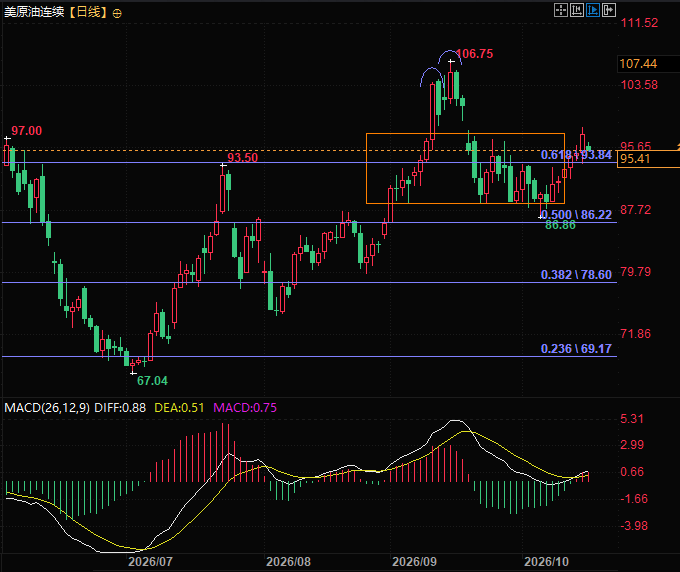 (WTI crude oil futures daily chart, source: EasyForex) Beijing time
The ongoing US-Iran standoff keeps shipping risks high in the Strait of Hormuz.
The US-Iran standoff is currently the most critical risk factor in the oil market. The shipping threat in the Strait of Hormuz remains at a "serious" level, with the UK Maritime Trade Authority warning of a very high probability of attacks on merchant ships. On October 11th and 13th, eight attacks involving unidentified munitions occurred in the strait, affecting four oil tankers and four container ships. A Singapore-flagged container ship sank in the strait, but all crew members were safely evacuated. The US and Iran have conflicting accounts of the cause of the sinking: Iran claims the ship struck a mine, while the US Central Command states the ship was hit by Iranian munitions and capsized during towing. The US continues to escalate financial sanctions against Iran, with the US Treasury Department releasing a new sanctions list covering 16 individuals and 10 entities, further cutting off Iran's funding for military operations. Investigations show that since the outbreak of the conflict in February, Iran and its allies have carried out at least 135 precision drone and missile strikes against 84 critical infrastructure sites in the Gulf states, targeting core assets including oil and gas facilities, airports, and pipelines. Even if such attacks do not cause a complete shutdown, they will increase shipping insurance and logistics costs, disrupting regional supply chains and business confidence. While Trump is signaling a potential end to the conflict, the US is still evaluating further strike options, and the fluctuating situation is increasing market uncertainty.The Houthi offensive escalates, putting pressure on Saudi infrastructure and adding further concerns to the Red Sea shipping lanes.
The Houthi rebels in Yemen have simultaneously escalated their operations, opening a new front in the regional conflict. Recently, the Houthis launched multiple ballistic missiles into residential areas of Marib, Yemen, and also attacked the presidential palace complex in Aden, causing casualties among security personnel. This is the first time the Houthis have attacked the presidential palace in Aden in this round of conflict; the location is the core headquarters of the Saudi-backed internationally recognized government of Yemen. The Houthis claimed responsibility for the attacks on the Saudi military headquarters in Aden and continue to launch missiles and drones at Saudi airports, ports, and oil infrastructure. The continued pressure on Saudi civilian infrastructure has also raised market concerns about further disruptions to shipping in the Red Sea and the Bab el-Mandeb Strait. With two of the world's core energy shipping routes simultaneously under threat, oil shipping risk premiums are further increasing.IEA releases less than market expectations, making it difficult to quickly alleviate the diesel shortage.
To offset supply shortages, the IEA announced an accelerated release of reserves, releasing over 20 million barrels of diesel, fulfilling the remaining portion of its large-scale emergency reserve release plan pledged in March, bringing the total released reserves to 330 million barrels. However, the market was clearly disappointed with the scale of this release, having previously expected a release of 50 million barrels of diesel. European diesel futures briefly surged after the announcement, reflecting the market's belief that this release would be insufficient to substantially alleviate the refined product shortage. Saxo Bank analysts pointed out that while there is no absolute supply disruption, the market needs stronger commitments to new supply, and maintaining reserves is a reasonable strategy. The US continues to pressure the EU to use its reserves in an attempt to suppress diesel prices and alleviate domestic inflationary pressures.The conflict between Russia and Ukraine has taken another turn, with attacks on oil refining facilities disrupting global diesel supply.
The Russia-Ukraine conflict continues to disrupt the global diesel supply chain. Ukraine recently launched nighttime attacks on Russian oil refining facilities, which Ukraine claims were retaliation for Russia's violation of the energy ceasefire agreement. The Kremlin stated that such attacks are detrimental to US-led peace negotiations. Putin also clearly stated that Russia will respond in kind to Ukraine's attacks on refining, logistics, and energy facilities. The continued attacks on Russian refining units have added further uncertainty to the already tight global diesel supply, and the strength of diesel prices, in turn, is supporting the bottom of crude oil prices.Institutional View: Oil prices have not yet fully factored in geopolitical risks, and there is still potential for further price increases.
At the market level, Jeff Currie, founder of Real Macro, made a judgment that traders should pay attention to: Brent crude oil has now almost become an "emotion-driven contract," with prices significantly decoupled from actual supply and demand fundamentals. WTI is holding near $95, and Brent is holding around $106 per barrel, but these prices do not fully reflect the supply risks along the Strait of Hormuz and the Black Sea coast. Refined oil and shipping costs have risen sharply, but crude oil futures have failed to keep pace. This price divergence between futures and spot markets creates tail risks that are difficult to price, reducing companies' willingness to hedge. If shipping through the Strait of Hormuz is widely disrupted or Middle Eastern oil production facilities are attacked, the potential for a price rebound will open up rapidly.Summary and Technical Analysis:
Currently, attacks on cargo ships have locked in crude oil transportation costs, making spot oil prices more likely to rise than fall. Meanwhile, Russian refineries are one of Ukraine's strategic assets. Geopolitical risks in the oil market continue to accumulate, making it difficult to fully realize the risk premium for crude oil. At the same time, the IEA's reserve release has had a positive effect but lacks strength, only providing temporary reassurance and failing to eradicate security risks in Middle Eastern shipping lanes. New attacks could occur at any time along the three conflict lines: Houthi, US-Iran, and Russia-Ukraine. In the short term, oil prices are likely to remain volatile at high levels. If key shipping routes or large refining facilities are damaged, crude oil and diesel prices could rise rapidly. In trading, special attention should be paid to the supply and demand narrative for diesel, and continued monitoring of ship traffic data in the Strait of Hormuz, US-Iran diplomatic statements, and the IEA's subsequent reserve release progress is necessary. Technically, the WTI crude oil futures contract is approaching the previous price gap (the chart shows today's lower opening price was due to the rollover of the main contract, with an actual drop of only 1%). Coupled with potential US intervention, recent price volatility may intensify, and the upward momentum may slow. (WTI crude oil futures daily chart, source: EasyForex) Beijing time
- Risk Warning and Disclaimer
- The market involves risk, and trading may not be suitable for all investors. This article is for reference only and does not constitute personal investment advice, nor does it take into account certain users’ specific investment objectives, financial situation, or other needs. Any investment decisions made based on this information are at your own risk.