The British pound continued its oversold rebound against the US dollar, hitting a two-week high.
2026-10-16 15:10:21
The pound traded around 1.3310 against the dollar in Asian trading on Friday, with little change from the previous day's close. The exchange rate remains caught in a tug-of-war between strong dollar pressure and resilient pound fundamentals, lacking clear momentum for a breakout in the short term.  The US dollar continued to benefit from better-than-expected US inflation data. The US PPI rose 6.3% year-on-year and 1.3% month-on-month in September, both the highest since 2022; core PPI rose 5.0% year-on-year and 0.7% month-on-month, also exceeding expectations. Rising energy prices were the main driver, with energy prices surging 10.8% month-on-month in September, with gasoline prices rising even more significantly, indicating that inflationary pressures are spreading from upstream production to a wider range of goods and services. Retail sales, also released on the same day, rose 0.8% month-on-month in September, exceeding expectations, showing that nominal consumption remains resilient. However, the inflation data has not fully translated into a certainty of a short-term interest rate hike. CME FedWatch shows that the market is currently pricing in a rate hike in October at around 29%, and the probability of at least one rate hike in December remains close to 90%. Federal Reserve Chairman Warsh will speak at the IMF annual meeting in Bangkok on Friday, and the market will focus on whether he signals a lack of confidence in a decline in inflation or further tightening of policy. If his speech is hawkish, the dollar may receive further support; if it is dovish, it will help alleviate pressure on non-US currencies. Regarding the pound, UK GDP grew 0.1% month-on-month in August, higher than the market expectation of a 0.1% decline, and the year-on-year growth rate rebounded to 2.1%, the highest since October 2022. Growth was mainly contributed by manufacturing, computer programming, and artificial intelligence-related industries, showing that the UK economy still has some resilience in the face of energy shocks. This data strengthened market pricing in a Bank of England rate hike in November, with most economists expecting the Bank of England to raise rates to 4.0%. However, the pound's upside potential is also constrained by multiple factors. Bank of England Governor Bailey said on Friday that the second-round effect of rising energy prices appears to have been contained so far, but it is too early to judge. He still called high inflation "extremely frustrating" and pointed out that the situation in the Middle East is a significant driver of UK government bond yields. This statement was more balanced than before, neither explicitly ruling out a November rate hike nor entirely weakening market bets on consecutive large rate hikes. Meanwhile, the narrowing fiscal buffer in the UK, the approaching budget on October 28, and high long-term government bond yields also make it difficult for the pound to break out of its range-bound trading pattern. From a technical perspective, the GBP/USD pair remains below its 100-day simple moving average on the daily chart, which is around 1.3390 and constitutes a significant medium-term resistance level. The price is currently near the upper Bollinger Band, which is around 1.3250, the upper band around 1.3335, and the lower band around 1.3160. The RSI (14) is around 47, close to the neutral zone, indicating insufficient directional momentum. On the 4-hour chart, the price fluctuates between 1.3250 and 1.3335, with short-term moving averages flattening and MACD momentum weak, yet no effective breakout signal has formed. Regarding resistance levels, 1.3335 is the initial resistance near the upper Bollinger Band, 1.3390 is the key resistance level where the 100-day moving average is located, and 1.3420 to 1.3450 is a stronger resistance zone. Support levels are at 1.3250, 1.3200, and 1.3160. If the price breaks below 1.3250, it may retrace further to the 1.3200-1.3160 area; if it breaks through 1.3335 with increased volume and holds above 1.3390, the short-term bearish structure may ease, and it could challenge the 1.3400-1.3450 area.
 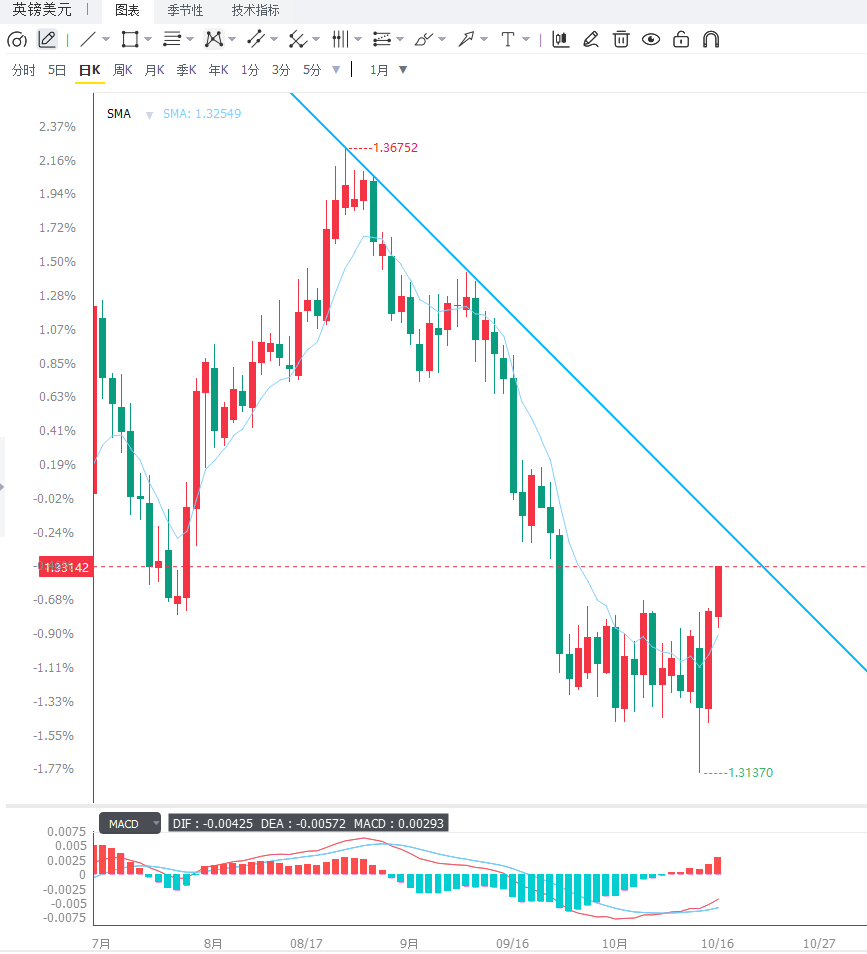 Editor's Summary: The British pound is expected to remain range-bound against the US dollar in the short term. The US dollar is supported by better-than-expected US PPI and expectations of a year-end rate hike, but the probability of an October rate hike is limited. The pound benefits from the resilience of the UK economy and expectations of a November rate hike, but Bailey's balanced remarks and continued fiscal uncertainty are concerning. Key events to watch include speeches by Bailey and Warsh, UK September inflation data, the UK budget on October 28th, and subsequent US CPI, PCE, and industrial production data.
The US dollar continued to benefit from better-than-expected US inflation data. The US PPI rose 6.3% year-on-year and 1.3% month-on-month in September, both the highest since 2022; core PPI rose 5.0% year-on-year and 0.7% month-on-month, also exceeding expectations. Rising energy prices were the main driver, with energy prices surging 10.8% month-on-month in September, with gasoline prices rising even more significantly, indicating that inflationary pressures are spreading from upstream production to a wider range of goods and services. Retail sales, also released on the same day, rose 0.8% month-on-month in September, exceeding expectations, showing that nominal consumption remains resilient. However, the inflation data has not fully translated into a certainty of a short-term interest rate hike. CME FedWatch shows that the market is currently pricing in a rate hike in October at around 29%, and the probability of at least one rate hike in December remains close to 90%. Federal Reserve Chairman Warsh will speak at the IMF annual meeting in Bangkok on Friday, and the market will focus on whether he signals a lack of confidence in a decline in inflation or further tightening of policy. If his speech is hawkish, the dollar may receive further support; if it is dovish, it will help alleviate pressure on non-US currencies. Regarding the pound, UK GDP grew 0.1% month-on-month in August, higher than the market expectation of a 0.1% decline, and the year-on-year growth rate rebounded to 2.1%, the highest since October 2022. Growth was mainly contributed by manufacturing, computer programming, and artificial intelligence-related industries, showing that the UK economy still has some resilience in the face of energy shocks. This data strengthened market pricing in a Bank of England rate hike in November, with most economists expecting the Bank of England to raise rates to 4.0%. However, the pound's upside potential is also constrained by multiple factors. Bank of England Governor Bailey said on Friday that the second-round effect of rising energy prices appears to have been contained so far, but it is too early to judge. He still called high inflation "extremely frustrating" and pointed out that the situation in the Middle East is a significant driver of UK government bond yields. This statement was more balanced than before, neither explicitly ruling out a November rate hike nor entirely weakening market bets on consecutive large rate hikes. Meanwhile, the narrowing fiscal buffer in the UK, the approaching budget on October 28, and high long-term government bond yields also make it difficult for the pound to break out of its range-bound trading pattern. From a technical perspective, the GBP/USD pair remains below its 100-day simple moving average on the daily chart, which is around 1.3390 and constitutes a significant medium-term resistance level. The price is currently near the upper Bollinger Band, which is around 1.3250, the upper band around 1.3335, and the lower band around 1.3160. The RSI (14) is around 47, close to the neutral zone, indicating insufficient directional momentum. On the 4-hour chart, the price fluctuates between 1.3250 and 1.3335, with short-term moving averages flattening and MACD momentum weak, yet no effective breakout signal has formed. Regarding resistance levels, 1.3335 is the initial resistance near the upper Bollinger Band, 1.3390 is the key resistance level where the 100-day moving average is located, and 1.3420 to 1.3450 is a stronger resistance zone. Support levels are at 1.3250, 1.3200, and 1.3160. If the price breaks below 1.3250, it may retrace further to the 1.3200-1.3160 area; if it breaks through 1.3335 with increased volume and holds above 1.3390, the short-term bearish structure may ease, and it could challenge the 1.3400-1.3450 area. Editor's Summary: The British pound is expected to remain range-bound against the US dollar in the short term. The US dollar is supported by better-than-expected US PPI and expectations of a year-end rate hike, but the probability of an October rate hike is limited. The pound benefits from the resilience of the UK economy and expectations of a November rate hike, but Bailey's balanced remarks and continued fiscal uncertainty are concerning. Key events to watch include speeches by Bailey and Warsh, UK September inflation data, the UK budget on October 28th, and subsequent US CPI, PCE, and industrial production data.
- Risk Warning and Disclaimer
- The market involves risk, and trading may not be suitable for all investors. This article is for reference only and does not constitute personal investment advice, nor does it take into account certain users’ specific investment objectives, financial situation, or other needs. Any investment decisions made based on this information are at your own risk.