Has the ECB suddenly put October and December on the table, and the real risks for the euro have changed?
2026-08-27 18:45:00
On Thursday, August 27th, European monetary policy once again became a core pricing variable in the foreign exchange market. The European Central Bank (ECB) kept interest rates unchanged at its July meeting, with the deposit facility rate at 2.25%, the main refinancing rate at 2.40%, and the marginal lending rate at 2.65%. The ECB also explicitly stated that it will continue to adopt a data-driven, meeting-by-meeting decision-making approach, without pre-committing to a specific interest rate path. Against this backdrop, ECB Governing Council member Dimitar Radev suggested that policy adjustments might still be discussed at the October and December meetings, warning that waiting for full confirmation of wage and broad price pressures before taking action could lead to policy lag. The market significance of this statement lies not only in the hawkish tone itself, but also in the fact that internal ECB discussions are gradually shifting from simply observing the energy shock to assessing the dynamic balance between inflation spread, wage transmission, and financial conditions. Regarding exchange rates, the euro has recently been trading above 1.16 against the US dollar, remaining in a relatively high range. Current euro pricing can no longer be simply attributed to interest rate differentials, but has entered a phase where inflation resilience, economic growth, policy credibility, and cross-market volatility all play a role.  Radev emphasized that action should not be taken until the second round of inflation fully manifests, a point that deserves close attention. The so-called second-round effect is not primarily a one-off increase in energy prices, but rather the spread of the initial cost shock to wages, service prices, and corporate pricing behavior. If this transmission becomes persistent, policymakers will no longer face short-term price disturbances, but rather the problem of underlying inflation re-solidifying. This risk is not currently an abstract discussion. Latest data shows that the Eurozone's Harmonized Index of Consumer Prices (HICP) rose 2.9% year-on-year in July, higher than June's 2.8% and significantly above the ECB's 2% medium-term target. Services contributed 1.55 percentage points to overall inflation, while energy contributed 0.94 percentage points. The importance of service inflation lies in its typically closer relationship with wages, rents, and localization costs, and its slower adjustment compared to energy and commodity prices. Therefore, even if energy volatility subsequently weakens, as long as service prices remain sticky, the ECB will find it difficult to confirm the relief of price pressures based solely on a short-term decline in overall inflation. In June, the European Central Bank (ECB) raised interest rates by 25 basis points due to the energy shock and projected overall inflation to average 3.0% in 2026, 2.3% in 2027, and return to 2.0% in 2028. Therefore, the core of current policy discussions is not simply judging whether interest rates are high or low, but rather confirming whether the degree of restraint is sufficient to suppress the spread of inflation. Radev's suggestion that around 2.5% might be close to the neutral interest rate is structurally more significant than whether to adjust rates at a single meeting. The neutral interest rate is not a fixed figure that can be observed in real time, but rather a theoretically appropriate level of interest rates that neither stimulates nor suppresses economic activity. Its estimate changes with productivity, demographics, fiscal environment, and savings-investment relationships. Currently, the ECB's deposit facility rate is 2.25%. If some policymakers believe the neutral level is around 2.5%, then the market needs to re-examine whether current policy is still significantly restrictive or has already approached a more neutral range. However, judging the tightness or looseness of policy cannot rely solely on nominal interest rates. Real financing costs, bank credit standards, corporate bond financing, and housing loan conditions also determine the strength of monetary policy transmission. The European Central Bank (ECB) has explicitly included financial conditions and the strength of policy transmission in its decision-making framework, which explains why Radev simultaneously emphasized the impact of tightening financial conditions on the real economy. Economic data currently offers no single answer. Eurozone GDP grew 0.4% quarter-on-quarter in the second quarter, with employment increasing by 0.1%; the unemployment rate in June was 6.3%, unchanged from May and the same period last year. Economic activity continues to grow, but the pace is insufficient to eliminate the constraints of policy tightening on the demand side. Therefore, the ECB faces a typical situation of coexisting inflationary risks and growth costs. For the euro against the dollar, the more important factor is not whether the ECB is unilaterally hawkish, but rather the relative changes between the ECB's and the Federal Reserve's policy functions. Latest data shows that US real GDP grew at an annualized rate of 1.5% in the second quarter, lower than the 2.1% in the first quarter. Personal consumption expenditure (PCE) rose 0.2% month-on-month in July, with real PCE essentially flat. Meanwhile, the PCE price index rose 3.7% year-on-year in July, with the core index rising 3.3% year-on-year. This data suggests that the dollar also faces the problem of slowing growth and price pressures. Therefore, short-term fluctuations in the euro exchange rate are more likely to reflect the difference in the speed of interest rate expectation adjustments between the two sides, rather than simply reflecting which side's economy is stronger. Looking at the daily chart, the euro/dollar exchange rate previously experienced a significant upward shift in its trading range, with the price briefly approaching the upper Bollinger Band before consolidating at higher levels. The Bollinger Bands are still wider than before, indicating that recent actual volatility is higher than during the previous compression phase. The MACD remains above the zero line, but the histogram is narrowing, reflecting a change in short-term price momentum compared to the previous acceleration phase.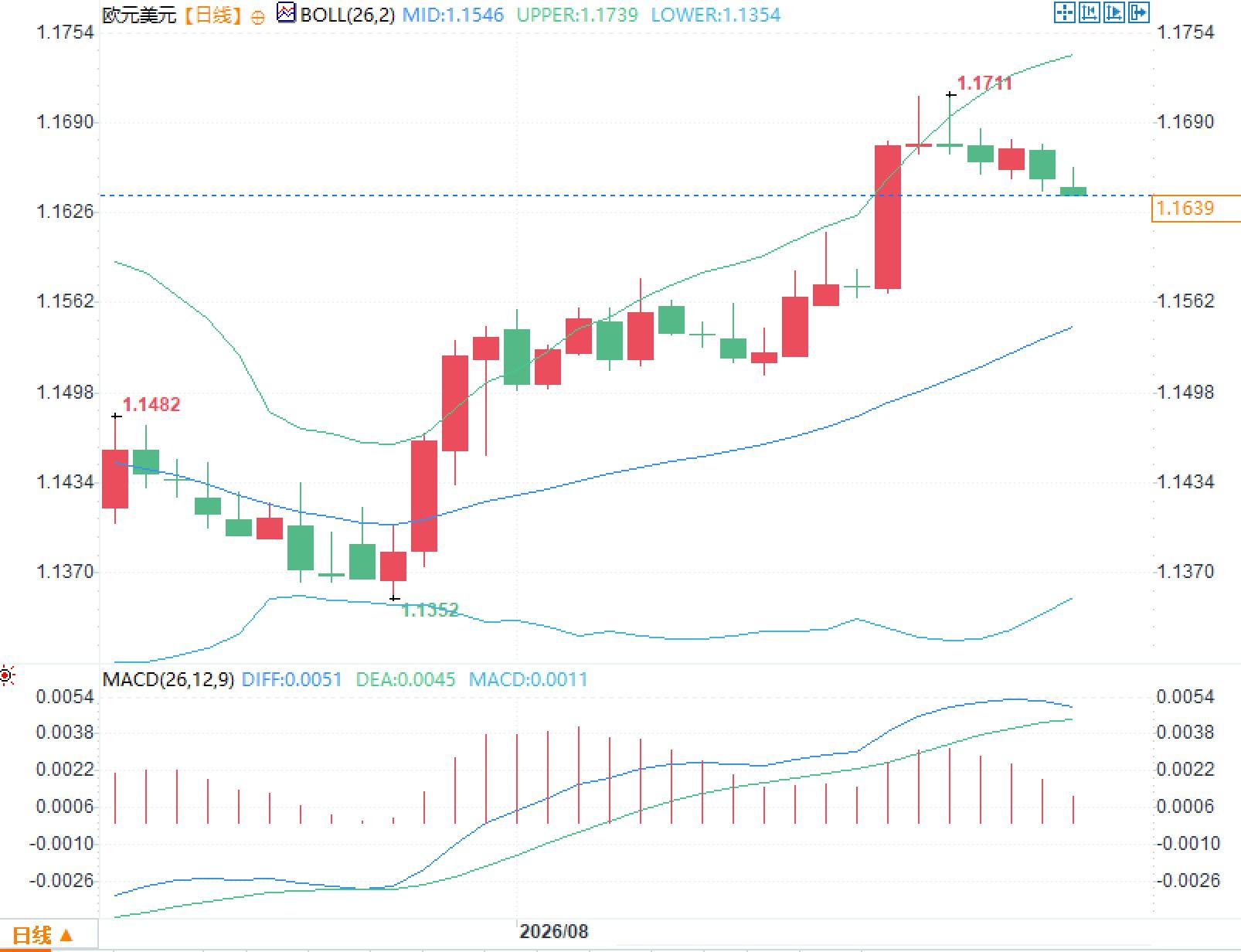
Radev emphasized that action should not be taken until the second round of inflation fully manifests, a point that deserves close attention. The so-called second-round effect is not primarily a one-off increase in energy prices, but rather the spread of the initial cost shock to wages, service prices, and corporate pricing behavior. If this transmission becomes persistent, policymakers will no longer face short-term price disturbances, but rather the problem of underlying inflation re-solidifying. This risk is not currently an abstract discussion. Latest data shows that the Eurozone's Harmonized Index of Consumer Prices (HICP) rose 2.9% year-on-year in July, higher than June's 2.8% and significantly above the ECB's 2% medium-term target. Services contributed 1.55 percentage points to overall inflation, while energy contributed 0.94 percentage points. The importance of service inflation lies in its typically closer relationship with wages, rents, and localization costs, and its slower adjustment compared to energy and commodity prices. Therefore, even if energy volatility subsequently weakens, as long as service prices remain sticky, the ECB will find it difficult to confirm the relief of price pressures based solely on a short-term decline in overall inflation. In June, the European Central Bank (ECB) raised interest rates by 25 basis points due to the energy shock and projected overall inflation to average 3.0% in 2026, 2.3% in 2027, and return to 2.0% in 2028. Therefore, the core of current policy discussions is not simply judging whether interest rates are high or low, but rather confirming whether the degree of restraint is sufficient to suppress the spread of inflation. Radev's suggestion that around 2.5% might be close to the neutral interest rate is structurally more significant than whether to adjust rates at a single meeting. The neutral interest rate is not a fixed figure that can be observed in real time, but rather a theoretically appropriate level of interest rates that neither stimulates nor suppresses economic activity. Its estimate changes with productivity, demographics, fiscal environment, and savings-investment relationships. Currently, the ECB's deposit facility rate is 2.25%. If some policymakers believe the neutral level is around 2.5%, then the market needs to re-examine whether current policy is still significantly restrictive or has already approached a more neutral range. However, judging the tightness or looseness of policy cannot rely solely on nominal interest rates. Real financing costs, bank credit standards, corporate bond financing, and housing loan conditions also determine the strength of monetary policy transmission. The European Central Bank (ECB) has explicitly included financial conditions and the strength of policy transmission in its decision-making framework, which explains why Radev simultaneously emphasized the impact of tightening financial conditions on the real economy. Economic data currently offers no single answer. Eurozone GDP grew 0.4% quarter-on-quarter in the second quarter, with employment increasing by 0.1%; the unemployment rate in June was 6.3%, unchanged from May and the same period last year. Economic activity continues to grow, but the pace is insufficient to eliminate the constraints of policy tightening on the demand side. Therefore, the ECB faces a typical situation of coexisting inflationary risks and growth costs. For the euro against the dollar, the more important factor is not whether the ECB is unilaterally hawkish, but rather the relative changes between the ECB's and the Federal Reserve's policy functions. Latest data shows that US real GDP grew at an annualized rate of 1.5% in the second quarter, lower than the 2.1% in the first quarter. Personal consumption expenditure (PCE) rose 0.2% month-on-month in July, with real PCE essentially flat. Meanwhile, the PCE price index rose 3.7% year-on-year in July, with the core index rising 3.3% year-on-year. This data suggests that the dollar also faces the problem of slowing growth and price pressures. Therefore, short-term fluctuations in the euro exchange rate are more likely to reflect the difference in the speed of interest rate expectation adjustments between the two sides, rather than simply reflecting which side's economy is stronger. Looking at the daily chart, the euro/dollar exchange rate previously experienced a significant upward shift in its trading range, with the price briefly approaching the upper Bollinger Band before consolidating at higher levels. The Bollinger Bands are still wider than before, indicating that recent actual volatility is higher than during the previous compression phase. The MACD remains above the zero line, but the histogram is narrowing, reflecting a change in short-term price momentum compared to the previous acceleration phase.
- Risk Warning and Disclaimer
- The market involves risk, and trading may not be suitable for all investors. This article is for reference only and does not constitute personal investment advice, nor does it take into account certain users’ specific investment objectives, financial situation, or other needs. Any investment decisions made based on this information are at your own risk.