The gold supercycle is far from over; strategists assert that prices will continue to rise until the debt crisis is resolved.
2026-08-28 10:41:02
Gold's dramatic surge over the past few years has pushed prices to previously unimaginable levels. But one market strategist cautions investors against being distracted by various price targets. John LaForge, chief alternative strategist at Ned Davis Research, says gold trading remains remarkably simple: the long-term trend for the precious metal will continue upward until governments around the world finally confront their growing debt burdens.
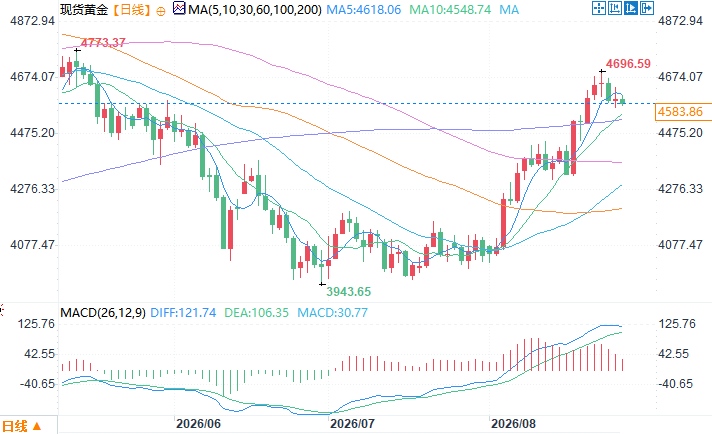 Spot gold daily chart source: EasyTrade. At 10:39 AM Beijing time on August 28th, spot gold was trading at $4588.86 per ounce.
When will gold prices peak? The answer lies in debt.
Lafucci stated, "I think gold prices will peak when people learn how to manage their debt. The longer we let it slide, the more we don't pay it off and the more debt piles up, the higher gold prices will rise." When asked if investors should be eyeing $8,000, $10,000, or even $12,000 per ounce, Lafucci said these price levels weren't particularly important to his outlook. He stated, "For me, there's no such thing as 8,000 or $12,000. I only know that the trend is upward until we resolve our government debt. I think we can still see years of price increases because I don't feel any global politicians or leaders want to address this issue." Despite gold rising from around $1,500 to over $4,000 per ounce in the past decade, Lafucci said the precious metal still has significant upside potential. He believes the market is in its sixth or seventh year of a broader commodities supercycle, and there's no evidence that the long-term trend is nearing exhaustion.Central banks are driving structural demand, and gold enjoys a unique status as an asset for its holders.
Lafocchi describes the current environment as one of the strongest fundamental backdrops for gold in history. He states that the key difference in this cycle is that traditional reserve assets have become a significant source of structural demand as central banks reassess the safety of these assets. This shift accelerated significantly after the outbreak of the Russia-Ukraine conflict in 2022 and the subsequent freeze of Russia's foreign exchange reserves. Lafocchi explains that this event forced central banks to realize that assets held within the global credit system are ultimately still exposed to government control. In contrast, gold remains one of the few globally recognized holder assets that can be physically held outside the credit system. He states, "Central banks don't have many holder assets, but they are universally recognized. If you give them a gold bar, they will accept it as payment."With debt piling up, currency devaluation is the only way out.
Meanwhile, LaFauci stated that the massive expansion of sovereign debt is creating increasingly strong tailwinds for hard assets. As governments continue to pile up debt, he believes there is virtually no politically acceptable way out except ultimately resorting to currency devaluation. He stated, "There is no other way to repay these debts except by devaluing everything, and that's the biggest tailwind for gold." While the US sovereign debt surpassing $40 trillion has brought the US economic situation under intense scrutiny in recent weeks, LaFauci suggested that Japan might offer an important warning to other highly indebted developed economies. He said Western policymakers had hoped Japan would prove that even with massive debt, governments could suppress borrowing costs indefinitely through yield curve control. However, rising yields in Japan and the exit from decades of ultra-loose monetary policy have precisely demonstrated the limitations of this strategy. He stated, "Many Western countries also have to find ways to solve their debt problems in the same way. The last thing those in power want to see is prove that yield curve control doesn't work."The gold price pullback is merely awaiting a catalyst; there are zero signs of a top.
Lafucci stated that he remained bullish on gold throughout the months-long correction, as government debt continued to rise. He added that the Treasury's market intervention reignited the devaluation trade, and what he sees as the gold sell-off is simply the market waiting for another catalyst. A key signal is gold's long-term momentum: despite record highs this year, Lafucci said none of the indicators he watches have issued the explosive topping signals typically marking the end of a commodity supercycle. "Not one, not a single one," he said. He added that gold's current momentum is more like a mid-cycle move than the speculative overheating seen near the 2011 peak. This context is also shaping Lafucci's portfolio strategy. He suggests investors consider building at least 10% of their portfolio into alternative assets, with gold at approximately 5%. Gold should be given the largest weighting because it provides the most direct exposure to the structural debt and monetary pressures driving this cycle. "Gold is at a historically unique moment," Lafucci said, "a moment when all the factors are converging."Conclusion
Lafocchi stated that the ultimate end of the gold bull market is unlikely to be determined by whether prices reach $8,000, $10,000, or any other predetermined level. Investors should focus more on the moment when governments finally implement fiscal discipline and restore confidence in the fiat currency system. Until then, he believes there is little reason for gold's structural trend to change. He said, "It hasn't completely derailed, but it's almost like a train accelerating from 40 miles per hour to 120 miles per hour. We have to slow it down, or we won't be able to stay on the tracks." Spot gold daily chart source: EasyTrade. At 10:39 AM Beijing time on August 28th, spot gold was trading at $4588.86 per ounce.
- Risk Warning and Disclaimer
- The market involves risk, and trading may not be suitable for all investors. This article is for reference only and does not constitute personal investment advice, nor does it take into account certain users’ specific investment objectives, financial situation, or other needs. Any investment decisions made based on this information are at your own risk.