The probability of an interest rate hike has dropped to only 15%! Pound bulls are "lying flat," but will Jackson Hole's decision be the decisive factor?
2026-08-28 11:01:03
On Friday (August 28) during the Asian session, the British pound traded in a narrow range against the US dollar, currently hovering around 1.3590, almost unchanged for the day. The recent decline in Brent crude oil prices has eased concerns about UK inflation, pushing back market expectations for the Bank of England's next interest rate hike from the end of 2026 to the beginning of 2027. LSEG data shows that financial markets are pricing in only 24 basis points of tightening before December, 36 basis points before February 2027, and less than 4 basis points before the September meeting (approximately a 15% probability of a rate hike). 
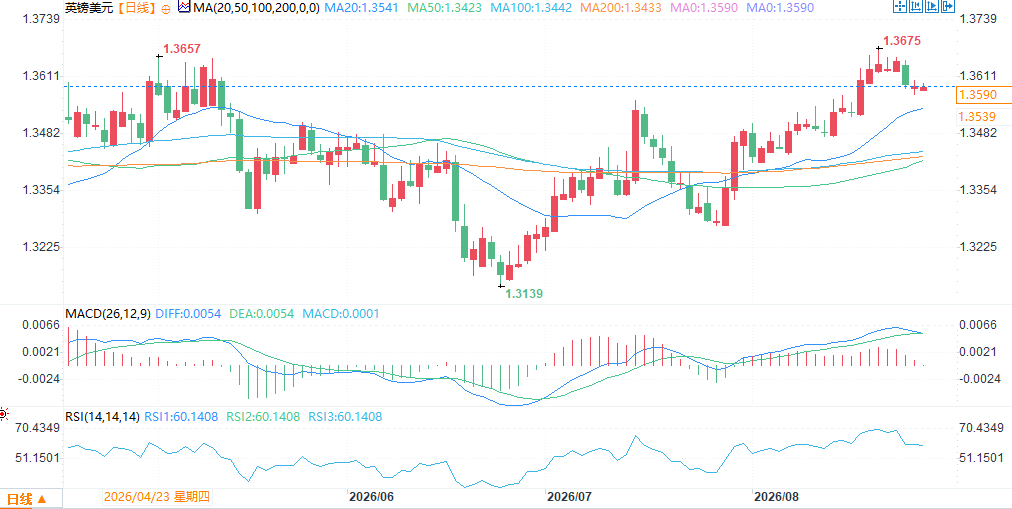 (GBP/USD daily chart, source: FX678) At 10:58 Beijing time, GBP/USD was trading at 1.3591/92.
Falling oil prices delay interest rate hike expectations; pound lacks short-term drivers.
Brent crude oil prices have recently fallen significantly, effectively easing market concerns about UK inflation and prompting traders to postpone their expectations for the Bank of England's next interest rate hike from the end of 2026 to the beginning of 2027. LSEG data shows that financial markets are currently pricing in only about 24 basis points of tightening before December, and a cumulative 36 basis points before February 2027, while the probability of a rate hike before the September meeting is less than 4 basis points, or about 15%. Most economists expect the official interest rate to remain at 3.75% by the end of the year. Although inflation rose to 2.9% in July due to an increase in energy bills, and the market expects it to rise further before the end of the year, the continued weakness in the labor market keeps the Bank of England highly cautious. Scotiabank points out that recent UK data has been generally light, and the policy signals released by central bank officials have also been limited, further softening expectations of moderate tightening. In the absence of strong domestic drivers, the pound is more likely to fluctuate in the short term following external risk sentiment and the dollar's movement, with relatively limited upside and downside potential. The market is awaiting more decisive data or policy guidance.Market focus on Jackson Hole; options market may underestimate risk.
Global markets are highly focused on Federal Reserve Chairman Kevin Warsh's keynote speech at Friday's Jackson Hole symposium, seeking the latest signals on US interest rate policy. Scotiabank analysis points out that while historical experience suggests Jackson Hole "can have a significant impact on market pricing," the current risk expectations reflected in the options market are clearly insufficient. One-week options implied volatility is far below the recent average, indicating that traders may be overly complacent about Warsh's speech and its potential impact. Even though the dollar has strengthened slightly before the event, the market as a whole has not fully priced in a possible policy surprise. If Warsh releases a hawkish signal, the dollar may strengthen further and put pressure on the pound; if his remarks are dovish or focus on long-term structural issues, it will help stabilize risk assets and the pound in the short term. The low volatility pricing in the options market contrasts sharply with the historical impact of the event, prompting investors to be wary of potential sharp fluctuations after the speech. Overall, Jackson Hole will be a key variable driving the short-term movements of the pound and the dollar.Institutional Views
Bank of America adopted a "downward then upward" stance for the pound against the dollar in its latest forecast. The target is 1.32 in the third quarter, rising to 1.37 by the end of 2026, followed by 1.45 by the end of 2027, and further to 1.47 in 2028. The near-term caution stems primarily from the dollar's continued support from US growth resilience and hawkish expectations from the Federal Reserve, as well as insufficient clarity regarding UK policy. Bank of America believes the pound is relatively attractive but prefers to wait for greater clarity on the UK policy path before actively positioning itself. Bank of America points out that the pound's volatility is relatively cheap and it may benefit from election-related or policy-related uncertainties. JPMorgan Chase holds a mildly bearish stance on the pound against the dollar, forecasting levels around 1.31 in September, 1.28 in December, and 1.30 in March 2027. The main drivers are rising political uncertainty in the UK (issues related to Labour leadership) and the potential for insufficient details in fiscal planning to re-increase political risk premiums. Investor positions are currently net short, indicating that the market has partially priced in depreciation expectations. JPMorgan Chase believes the pound will remain around 0.88-0.89 against the euro and trade in the 1.31-1.34 range against the dollar, showing a generally mild weakening trend. If the US exceptionalism persists and the Federal Reserve remains relatively hawkish, the pound's upside potential will be further limited.Summarize
Falling oil prices eased inflation concerns, pushing back market expectations for a Bank of England rate hike to early 2027, with only a 15% probability of a rate hike at the September meeting. Most economists expect rates to remain at 3.75% until the end of the year. Scotiabank noted limited UK data and central bank signals. The market is focused on Jackson Hole's speech, and Scotiabank warned that the options market suggests investors may be underestimating its impact. The pound is likely to fluctuate between 1.3550 and 1.3650 in the short term, awaiting new directional guidance from Jackson Hole. (GBP/USD daily chart, source: FX678) At 10:58 Beijing time, GBP/USD was trading at 1.3591/92.
- Risk Warning and Disclaimer
- The market involves risk, and trading may not be suitable for all investors. This article is for reference only and does not constitute personal investment advice, nor does it take into account certain users’ specific investment objectives, financial situation, or other needs. Any investment decisions made based on this information are at your own risk.