With the European Central Bank's hawkish signals continuing to intensify, the euro may rise again against the dollar after a pullback.
2026-08-28 15:34:02
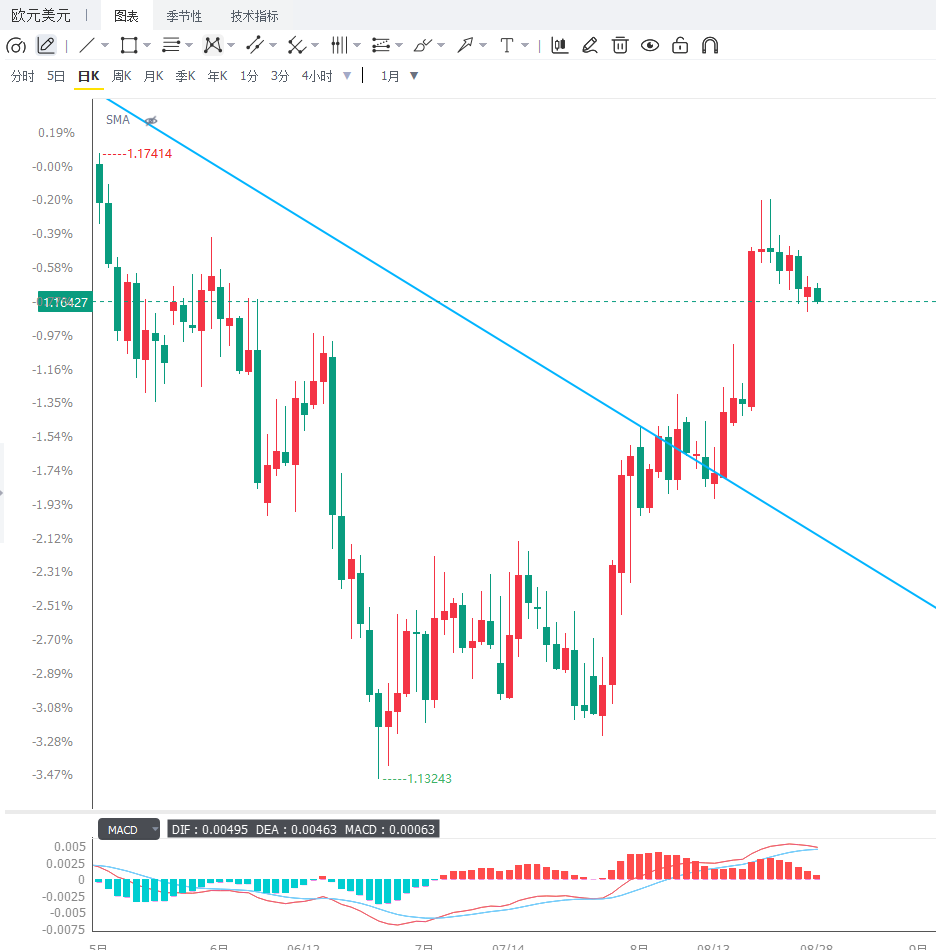
The European Central Bank (ECB) is increasingly wary of inflation risks. ECB Governing Council member Martins Cazax stated on Friday that the central bank cannot allow rising consumer prices to develop into deep-seated inflation, noting that raising interest rates is a crucial tool for curbing the spread of inflation. He also indicated that, given the current economic and inflationary environment, the ECB is quite likely to raise interest rates in September.  This statement further strengthened market expectations for the European Central Bank (ECB) to raise interest rates again in September. The ECB had already raised rates by 25 basis points in June, increasing the deposit facility rate to 2.25%, before pausing the adjustment at its July meeting. However, the latest minutes of the July meeting show that policymakers believed that further rate hikes might be necessary if the inflation outlook did not improve significantly. The ECB also emphasized that the July pause did not mean the end of the tightening cycle. Therefore, the market currently tends to interpret the July pause as a policy observation period rather than a signal that the ECB has completed its rate hike cycle. The September meeting will release new economic forecasts and include more data on inflation, wages, economic growth, and inflation expectations, which will directly influence the ECB's final interest rate decision. Energy prices are the core factor driving the renewed rise in European inflation risks. The European energy market is highly sensitive to the situation in the Middle East; if regional conflicts persist, crude oil, natural gas, and refined energy prices may remain high. For the Eurozone, which is highly dependent on energy imports, rising energy costs will not only directly push up consumer prices but may also be passed on to a wider range of sectors through transportation, manufacturing, and service sector costs. The European Central Bank (ECB) has previously learned from the experience of energy shocks leading to the spread of inflation. The latest meeting minutes show that policymakers are particularly concerned about whether rising energy prices will evolve from a direct impact into a secondary effect on wages, corporate pricing, and inflation expectations. If this transmission forms a sustained cycle, the central bank will need to suppress demand through higher interest rates to prevent inflation from spiraling out of control again. ECB Executive Board member Isabelle Schnabel has also previously released clear hawkish signals. She stated that at the current policy rate level, medium-term inflation may not return to the target level, thus requiring further policy tightening. She warned that if action is not taken until energy price pressures are fully transmitted to wages, the ECB may already be behind the inflation curve. This means that Kazzak's latest remarks are not an isolated view from a single official, but rather echo the gradually strengthening policy inclination within the ECB recently. The market currently expects the ECB to raise the deposit rate from 2.25% to 2.50% in September. The ECB's July meeting minutes showed that the market had already largely priced in a September rate hike and anticipated further tightening space in early 2027. Meanwhile, the Eurozone's economic performance also provides some room for the ECB to continue raising interest rates. Recent business activity and credit data have shown some resilience, indicating that while current interest rates are already limiting, they have not significantly crippled economic activity. This allows the European Central Bank (ECB) to continue finding a balance between controlling inflation and maintaining economic growth. Latest information shows that Eurozone business lending growth reached 4.4% in July, the fastest pace in over three years, further illustrating that tightening financial conditions have not completely blocked corporate financing needs. The stronger the economic resilience, the higher the ECB's tolerance for further interest rate hikes may be. However, the ECB has not signaled a sustained and significant interest rate hike. The market currently tends to believe that a September rate hike is highly certain, but whether the central bank continues to tighten after that will still heavily depend on energy prices, wage growth, and core inflation. In particular, long-term inflation expectations are currently largely anchored around 2%, meaning that the ECB does not need to initiate a continuous and aggressive rate hike cycle for the time being. For the euro, the ECB's policy shift to a hawkish stance can provide significant interest rate support. If the Federal Reserve gradually lowers its rate hike expectations in the future, while the ECB continues to tighten in September, the interest rate differential between the US and Europe may shift towards the euro, providing medium-term support for the euro/dollar exchange rate. However, US inflation also exhibits stickiness, and the possibility of another Fed rate hike this year has not completely disappeared. Therefore, a ECB rate hike does not necessarily mean the euro will continue to rise. If US long-term Treasury yields continue to rise, the dollar may still maintain its resilience due to its yield advantage, thus limiting the euro's appreciation potential. From the bond market perspective, the ECB's hawkish stance may first push up German bond yields and short-term interest rates in the Eurozone. If the market further increases its expectations for rate hikes after September, the European short-term yield curve may continue to move upward. Conversely, if Eurozone inflation falls rapidly and energy prices decline significantly in the future, current rate hike expectations may be weakened by the market again. Therefore, the key variable in the next two weeks is not Kazzak's speech itself, but the Eurozone's August inflation data and the ECB's new economic forecasts released in September. If inflation continues to remain high while economic growth shows resilience, a September rate hike will almost become the market's baseline scenario; if inflation cools significantly, the ECB may reduce the need for further tightening. From a market sentiment perspective, the ECB is gradually shifting from "observing the energy shock" to "preventing the spread of inflation." This policy change provides some support for Eurozone interest rates and Euro assets, but it also implies that corporate financing costs and household borrowing costs may rise further, and the growth pressure on the European economy in the coming quarters warrants attention. From the daily chart of EUR/USD, the ECB's hawkish expectations are conducive to maintaining the euro's medium-term bullish structure, but the exchange rate still needs further weakening of the US dollar to open up new upside potential. In the short term, focus is on support around 1.1630, with the first resistance level at the psychological level of 1.1700. A successful break above this level could lead to further testing of the 1.1750 and 1.1800 areas. If the price falls below 1.1630 again, then support around 1.1580 needs to be monitored, and a further breach could lead to a retest of the 1.1500 area. Overall, improved expectations for ECB policy are beneficial to the euro, but the path of US dollar interest rates remains a key factor determining whether EUR/USD can break through previous highs. From the 4-hour chart, EUR/USD has recently maintained a slightly bullish oscillating structure. The ECB's continuous hawkish signals have helped stabilize short-term buying, but profit-taking pressure still exists near previous highs. If the MACD bullish momentum expands again, the exchange rate could break through 1.1700 and further test 1.1750; if 1.1700 continues to be resisted, and US interest rate expectations rise again, a pullback may be triggered, testing 1.1580. In the short term, the 1.1630-1.1700 area will become a key battleground between bulls and bears.
  Editor's Summary: The European Central Bank's (ECB) hawkish signals are continuing to strengthen. Kazak's statement that "inflation cannot be allowed to become entrenched" is largely consistent with the policy inclinations released by Schnabel and the July meeting minutes. The market has already largely priced in a September rate hike, with the ECB's policy rate potentially rising from 2.25% to 2.50%. In the short term, energy prices and the situation in the Middle East remain the core variables determining the path of European inflation. If energy costs remain high, the ECB may need to raise interest rates to suppress the effects of double-dip inflation; if energy prices fall significantly, the scope for further rate hikes after September may be limited. For the euro, the ECB's shift to a hawkish stance is a medium-term positive, but whether it can translate into sustained growth depends on the Fed's policy path and changes in the interest rate differential between the US and Europe. Going forward, the market should focus on the Eurozone's August inflation data and the ECB's September economic forecasts. These two factors will determine whether this round of rate hike expectations is a temporary adjustment or the beginning of a new round of tightening by the ECB.
This statement further strengthened market expectations for the European Central Bank (ECB) to raise interest rates again in September. The ECB had already raised rates by 25 basis points in June, increasing the deposit facility rate to 2.25%, before pausing the adjustment at its July meeting. However, the latest minutes of the July meeting show that policymakers believed that further rate hikes might be necessary if the inflation outlook did not improve significantly. The ECB also emphasized that the July pause did not mean the end of the tightening cycle. Therefore, the market currently tends to interpret the July pause as a policy observation period rather than a signal that the ECB has completed its rate hike cycle. The September meeting will release new economic forecasts and include more data on inflation, wages, economic growth, and inflation expectations, which will directly influence the ECB's final interest rate decision. Energy prices are the core factor driving the renewed rise in European inflation risks. The European energy market is highly sensitive to the situation in the Middle East; if regional conflicts persist, crude oil, natural gas, and refined energy prices may remain high. For the Eurozone, which is highly dependent on energy imports, rising energy costs will not only directly push up consumer prices but may also be passed on to a wider range of sectors through transportation, manufacturing, and service sector costs. The European Central Bank (ECB) has previously learned from the experience of energy shocks leading to the spread of inflation. The latest meeting minutes show that policymakers are particularly concerned about whether rising energy prices will evolve from a direct impact into a secondary effect on wages, corporate pricing, and inflation expectations. If this transmission forms a sustained cycle, the central bank will need to suppress demand through higher interest rates to prevent inflation from spiraling out of control again. ECB Executive Board member Isabelle Schnabel has also previously released clear hawkish signals. She stated that at the current policy rate level, medium-term inflation may not return to the target level, thus requiring further policy tightening. She warned that if action is not taken until energy price pressures are fully transmitted to wages, the ECB may already be behind the inflation curve. This means that Kazzak's latest remarks are not an isolated view from a single official, but rather echo the gradually strengthening policy inclination within the ECB recently. The market currently expects the ECB to raise the deposit rate from 2.25% to 2.50% in September. The ECB's July meeting minutes showed that the market had already largely priced in a September rate hike and anticipated further tightening space in early 2027. Meanwhile, the Eurozone's economic performance also provides some room for the ECB to continue raising interest rates. Recent business activity and credit data have shown some resilience, indicating that while current interest rates are already limiting, they have not significantly crippled economic activity. This allows the European Central Bank (ECB) to continue finding a balance between controlling inflation and maintaining economic growth. Latest information shows that Eurozone business lending growth reached 4.4% in July, the fastest pace in over three years, further illustrating that tightening financial conditions have not completely blocked corporate financing needs. The stronger the economic resilience, the higher the ECB's tolerance for further interest rate hikes may be. However, the ECB has not signaled a sustained and significant interest rate hike. The market currently tends to believe that a September rate hike is highly certain, but whether the central bank continues to tighten after that will still heavily depend on energy prices, wage growth, and core inflation. In particular, long-term inflation expectations are currently largely anchored around 2%, meaning that the ECB does not need to initiate a continuous and aggressive rate hike cycle for the time being. For the euro, the ECB's policy shift to a hawkish stance can provide significant interest rate support. If the Federal Reserve gradually lowers its rate hike expectations in the future, while the ECB continues to tighten in September, the interest rate differential between the US and Europe may shift towards the euro, providing medium-term support for the euro/dollar exchange rate. However, US inflation also exhibits stickiness, and the possibility of another Fed rate hike this year has not completely disappeared. Therefore, a ECB rate hike does not necessarily mean the euro will continue to rise. If US long-term Treasury yields continue to rise, the dollar may still maintain its resilience due to its yield advantage, thus limiting the euro's appreciation potential. From the bond market perspective, the ECB's hawkish stance may first push up German bond yields and short-term interest rates in the Eurozone. If the market further increases its expectations for rate hikes after September, the European short-term yield curve may continue to move upward. Conversely, if Eurozone inflation falls rapidly and energy prices decline significantly in the future, current rate hike expectations may be weakened by the market again. Therefore, the key variable in the next two weeks is not Kazzak's speech itself, but the Eurozone's August inflation data and the ECB's new economic forecasts released in September. If inflation continues to remain high while economic growth shows resilience, a September rate hike will almost become the market's baseline scenario; if inflation cools significantly, the ECB may reduce the need for further tightening. From a market sentiment perspective, the ECB is gradually shifting from "observing the energy shock" to "preventing the spread of inflation." This policy change provides some support for Eurozone interest rates and Euro assets, but it also implies that corporate financing costs and household borrowing costs may rise further, and the growth pressure on the European economy in the coming quarters warrants attention. From the daily chart of EUR/USD, the ECB's hawkish expectations are conducive to maintaining the euro's medium-term bullish structure, but the exchange rate still needs further weakening of the US dollar to open up new upside potential. In the short term, focus is on support around 1.1630, with the first resistance level at the psychological level of 1.1700. A successful break above this level could lead to further testing of the 1.1750 and 1.1800 areas. If the price falls below 1.1630 again, then support around 1.1580 needs to be monitored, and a further breach could lead to a retest of the 1.1500 area. Overall, improved expectations for ECB policy are beneficial to the euro, but the path of US dollar interest rates remains a key factor determining whether EUR/USD can break through previous highs. From the 4-hour chart, EUR/USD has recently maintained a slightly bullish oscillating structure. The ECB's continuous hawkish signals have helped stabilize short-term buying, but profit-taking pressure still exists near previous highs. If the MACD bullish momentum expands again, the exchange rate could break through 1.1700 and further test 1.1750; if 1.1700 continues to be resisted, and US interest rate expectations rise again, a pullback may be triggered, testing 1.1580. In the short term, the 1.1630-1.1700 area will become a key battleground between bulls and bears. Editor's Summary: The European Central Bank's (ECB) hawkish signals are continuing to strengthen. Kazak's statement that "inflation cannot be allowed to become entrenched" is largely consistent with the policy inclinations released by Schnabel and the July meeting minutes. The market has already largely priced in a September rate hike, with the ECB's policy rate potentially rising from 2.25% to 2.50%. In the short term, energy prices and the situation in the Middle East remain the core variables determining the path of European inflation. If energy costs remain high, the ECB may need to raise interest rates to suppress the effects of double-dip inflation; if energy prices fall significantly, the scope for further rate hikes after September may be limited. For the euro, the ECB's shift to a hawkish stance is a medium-term positive, but whether it can translate into sustained growth depends on the Fed's policy path and changes in the interest rate differential between the US and Europe. Going forward, the market should focus on the Eurozone's August inflation data and the ECB's September economic forecasts. These two factors will determine whether this round of rate hike expectations is a temporary adjustment or the beginning of a new round of tightening by the ECB.
- Risk Warning and Disclaimer
- The market involves risk, and trading may not be suitable for all investors. This article is for reference only and does not constitute personal investment advice, nor does it take into account certain users’ specific investment objectives, financial situation, or other needs. Any investment decisions made based on this information are at your own risk.