Rumors of the Strait of Hormuz reopening, coupled with hawkish rhetoric from the Federal Reserve, dealt a double blow to the oil market, causing oil prices to plummet 6% in a single week.
2026-08-29 09:36:02
Oil prices closed lower on Friday, also recording a significant weekly decline. Brent crude fell nearly 6% this week, closing at $88.24 per barrel; WTI crude fell 3.69% this week, closing at $83.44 per barrel, marking its second consecutive week of weakness.  The sharp weekly drop in oil prices reflects the market's dual sensitivity to macroeconomic policies and geopolitical supply. On the one hand, hawkish signals from Federal Reserve officials suppressed the valuation of risk assets; on the other hand, rumors of a possible reopening of the Strait of Hormuz caused the supply-side premium to quickly subside. Since the outbreak of the war, the market has regarded the strait blockade as a core support for reducing exports by 7 to 8 million barrels per day, and any sign of loosening would trigger long positions to be liquidated. Phil Flynn, an analyst at Price Futures Group, also pointed out that although Ukraine's attack on Russian refineries boosted the refined oil market, the rumor of the "strait reopening" was enough to outweigh the short-term positive. It is worth noting that Friday's shipping data showed that the number of ships passing through the strait decreased rather than increased (7 ships, lower than the previous day's 17 ships and the 10-day average of 15 ships), but oil prices still fell, indicating that traders were more inclined to believe the political signal of an "imminent US-Iran agreement" rather than real-time traffic flow. This "buy the rumor, sell the fact" pricing in advance is a typical market behavior in geopolitical risk events. Federal Reserve Policy Signals and Rate Hike Expectations The remarks made by newly appointed Federal Reserve Chairman Warsh on Friday were another key driver of the oil price decline. Warsh hinted that "rates may be raised later this year to curb inflation," a statement that contradicted the market's previous widespread expectation of a rate cut. This triggered a short-term jump in the dollar index, putting downward pressure on dollar-denominated commodities such as crude oil. The underlying logic is that if the Fed resumes rate hikes, it will directly increase financing costs for businesses and consumers, suppressing economic activity and energy demand. Simultaneously, a strong dollar will reduce the purchasing power of non-US countries, further compressing the incremental growth in global oil demand. Currently, core inflation in the US remains above the 2% target, and war-related energy subsidies, fiscal expansion, and supply chain distortions mean that a decisive victory in the fight against inflation has not yet been achieved. Warsh's remarks were essentially a "correction" of the market's overly optimistic expectations of rate cuts, which explains why oil prices accelerated their decline after the news broke. However, from another perspective, Warsh's statement left a buffer of "later this year," without providing a timetable, indicating that the Fed is still wavering in its data-dependent mode. If subsequent economic data weakens or geopolitical risks escalate, policy shifts may still occur repeatedly. Therefore, the short-term decline in oil prices in response to Fed signals is more of an emotional outburst than a trend reversal. Rumors of a Strait of Hormuz Agreement and Shipping Data The passage through the Strait of Hormuz is currently the most crucial "switch" in the global oil market. Before the war, approximately 20% of global oil production was transported through this strait. Since the escalation of the conflict, the Iranian Revolutionary Guard has effectively controlled the waterway through mines, speedboats, and a military blockade. Goldman Sachs estimates that recent total Gulf exports are only 15-16 million barrels per day, 7-8 million barrels lower than pre-war levels, but 5-6 million barrels higher than the March low, indicating that supply has partially adapted to the new normal. The "agreement rumors" that triggered sharp market fluctuations on Friday specifically refer to Tehran's agreement to draft a list of conditions for resuming normal navigation after the Qatari envoy urged Iran to respect freedom of navigation. Iran's past demands included the lifting of the US blockade of Iranian ports, war reparations, and the complete removal of sanctions. Although the list has not yet been released, the market began pricing in an optimistic scenario that the Strait might reopen over the weekend. However, the Iranian Revolutionary Guard Navy immediately denied the US claim that the Strait had reopened, stating that Washington's move was intended to control oil prices and cover up its failures, emphasizing that the restrictions would continue until the US ceased military operations and fulfilled its commitments. This standoff shows that a deal is still a long way from being implemented. Shipping data also confirms this: only seven commodity ships passed through the Strait on Thursday, far below normal levels. Traders need to be wary of the risk of "buy the rumor, sell the fact"—if no substantial agreement is reached over the weekend, the market could see a sharp rebound at the start of next week. US-Iran Sanctions Escalation and Iran's Response The US announced a new round of targeted sanctions against Iran on Friday, the "toughest in history," including restrictions on the UAE branch of the National Bank of Egypt (revoking its eligibility to use the US financial system) and sanctions against an individual linked to the National Bank of Iran. Finance Minister Bessant called it an "economic Normandy landing," intending to completely sever Iran's international trade routes. Iran's response was extremely strong: the Foreign Ministry characterized the new sanctions as "state terrorism," stating that they seriously endanger the health and livelihoods of millions of civilians, and called on all countries to refuse to implement the US sanctions, citing international law. Supreme Leader Mojtaba Khamenei issued a written injunction demanding that officials "not engage in any actions that undermine social cohesion," while urging the government to seriously address inflation (reaching 66%), unemployment, and price issues. This statement reveals the Iranian leadership's deep concern about domestic social unrest; if economic pressure continues to escalate, it could trigger nationwide protests similar to those of 2019. From a strategic perspective, the US sanctions and Iran's "list of conditions" are two sides of the same coin. Washington is attempting to use maximum pressure to force Tehran to concede on the Straits issue, while Iran is using the Straits blockade as its biggest bargaining chip, demanding the lifting of sanctions and compensation. The two sides' positions are far apart, but the intervention of mediators such as Qatar and Oman indicates that diplomatic channels have not been completely frozen. In the short term, the escalating spiral of sanctions and counter-sanctions remains the biggest source of uncertainty in the oil market. US-Venezuela Oil Agreement and Venezuela's OPEC Moves Another significant geopolitical clue comes from the Western Hemisphere—the United States and Venezuela have reached a historic oil agreement. According to multiple reports, the Trump administration negotiated with the Maduro regime to gain "majority control" of over 65 billion barrels of Venezuela's proven oil reserves (Trump stated this would "more than double US oil reserves"), involving 17 strategic oil fields. US energy companies such as Chevron and Halliburton are about to sign multi-billion dollar expansion contracts, including two new operating oil fields and supply facilities. The Venezuelan government claims the development project will generate over $209 billion in tax revenue and emphasizes that it is "cooperation" rather than "a surrender of sovereignty." However, the market generally believes this is a pragmatic deal by the US to secure long-term crude oil supplies and stabilize domestic gasoline prices after the weakening of the Venezuelan opposition. Venezuela possesses the world's largest proven oil reserves (approximately 300 billion barrels), but due to long-term sanctions and insufficient investment, its production has fallen to less than 1 million barrels per day. If US capital and technology return on a large scale, production could increase to over 2 million barrels per day within 3 to 5 years, profoundly impacting the global supply structure. Meanwhile, Bloomberg reports that Venezuela is considering leaving OPEC. If this happens, it will further weaken OPEC's coordinating pricing power and could trigger other sanctioned oil-producing countries (such as Iran) to follow suit. However, Venezuela's withdrawal from OPEC requires congressional approval, and the Maduro government may use it as additional leverage in negotiations with Washington. Overall, the US-Venezuela agreement is a long-term structural positive (increasing supply), but its short-term suppressive effect on oil prices is limited because infrastructure reconstruction and production ramp-up take time. Geopolitical Games and Oil Market Outlook: A Comprehensive Analysis Considering the above multiple variables, the current oil market is under the dual pressure of "fading geopolitical premiums on the supply side" and "increasing macroeconomic headwinds on the demand side." If the Strait of Hormuz can indeed resume navigation in stages, Brent crude oil prices may fall to the $80-$85 range; if negotiations break down, they may quickly rebound to above $95. While the US-Venezuela agreement is a long-term negative factor, its short-term psychological impact outweighs any substantial changes in supply and demand. It's noteworthy that navigation in the Bab el-Mandeb Strait remains relatively stable (17 ships passed through on Thursday), indicating that risks in the Red Sea have not escalated accordingly. The Iranian Revolutionary Guard maintains strong control over the strait, and although the US claims to have cleared mines, the military standoff remains. Furthermore, Ukraine's continued attacks on Russian oil refineries have created a supply gap in refined oil products, partially offsetting pessimistic sentiment in the crude oil market. From an investment strategy perspective, the market is pricing in the "most optimistic scenario" (reopening of the strait + Fed rate hike + increased Venezuelan production), but any failure to meet these expectations could trigger a sharp correction. In the coming week, the progress of the Qatar settlement, the enforcement of US sanctions, and whether Iran releases a formal list of conditions will be decisive factors. High volatility will be the new normal; participants are advised to closely monitor real-time shipping data and official statements to avoid being swayed by rumors in their trading decisions.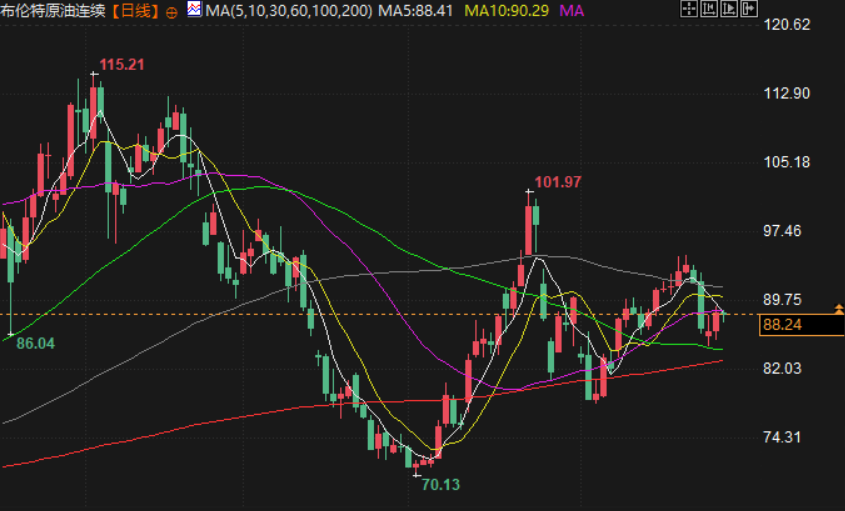
The sharp weekly drop in oil prices reflects the market's dual sensitivity to macroeconomic policies and geopolitical supply. On the one hand, hawkish signals from Federal Reserve officials suppressed the valuation of risk assets; on the other hand, rumors of a possible reopening of the Strait of Hormuz caused the supply-side premium to quickly subside. Since the outbreak of the war, the market has regarded the strait blockade as a core support for reducing exports by 7 to 8 million barrels per day, and any sign of loosening would trigger long positions to be liquidated. Phil Flynn, an analyst at Price Futures Group, also pointed out that although Ukraine's attack on Russian refineries boosted the refined oil market, the rumor of the "strait reopening" was enough to outweigh the short-term positive. It is worth noting that Friday's shipping data showed that the number of ships passing through the strait decreased rather than increased (7 ships, lower than the previous day's 17 ships and the 10-day average of 15 ships), but oil prices still fell, indicating that traders were more inclined to believe the political signal of an "imminent US-Iran agreement" rather than real-time traffic flow. This "buy the rumor, sell the fact" pricing in advance is a typical market behavior in geopolitical risk events. Federal Reserve Policy Signals and Rate Hike Expectations The remarks made by newly appointed Federal Reserve Chairman Warsh on Friday were another key driver of the oil price decline. Warsh hinted that "rates may be raised later this year to curb inflation," a statement that contradicted the market's previous widespread expectation of a rate cut. This triggered a short-term jump in the dollar index, putting downward pressure on dollar-denominated commodities such as crude oil. The underlying logic is that if the Fed resumes rate hikes, it will directly increase financing costs for businesses and consumers, suppressing economic activity and energy demand. Simultaneously, a strong dollar will reduce the purchasing power of non-US countries, further compressing the incremental growth in global oil demand. Currently, core inflation in the US remains above the 2% target, and war-related energy subsidies, fiscal expansion, and supply chain distortions mean that a decisive victory in the fight against inflation has not yet been achieved. Warsh's remarks were essentially a "correction" of the market's overly optimistic expectations of rate cuts, which explains why oil prices accelerated their decline after the news broke. However, from another perspective, Warsh's statement left a buffer of "later this year," without providing a timetable, indicating that the Fed is still wavering in its data-dependent mode. If subsequent economic data weakens or geopolitical risks escalate, policy shifts may still occur repeatedly. Therefore, the short-term decline in oil prices in response to Fed signals is more of an emotional outburst than a trend reversal. Rumors of a Strait of Hormuz Agreement and Shipping Data The passage through the Strait of Hormuz is currently the most crucial "switch" in the global oil market. Before the war, approximately 20% of global oil production was transported through this strait. Since the escalation of the conflict, the Iranian Revolutionary Guard has effectively controlled the waterway through mines, speedboats, and a military blockade. Goldman Sachs estimates that recent total Gulf exports are only 15-16 million barrels per day, 7-8 million barrels lower than pre-war levels, but 5-6 million barrels higher than the March low, indicating that supply has partially adapted to the new normal. The "agreement rumors" that triggered sharp market fluctuations on Friday specifically refer to Tehran's agreement to draft a list of conditions for resuming normal navigation after the Qatari envoy urged Iran to respect freedom of navigation. Iran's past demands included the lifting of the US blockade of Iranian ports, war reparations, and the complete removal of sanctions. Although the list has not yet been released, the market began pricing in an optimistic scenario that the Strait might reopen over the weekend. However, the Iranian Revolutionary Guard Navy immediately denied the US claim that the Strait had reopened, stating that Washington's move was intended to control oil prices and cover up its failures, emphasizing that the restrictions would continue until the US ceased military operations and fulfilled its commitments. This standoff shows that a deal is still a long way from being implemented. Shipping data also confirms this: only seven commodity ships passed through the Strait on Thursday, far below normal levels. Traders need to be wary of the risk of "buy the rumor, sell the fact"—if no substantial agreement is reached over the weekend, the market could see a sharp rebound at the start of next week. US-Iran Sanctions Escalation and Iran's Response The US announced a new round of targeted sanctions against Iran on Friday, the "toughest in history," including restrictions on the UAE branch of the National Bank of Egypt (revoking its eligibility to use the US financial system) and sanctions against an individual linked to the National Bank of Iran. Finance Minister Bessant called it an "economic Normandy landing," intending to completely sever Iran's international trade routes. Iran's response was extremely strong: the Foreign Ministry characterized the new sanctions as "state terrorism," stating that they seriously endanger the health and livelihoods of millions of civilians, and called on all countries to refuse to implement the US sanctions, citing international law. Supreme Leader Mojtaba Khamenei issued a written injunction demanding that officials "not engage in any actions that undermine social cohesion," while urging the government to seriously address inflation (reaching 66%), unemployment, and price issues. This statement reveals the Iranian leadership's deep concern about domestic social unrest; if economic pressure continues to escalate, it could trigger nationwide protests similar to those of 2019. From a strategic perspective, the US sanctions and Iran's "list of conditions" are two sides of the same coin. Washington is attempting to use maximum pressure to force Tehran to concede on the Straits issue, while Iran is using the Straits blockade as its biggest bargaining chip, demanding the lifting of sanctions and compensation. The two sides' positions are far apart, but the intervention of mediators such as Qatar and Oman indicates that diplomatic channels have not been completely frozen. In the short term, the escalating spiral of sanctions and counter-sanctions remains the biggest source of uncertainty in the oil market. US-Venezuela Oil Agreement and Venezuela's OPEC Moves Another significant geopolitical clue comes from the Western Hemisphere—the United States and Venezuela have reached a historic oil agreement. According to multiple reports, the Trump administration negotiated with the Maduro regime to gain "majority control" of over 65 billion barrels of Venezuela's proven oil reserves (Trump stated this would "more than double US oil reserves"), involving 17 strategic oil fields. US energy companies such as Chevron and Halliburton are about to sign multi-billion dollar expansion contracts, including two new operating oil fields and supply facilities. The Venezuelan government claims the development project will generate over $209 billion in tax revenue and emphasizes that it is "cooperation" rather than "a surrender of sovereignty." However, the market generally believes this is a pragmatic deal by the US to secure long-term crude oil supplies and stabilize domestic gasoline prices after the weakening of the Venezuelan opposition. Venezuela possesses the world's largest proven oil reserves (approximately 300 billion barrels), but due to long-term sanctions and insufficient investment, its production has fallen to less than 1 million barrels per day. If US capital and technology return on a large scale, production could increase to over 2 million barrels per day within 3 to 5 years, profoundly impacting the global supply structure. Meanwhile, Bloomberg reports that Venezuela is considering leaving OPEC. If this happens, it will further weaken OPEC's coordinating pricing power and could trigger other sanctioned oil-producing countries (such as Iran) to follow suit. However, Venezuela's withdrawal from OPEC requires congressional approval, and the Maduro government may use it as additional leverage in negotiations with Washington. Overall, the US-Venezuela agreement is a long-term structural positive (increasing supply), but its short-term suppressive effect on oil prices is limited because infrastructure reconstruction and production ramp-up take time. Geopolitical Games and Oil Market Outlook: A Comprehensive Analysis Considering the above multiple variables, the current oil market is under the dual pressure of "fading geopolitical premiums on the supply side" and "increasing macroeconomic headwinds on the demand side." If the Strait of Hormuz can indeed resume navigation in stages, Brent crude oil prices may fall to the $80-$85 range; if negotiations break down, they may quickly rebound to above $95. While the US-Venezuela agreement is a long-term negative factor, its short-term psychological impact outweighs any substantial changes in supply and demand. It's noteworthy that navigation in the Bab el-Mandeb Strait remains relatively stable (17 ships passed through on Thursday), indicating that risks in the Red Sea have not escalated accordingly. The Iranian Revolutionary Guard maintains strong control over the strait, and although the US claims to have cleared mines, the military standoff remains. Furthermore, Ukraine's continued attacks on Russian oil refineries have created a supply gap in refined oil products, partially offsetting pessimistic sentiment in the crude oil market. From an investment strategy perspective, the market is pricing in the "most optimistic scenario" (reopening of the strait + Fed rate hike + increased Venezuelan production), but any failure to meet these expectations could trigger a sharp correction. In the coming week, the progress of the Qatar settlement, the enforcement of US sanctions, and whether Iran releases a formal list of conditions will be decisive factors. High volatility will be the new normal; participants are advised to closely monitor real-time shipping data and official statements to avoid being swayed by rumors in their trading decisions. - Risk Warning and Disclaimer
- The market involves risk, and trading may not be suitable for all investors. This article is for reference only and does not constitute personal investment advice, nor does it take into account certain users’ specific investment objectives, financial situation, or other needs. Any investment decisions made based on this information are at your own risk.