Crude oil trading alert: Renewed tensions between the US and Iran put pressure on supply concerns, causing oil prices to open sharply higher and test consolidation resistance.
2026-08-31 09:40:02
WTI crude oil opened significantly higher in Asian trading on Monday, after closing at around $83.40 on Friday, but gains subsequently narrowed, with the latest trading around $85.20 per barrel. This followed the US strikes on military targets near Iran's Larak Island, which reignited concerns about shipping security in the Strait of Hormuz, giving crude oil prices a new risk premium. The US stated that the operation targeted potential launch devices to be deployed in strategic waterways, indicating that market focus has shifted from general regional conflicts to energy transportation infrastructure and shipping security.  Iran's subsequent retaliation prompted a rapid reassessment of supply risks in the Strait of Hormuz. Recent conflicts had already led to a significant decrease in vessel traffic through the waterway, and the latest military action signifies a renewed increase in security risks for shipping companies. Given the Strait of Hormuz's long-standing role in global energy transport, any sustained disruption to shipping could quickly translate into a risk premium for crude oil. The US continues to strengthen its monitoring of the waterway and is pushing forward with minesweeping and escort operations, leading the market to closely monitor for any new ship attacks, waterway blockades, or transport disruptions in the coming days. However, rather than solely relying on military conflict to predict oil price direction, actual crude oil flows are currently more important. Data shows that Persian Gulf crude oil and refined product exports have recovered to approximately 15-16 million barrels per day, roughly two-thirds of pre-conflict levels, significantly higher than the March low of approximately 5-6 million barrels per day. Goldman Sachs' assessment indicates that as more ships re-pass through the Strait of Hormuz, and with increased ship-to-ship transshipment and non-public shipping activities, regional producers and shipping companies are gradually adapting to the current transport environment. This means the current oil market faces a rather unique situation: geopolitical risks are rising, but actual supply losses are not expanding in tandem. The market has priced in significant risks associated with the Strait of Hormuz over the past few months, but recent export recovery has been weakening this risk premium. Goldman Sachs estimates that oil flows through the Strait of Hormuz alone may have reached approximately 8 to 10 million barrels per day; other market estimates suggest that approximately 6 to 8 million barrels of crude oil are still passing through the waterway daily. While there is considerable uncertainty in these statistics, they all point to the fact that the global crude oil supply chain has not been completely disrupted. Therefore, whether the current WTI price increase can evolve into a trend reversal depends not only on whether the military conflict continues, but also on whether the conflict further impacts actual loading, tanker traffic, and regional production capacity. If military action is confined to a limited scope, and major shipping lanes can still maintain a certain level of transportation, then the crude oil market is more likely to maintain a high geopolitical risk premium rather than experiencing a sustained supply gap. Conversely, if there is a redeployment, tanker attacks, or a significant decline in exports from major producing countries, the previously suppressed supply risks in the market may be quickly repriced, significantly increasing the probability of WTI breaking through $86 and even expanding further towards the $90 area. The US domestic market also provides some buffer. Previously, WTI briefly fell below $83 in late August, mainly due to the market's perception of a recovery in Persian Gulf exports and gradual improvement in shipping through the Strait of Hormuz. Last Friday, WTI closed at approximately $83.40, a weekly drop of over 4%, indicating that the market had significantly reduced some of the supply disruption risks before the latest military escalation. Meanwhile, the crude oil market is also constrained by macroeconomic policy expectations. Recently, US inflationary pressures have once again become the market focus, with the Federal Reserve's policy expectations becoming more cautious. A stronger dollar and US Treasury yields may exert some downward pressure on dollar-denominated crude oil. If oil prices rise further due to geopolitical conflicts, it could push up inflation expectations again through energy prices, thereby reinforcing market concerns about high interest rates or even further tightening. In this way, the rise in oil prices themselves could create new demand pressure through macroeconomic channels. From a global energy market perspective, current risks are not evenly distributed. The recovery in crude oil exports suggests some easing of immediate supply pressures in the global crude oil market, but the impact on liquefied natural gas (LNG) and refined product transportation remains more pronounced. Recent European LNG prices have risen to their highest levels since 2023, indicating that the energy market's dependence on the Strait of Hormuz is not limited to crude oil. Three variables need to be closely monitored going forward: first, whether actual ship traffic through the Strait of Hormuz continues to recover; second, whether the current daily export volume of approximately 15-16 million barrels from the Persian Gulf can be maintained; and third, whether military action expands from localized conflicts to energy facilities, ports, and tanker transportation. If exports continue to rebound, the upside potential for WTI will be significantly limited; if transportation declines rapidly again, oil prices may re-induce a significant supply disruption premium. From a daily chart perspective, WTI is currently still in a high-level consolidation phase after its previous rise, with the latest price returning to around $85 and briefly regaining the important $83 price level. Previously, the market had been fluctuating within the $82.50-$85.50 range for an extended period, with $85.50 becoming a significant resistance level. The area around $86 represents both a previous high and a key moving average resistance. Technically, the MACD recently showed signs of momentum contraction, and the RSI has retreated from a relatively strong zone, indicating a weakening of the previous upward momentum in oil prices. However, with the recent renewed push in prices due to military risks, short-term bullish momentum is recovering. If the daily chart can effectively break through and close above $85.50, the next target may be $86, with a further break potentially testing the $87-$90 area. Conversely, if significant selling pressure reappears around $85.50, and the price falls below $83, $81.50-$82 will become the first support area; a further breach of this area could lead to a retest of the $80 area. Looking at the 4-hour chart, WTI saw some pullback after a higher opening at the beginning of the week, indicating that while the market quickly priced in new geopolitical risks, those chasing the rally remain cautious. The short-term price range to watch is $82.50-$86, with the area around $83 being a potential turning point for bulls and bears, and $85.50 being the most immediate breakout level. If the 4-hour candlestick chart continues to trade above $85.50, accompanied by a renewed upward expansion of the MACD and the RSI remaining above 50, the short-term trend will further tilt towards the bulls, with $86 or even $87 potentially becoming the next target. Conversely, if the gap up is consistently filled and the price falls back below $82.50, it indicates insufficient upward momentum driven by geopolitical risks, and WTI may fall back to the $81.50-$80 area. Recent technical structures suggest that only a true breakout of the $85.50-$86 resistance zone will confirm an upward breakout from the current consolidation pattern; otherwise, a technical pullback after high-level consolidation should be anticipated.
 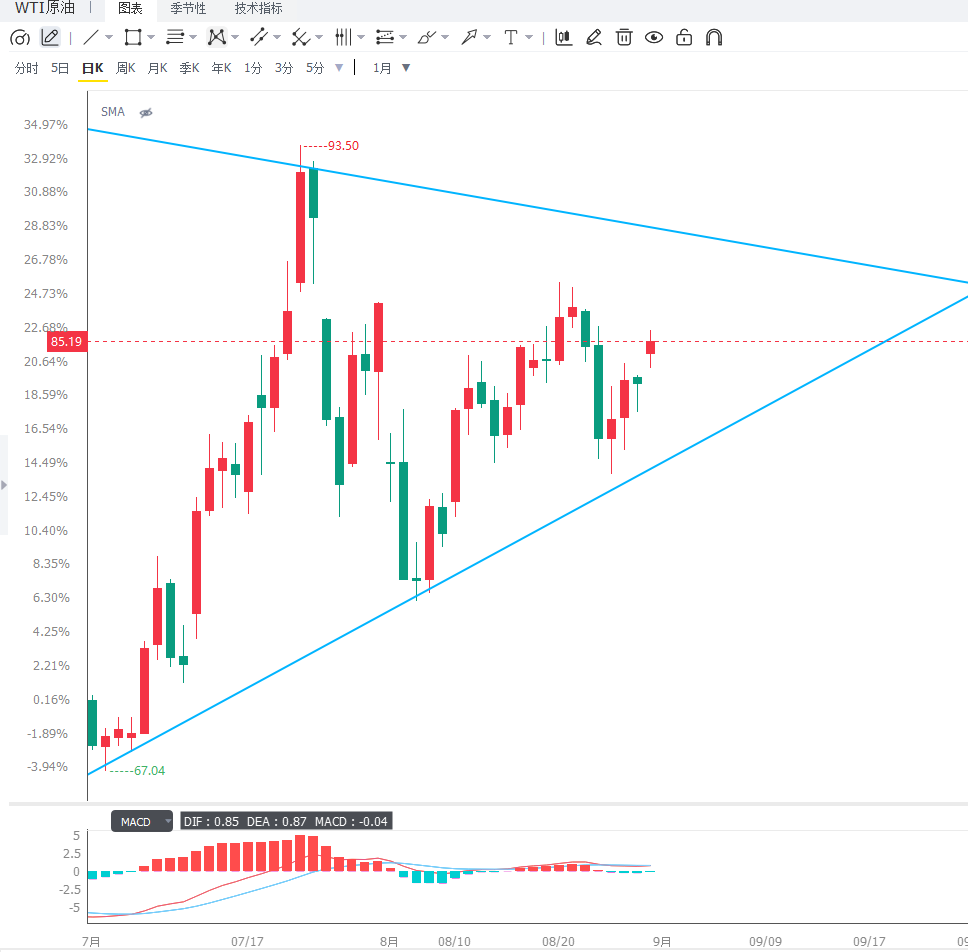 The editor summarizes that WTI is currently facing a tug-of-war between escalating geopolitical risks and the gradual recovery of actual supply. The escalation of military action between the US and Iran has significantly increased the risk premium in the Strait of Hormuz, but the recovery of Persian Gulf exports to approximately 15-16 million barrels per day has limited the possibility of an uncontrolled price surge. In the short term, $85.50 is a key level for WTI to open up further upside potential; a break above this level could see prices reach $86-$87. If risk events further impact actual transportation, the $90 level may re-emerge in the market's view. Conversely, as long as transportation in the Strait of Hormuz continues to recover and there are no new significant losses in actual supply, WTI is still likely to encounter profit-taking pressure around $85.50-$86. Therefore, the current oil price is more appropriately viewed as a range-bound game within a high geopolitical risk premium, and it is crucial to distinguish between the different levels of market signals: "escalating conflict" and "genuine supply disruption."
Iran's subsequent retaliation prompted a rapid reassessment of supply risks in the Strait of Hormuz. Recent conflicts had already led to a significant decrease in vessel traffic through the waterway, and the latest military action signifies a renewed increase in security risks for shipping companies. Given the Strait of Hormuz's long-standing role in global energy transport, any sustained disruption to shipping could quickly translate into a risk premium for crude oil. The US continues to strengthen its monitoring of the waterway and is pushing forward with minesweeping and escort operations, leading the market to closely monitor for any new ship attacks, waterway blockades, or transport disruptions in the coming days. However, rather than solely relying on military conflict to predict oil price direction, actual crude oil flows are currently more important. Data shows that Persian Gulf crude oil and refined product exports have recovered to approximately 15-16 million barrels per day, roughly two-thirds of pre-conflict levels, significantly higher than the March low of approximately 5-6 million barrels per day. Goldman Sachs' assessment indicates that as more ships re-pass through the Strait of Hormuz, and with increased ship-to-ship transshipment and non-public shipping activities, regional producers and shipping companies are gradually adapting to the current transport environment. This means the current oil market faces a rather unique situation: geopolitical risks are rising, but actual supply losses are not expanding in tandem. The market has priced in significant risks associated with the Strait of Hormuz over the past few months, but recent export recovery has been weakening this risk premium. Goldman Sachs estimates that oil flows through the Strait of Hormuz alone may have reached approximately 8 to 10 million barrels per day; other market estimates suggest that approximately 6 to 8 million barrels of crude oil are still passing through the waterway daily. While there is considerable uncertainty in these statistics, they all point to the fact that the global crude oil supply chain has not been completely disrupted. Therefore, whether the current WTI price increase can evolve into a trend reversal depends not only on whether the military conflict continues, but also on whether the conflict further impacts actual loading, tanker traffic, and regional production capacity. If military action is confined to a limited scope, and major shipping lanes can still maintain a certain level of transportation, then the crude oil market is more likely to maintain a high geopolitical risk premium rather than experiencing a sustained supply gap. Conversely, if there is a redeployment, tanker attacks, or a significant decline in exports from major producing countries, the previously suppressed supply risks in the market may be quickly repriced, significantly increasing the probability of WTI breaking through $86 and even expanding further towards the $90 area. The US domestic market also provides some buffer. Previously, WTI briefly fell below $83 in late August, mainly due to the market's perception of a recovery in Persian Gulf exports and gradual improvement in shipping through the Strait of Hormuz. Last Friday, WTI closed at approximately $83.40, a weekly drop of over 4%, indicating that the market had significantly reduced some of the supply disruption risks before the latest military escalation. Meanwhile, the crude oil market is also constrained by macroeconomic policy expectations. Recently, US inflationary pressures have once again become the market focus, with the Federal Reserve's policy expectations becoming more cautious. A stronger dollar and US Treasury yields may exert some downward pressure on dollar-denominated crude oil. If oil prices rise further due to geopolitical conflicts, it could push up inflation expectations again through energy prices, thereby reinforcing market concerns about high interest rates or even further tightening. In this way, the rise in oil prices themselves could create new demand pressure through macroeconomic channels. From a global energy market perspective, current risks are not evenly distributed. The recovery in crude oil exports suggests some easing of immediate supply pressures in the global crude oil market, but the impact on liquefied natural gas (LNG) and refined product transportation remains more pronounced. Recent European LNG prices have risen to their highest levels since 2023, indicating that the energy market's dependence on the Strait of Hormuz is not limited to crude oil. Three variables need to be closely monitored going forward: first, whether actual ship traffic through the Strait of Hormuz continues to recover; second, whether the current daily export volume of approximately 15-16 million barrels from the Persian Gulf can be maintained; and third, whether military action expands from localized conflicts to energy facilities, ports, and tanker transportation. If exports continue to rebound, the upside potential for WTI will be significantly limited; if transportation declines rapidly again, oil prices may re-induce a significant supply disruption premium. From a daily chart perspective, WTI is currently still in a high-level consolidation phase after its previous rise, with the latest price returning to around $85 and briefly regaining the important $83 price level. Previously, the market had been fluctuating within the $82.50-$85.50 range for an extended period, with $85.50 becoming a significant resistance level. The area around $86 represents both a previous high and a key moving average resistance. Technically, the MACD recently showed signs of momentum contraction, and the RSI has retreated from a relatively strong zone, indicating a weakening of the previous upward momentum in oil prices. However, with the recent renewed push in prices due to military risks, short-term bullish momentum is recovering. If the daily chart can effectively break through and close above $85.50, the next target may be $86, with a further break potentially testing the $87-$90 area. Conversely, if significant selling pressure reappears around $85.50, and the price falls below $83, $81.50-$82 will become the first support area; a further breach of this area could lead to a retest of the $80 area. Looking at the 4-hour chart, WTI saw some pullback after a higher opening at the beginning of the week, indicating that while the market quickly priced in new geopolitical risks, those chasing the rally remain cautious. The short-term price range to watch is $82.50-$86, with the area around $83 being a potential turning point for bulls and bears, and $85.50 being the most immediate breakout level. If the 4-hour candlestick chart continues to trade above $85.50, accompanied by a renewed upward expansion of the MACD and the RSI remaining above 50, the short-term trend will further tilt towards the bulls, with $86 or even $87 potentially becoming the next target. Conversely, if the gap up is consistently filled and the price falls back below $82.50, it indicates insufficient upward momentum driven by geopolitical risks, and WTI may fall back to the $81.50-$80 area. Recent technical structures suggest that only a true breakout of the $85.50-$86 resistance zone will confirm an upward breakout from the current consolidation pattern; otherwise, a technical pullback after high-level consolidation should be anticipated. The editor summarizes that WTI is currently facing a tug-of-war between escalating geopolitical risks and the gradual recovery of actual supply. The escalation of military action between the US and Iran has significantly increased the risk premium in the Strait of Hormuz, but the recovery of Persian Gulf exports to approximately 15-16 million barrels per day has limited the possibility of an uncontrolled price surge. In the short term, $85.50 is a key level for WTI to open up further upside potential; a break above this level could see prices reach $86-$87. If risk events further impact actual transportation, the $90 level may re-emerge in the market's view. Conversely, as long as transportation in the Strait of Hormuz continues to recover and there are no new significant losses in actual supply, WTI is still likely to encounter profit-taking pressure around $85.50-$86. Therefore, the current oil price is more appropriately viewed as a range-bound game within a high geopolitical risk premium, and it is crucial to distinguish between the different levels of market signals: "escalating conflict" and "genuine supply disruption."
- Risk Warning and Disclaimer
- The market involves risk, and trading may not be suitable for all investors. This article is for reference only and does not constitute personal investment advice, nor does it take into account certain users’ specific investment objectives, financial situation, or other needs. Any investment decisions made based on this information are at your own risk.