Goldman Sachs pours cold water: Warsh's "most hawkish" speech is unlikely to change the market's decision to hold rates steady in September; will market expectations for rate hikes be reversed?
2026-08-31 10:06:04
Goldman Sachs chief economist Hatzius stated that despite Warsh's hawkish tone in his Jackson Hole speech last Friday (August 28), Goldman Sachs still expects the Federal Reserve to keep interest rates unchanged in September. Hatzius pointed out that Warsh's speech opened the door to a September rate hike, but only if August's CPI and PPI data unexpectedly rise. Goldman Sachs expects core CPI and core PCE to rise by about 0.2% month-on-month, roughly in line with recent inflation trends, which is insufficient to support a rate hike. 
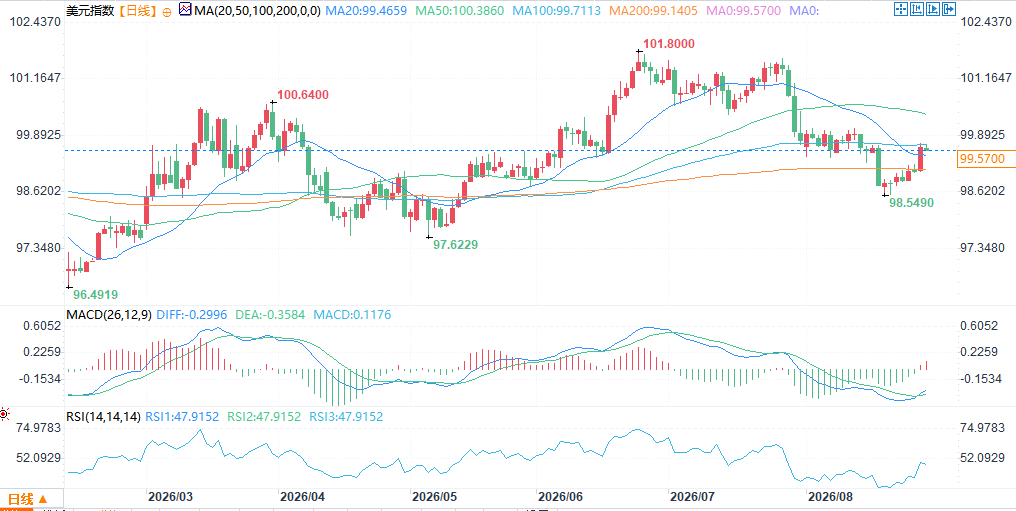 At 9:46 AM Beijing time on August 31, the US dollar index was at 99.56.
Goldman Sachs: Warsh's "most hawkish" speech, but the threshold for a rate hike has not yet been reached.
In a client report, Goldman Sachs Chief Economist Jan Hatzius noted that Federal Reserve Chairman Kevin Warsh's speech at the Jackson Hole symposium was his "most hawkish" statement since taking office. Warsh explicitly emphasized that the Fed's top priority is ensuring that underlying inflation returns to the 2% target at a clear and sufficiently rapid pace; otherwise, "there is still work to be done." He acknowledged that this summer's PCE and CPI readings were better than expected, but stressed that these data have not yet shown a meaningful improvement in the underlying inflation trend, with price increases for some goods and services still significantly higher than pre-pandemic levels. Hatzius believes this framework opens the door to a September rate hike, but the triggering conditions are quite stringent: only an unexpected rise in the upcoming August CPI and PPI data can support a policy response. Goldman Sachs itself predicts that core CPI and core PCE will rise by about 0.2% month-on-month, roughly in line with recent inflation trends, therefore the threshold for a rate hike has not yet been truly reached in the short term. Following the speech, the market's probability of a rate hike briefly jumped, but Goldman Sachs reminded investors that Warsh did not provide clear forward guidance, and policy still highly depends on subsequent data verification.Goldman Sachs expects inflation to be moderate in August and maintains its benchmark of keeping rates unchanged in September.
Based on a cautious forecast of August inflation, Goldman Sachs continues to use the scenario of the September FOMC meeting maintaining interest rates unchanged as its baseline. The bank expects both core CPI and core PCE to rise by around 0.2% month-on-month in August, a pace consistent with recent inflation trends and insufficient to trigger a rate hike as suggested by Warsh's remarks, which indicated "no meaningful improvement in underlying inflation." Hatzius points out that if the actual data matches this moderate expectation, the market's rapid upward adjustment of rate hike pricing based on Warsh's hawkish comments may prove premature. Compared to the speech itself, the August CPI and PPI reports will be more crucial input variables for the September decision. Goldman Sachs emphasizes that while Warsh released a hawkish signal and reiterated his unwavering 2% target, he did not lock in a specific policy path; a comprehensive assessment of financial conditions and the labor market will still determine the final action. If inflation remains moderate, the Fed is more likely to continue to observe rather than rush to raise rates, thus avoiding unnecessary shocks to the economy from premature tightening.US Dollar Index: A Game Between Policy Expectations and Actual Data
Goldman Sachs maintains its assessment that the Federal Reserve will hold rates steady in September, a subtle contrast to the market's rapidly rising expectations for a rate hike following Warsh's hawkish remarks. On one hand, Warsh's speech pushed the market's probability of a September rate hike to around 60%, providing short-term support for the dollar, with the dollar index holding steady around 99.00 last Friday. On the other hand, if Goldman Sachs' assessment is correct—with moderate August CPI and PPI data (core CPI and core PCE up approximately 0.2% month-on-month)—the probability of a rate hike may recede, and the dollar index may fall back towards 98.50. Goldman Sachs' analysis suggests that Warsh's hawkish rhetoric alone is insufficient to prompt the Fed to raise rates in September; the actual decision will heavily depend on inflation data over the next two weeks. This means that the dollar index may maintain a range-bound pattern with a ceiling and a floor before the September meeting—upward movement is constrained by Goldman Sachs and other institutions' assessments of the rate hike threshold, while downward movement is limited by the policy expectation support provided by Warsh's hawkish remarks. Furthermore, if August inflation data is moderate, US Treasury yields may give back some of their gains, weakening the dollar's interest rate advantage; if the data unexpectedly rises, it will validate Warsh's hawkish framework and increase the probability of a rate hike, potentially causing the dollar index to rebound towards the 99.50-99.80 range. August CPI and PPI data will be the key catalysts for the short-term direction of the dollar index, rather than Warsh's speech itself. Before the data release, the dollar index is expected to fluctuate around 99.50. At 9:46 AM Beijing time on August 31, the US dollar index was at 99.56.
- Risk Warning and Disclaimer
- The market involves risk, and trading may not be suitable for all investors. This article is for reference only and does not constitute personal investment advice, nor does it take into account certain users’ specific investment objectives, financial situation, or other needs. Any investment decisions made based on this information are at your own risk.