Gold prices fell as expectations rose for a September rate hike by the Federal Reserve, remaining range-bound.
2026-08-31 10:08:03
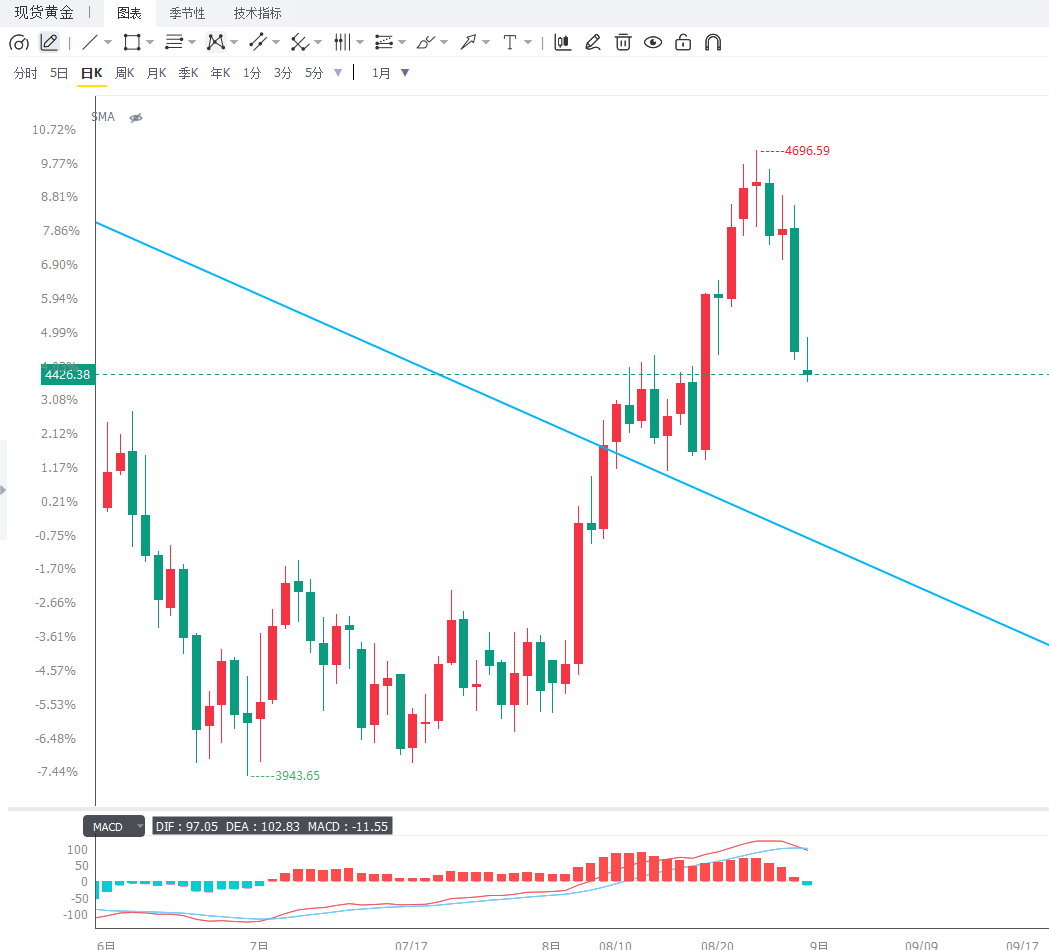
Spot gold traded under pressure in early Asian trading on Monday, last settling around $4430 per ounce. Gold prices had previously experienced a rapid rise and remained range-bound at high levels, but profit-taking occurred as Federal Reserve Chairman Kevin Warsh delivered a clearly hawkish signal at the Jackson Hole symposium, prompting a rapid reassessment of the US monetary policy path. Since gold itself does not generate interest income, the opportunity cost of holding gold increases when the market expects interest rates to remain high or even rise further. A stronger dollar and US Treasury yields also put downward pressure on gold prices.  At the Jackson Hole Economic Symposium, Warsh stated that if policymakers cannot confirm that underlying inflation in the US is clearly declining towards the 2% policy target, the Federal Reserve still needs to further tighten policy. This statement significantly reinforced market expectations that US interest rates will remain high. Data shows that the market currently expects a 25 basis point rate hike by the Fed in September to be approximately 56.9%, significantly higher than the 39.9% before Warsh's speech; the probability of another rate hike in December has reached approximately 88.7%. This means that the market has begun to re-indulge future monetary policy in a tightening scenario, naturally putting greater valuation pressure on gold in the short term. From an asset pricing perspective, gold is currently facing a typical game between interest rates and safe-haven demand. On the one hand, rising expectations of US interest rates will push up real interest rates and the attractiveness of dollar assets, putting downward pressure on gold; on the other hand, global geopolitical risks, fiscal sustainability, and financial market volatility still support long-term allocation demand for gold. Therefore, this round of gold price correction is more a valuation adjustment caused by changes in macroeconomic interest rate expectations, rather than a complete reversal of the medium- to long-term investment logic of gold. It is worth noting that the renewed changes in the Middle East situation have also given gold's safe-haven attributes some support again. The recent US strikes on Iranian military targets have reignited market focus on energy transport risks in the Strait of Hormuz. With crude oil prices driven by geopolitical risk premiums, continued rises in energy prices could increase market concerns about global price pressures through inflation, further influencing the policy paths of major central banks. For gold, this factor has a dual impact: in the short term, higher interest rate expectations may suppress gold prices; however, if market concerns about continued energy price increases leading to increased economic and financial market risks could revitalize gold's safe-haven demand. Currently, the market has not completely turned bearish on gold due to Warsh's hawkish remarks. TD Securities believes that the Fed's significantly hawkish policy stance could indeed be a catalyst for a short-term pullback in gold, but a stronger bearish factor is still needed to completely reverse the recent improved sentiment in the precious metals market. The gold market currently still has a certain amount of long positions and macro-allocation demand, meaning that if prices fall rapidly, some funds may re-enter the market. From a funding perspective, the biggest support for gold at present is not simply inflation hedging demand, but the result of the combined effect of multiple macro factors. Global central bank gold reserve demand, fiscal deficit risks, changes in real interest rates, and the flow of safe-haven funds remain key variables determining the medium-term trend of gold. If the US economy shows a significant slowdown in the future, and the market lowers its expectations for further interest rate hikes by the Federal Reserve, then the pressure on the dollar and real interest rates may ease simultaneously, and gold will regain upward potential. Conversely, if US inflation remains resilient while the job market does not show a significant slowdown, and the probability of further tightening by the Federal Reserve continues to rise, then gold may face longer periods of adjustment pressure. In particular, if US Treasury yields rise in tandem, gold's non-interest-bearing asset status will be more clearly tested by the market. Therefore, it is currently crucial to focus on US inflation, employment, and subsequent speeches by Federal Reserve officials. In particular, whether core PCE inflation remains high will directly affect the market's judgment on the interest rate path in September and throughout the year. If expectations of interest rate hikes continue to rise, gold may continue to seek support downwards; if US economic data begins to weaken significantly, the recent pullback may turn into a buying opportunity. From a global market perspective, gold is currently still in a relatively high price range, and the market's sensitivity to macroeconomic events has significantly increased. Every rapid rise in the US dollar and every significant increase in US Treasury yields can trigger short-term profit-taking in gold; conversely, escalating geopolitical risks, fiscal risks, or financial market volatility can quickly attract safe-haven funds back to gold. This means that future gold price volatility may further amplify, and investors need to pay attention to both interest rates and safe-haven demand simultaneously, rather than relying solely on one factor to determine the trend. From a daily chart perspective, although spot gold has recently undergone a correction, it still maintains a relatively robust bullish structure overall. The price continues to trade above the 100-day simple moving average and the 20-day Bollinger Band middle line, indicating that the medium-term trend has not been significantly damaged. The RSI is currently around 54, in the neutral-to-strong zone, meaning that market momentum has cooled somewhat from previous highs, but it has not entered a clearly oversold state. The first resistance level to watch is around $4730, near the 20-day Bollinger Band upper line. If the gold price breaks through this area again and forms a valid daily hold, it will signify a reconfirmation of the upward trend, potentially opening up new historical highs. On the downside, the first key level to watch is the 20-day Bollinger Band middle line around $4400, which is one of the most important short-term support levels. A break below this area would target the 100-day moving average around $4370, and a further breach could lead to a correction towards the lower Bollinger Band around $4135. Overall, the daily chart still shows a pullback within an uptrend, but whether the $4400-$4370 area holds will directly impact the sustainability of the medium-term bullish structure. Looking at the 4-hour chart, gold has clearly entered a short-term correction phase. After the previous rapid rise, profit-taking occurred at higher levels, resulting in a decrease in short-term momentum. Currently, the support level around $4400 needs to be monitored. If the price can stabilize above $4400 on the 4-hour chart and reclaim the $4500 psychological level, it indicates that the bulls still have strong support, and the price may rebound again towards the $4550-$4600 area. If the price effectively breaks below $4400, the correction may extend further, with $4370 becoming the next important defense level. If $4370 is also breached, the market may further test $4300 or even the vicinity of $4135. Conversely, if future US inflation data is weaker than expected, the dollar weakens, and gold re-breaks above $4600, the 4-hour correction structure may have ended, and the price could potentially challenge the $4725 level again. Currently, $4430 will determine the strength of the short-term correction, while $4600 will determine whether the rebound can regain the upper hand.
  Editor's Summary: Gold is currently caught in a tug-of-war between expectations of a hawkish Federal Reserve policy and global safe-haven demand. Warsh's hawkish remarks have pushed the probability of a September rate hike to approximately 56.9%, making the dollar and interest rate expectations the biggest source of short-term pressure on gold prices; however, geopolitical risks, fiscal risks, and long-term investment demand for gold still limit the downside potential. Whether gold prices can regain strength in the future depends crucially on whether US inflation and employment data support further tightening by the Fed. If rate hike expectations continue to rise, gold may maintain high-level fluctuations or even further pullback; if US economic data weakens and cools interest rate expectations, then safe-haven and investment demand for gold is expected to regain dominance. Overall, gold is currently more like a macroeconomic adjustment phase within a strong trend, and a true trend reversal still requires clearer signals from interest rates and liquidity.
At the Jackson Hole Economic Symposium, Warsh stated that if policymakers cannot confirm that underlying inflation in the US is clearly declining towards the 2% policy target, the Federal Reserve still needs to further tighten policy. This statement significantly reinforced market expectations that US interest rates will remain high. Data shows that the market currently expects a 25 basis point rate hike by the Fed in September to be approximately 56.9%, significantly higher than the 39.9% before Warsh's speech; the probability of another rate hike in December has reached approximately 88.7%. This means that the market has begun to re-indulge future monetary policy in a tightening scenario, naturally putting greater valuation pressure on gold in the short term. From an asset pricing perspective, gold is currently facing a typical game between interest rates and safe-haven demand. On the one hand, rising expectations of US interest rates will push up real interest rates and the attractiveness of dollar assets, putting downward pressure on gold; on the other hand, global geopolitical risks, fiscal sustainability, and financial market volatility still support long-term allocation demand for gold. Therefore, this round of gold price correction is more a valuation adjustment caused by changes in macroeconomic interest rate expectations, rather than a complete reversal of the medium- to long-term investment logic of gold. It is worth noting that the renewed changes in the Middle East situation have also given gold's safe-haven attributes some support again. The recent US strikes on Iranian military targets have reignited market focus on energy transport risks in the Strait of Hormuz. With crude oil prices driven by geopolitical risk premiums, continued rises in energy prices could increase market concerns about global price pressures through inflation, further influencing the policy paths of major central banks. For gold, this factor has a dual impact: in the short term, higher interest rate expectations may suppress gold prices; however, if market concerns about continued energy price increases leading to increased economic and financial market risks could revitalize gold's safe-haven demand. Currently, the market has not completely turned bearish on gold due to Warsh's hawkish remarks. TD Securities believes that the Fed's significantly hawkish policy stance could indeed be a catalyst for a short-term pullback in gold, but a stronger bearish factor is still needed to completely reverse the recent improved sentiment in the precious metals market. The gold market currently still has a certain amount of long positions and macro-allocation demand, meaning that if prices fall rapidly, some funds may re-enter the market. From a funding perspective, the biggest support for gold at present is not simply inflation hedging demand, but the result of the combined effect of multiple macro factors. Global central bank gold reserve demand, fiscal deficit risks, changes in real interest rates, and the flow of safe-haven funds remain key variables determining the medium-term trend of gold. If the US economy shows a significant slowdown in the future, and the market lowers its expectations for further interest rate hikes by the Federal Reserve, then the pressure on the dollar and real interest rates may ease simultaneously, and gold will regain upward potential. Conversely, if US inflation remains resilient while the job market does not show a significant slowdown, and the probability of further tightening by the Federal Reserve continues to rise, then gold may face longer periods of adjustment pressure. In particular, if US Treasury yields rise in tandem, gold's non-interest-bearing asset status will be more clearly tested by the market. Therefore, it is currently crucial to focus on US inflation, employment, and subsequent speeches by Federal Reserve officials. In particular, whether core PCE inflation remains high will directly affect the market's judgment on the interest rate path in September and throughout the year. If expectations of interest rate hikes continue to rise, gold may continue to seek support downwards; if US economic data begins to weaken significantly, the recent pullback may turn into a buying opportunity. From a global market perspective, gold is currently still in a relatively high price range, and the market's sensitivity to macroeconomic events has significantly increased. Every rapid rise in the US dollar and every significant increase in US Treasury yields can trigger short-term profit-taking in gold; conversely, escalating geopolitical risks, fiscal risks, or financial market volatility can quickly attract safe-haven funds back to gold. This means that future gold price volatility may further amplify, and investors need to pay attention to both interest rates and safe-haven demand simultaneously, rather than relying solely on one factor to determine the trend. From a daily chart perspective, although spot gold has recently undergone a correction, it still maintains a relatively robust bullish structure overall. The price continues to trade above the 100-day simple moving average and the 20-day Bollinger Band middle line, indicating that the medium-term trend has not been significantly damaged. The RSI is currently around 54, in the neutral-to-strong zone, meaning that market momentum has cooled somewhat from previous highs, but it has not entered a clearly oversold state. The first resistance level to watch is around $4730, near the 20-day Bollinger Band upper line. If the gold price breaks through this area again and forms a valid daily hold, it will signify a reconfirmation of the upward trend, potentially opening up new historical highs. On the downside, the first key level to watch is the 20-day Bollinger Band middle line around $4400, which is one of the most important short-term support levels. A break below this area would target the 100-day moving average around $4370, and a further breach could lead to a correction towards the lower Bollinger Band around $4135. Overall, the daily chart still shows a pullback within an uptrend, but whether the $4400-$4370 area holds will directly impact the sustainability of the medium-term bullish structure. Looking at the 4-hour chart, gold has clearly entered a short-term correction phase. After the previous rapid rise, profit-taking occurred at higher levels, resulting in a decrease in short-term momentum. Currently, the support level around $4400 needs to be monitored. If the price can stabilize above $4400 on the 4-hour chart and reclaim the $4500 psychological level, it indicates that the bulls still have strong support, and the price may rebound again towards the $4550-$4600 area. If the price effectively breaks below $4400, the correction may extend further, with $4370 becoming the next important defense level. If $4370 is also breached, the market may further test $4300 or even the vicinity of $4135. Conversely, if future US inflation data is weaker than expected, the dollar weakens, and gold re-breaks above $4600, the 4-hour correction structure may have ended, and the price could potentially challenge the $4725 level again. Currently, $4430 will determine the strength of the short-term correction, while $4600 will determine whether the rebound can regain the upper hand. Editor's Summary: Gold is currently caught in a tug-of-war between expectations of a hawkish Federal Reserve policy and global safe-haven demand. Warsh's hawkish remarks have pushed the probability of a September rate hike to approximately 56.9%, making the dollar and interest rate expectations the biggest source of short-term pressure on gold prices; however, geopolitical risks, fiscal risks, and long-term investment demand for gold still limit the downside potential. Whether gold prices can regain strength in the future depends crucially on whether US inflation and employment data support further tightening by the Fed. If rate hike expectations continue to rise, gold may maintain high-level fluctuations or even further pullback; if US economic data weakens and cools interest rate expectations, then safe-haven and investment demand for gold is expected to regain dominance. Overall, gold is currently more like a macroeconomic adjustment phase within a strong trend, and a true trend reversal still requires clearer signals from interest rates and liquidity.
- Risk Warning and Disclaimer
- The market involves risk, and trading may not be suitable for all investors. This article is for reference only and does not constitute personal investment advice, nor does it take into account certain users’ specific investment objectives, financial situation, or other needs. Any investment decisions made based on this information are at your own risk.