Market panic bets on a September rate hike; calm analysis clarifies future market direction.
2026-08-31 20:47:02
On Monday (August 31), spot gold rebounded after hitting a low, closing at $4,455 per ounce, a slight increase of 0.04%. Last Friday, gold experienced a sharp drop, plunging 3.2% in a single day, marking its largest single-day decline since early June. Hawkish statements from the Federal Reserve reversed market sentiment, coupled with rising interest rate expectations, leading to a significant correction in gold prices and a noticeable slowdown in the short-term upward momentum. Throughout August, gold prices rose by nearly 10%, marking its best monthly performance since January of this year. From the low point in early July, gold prices climbed nearly 15%, reaching a high of $4,686 per ounce at one point. Many investment institutions are even optimistic that gold prices will challenge the $5,000 mark by the end of the year. 
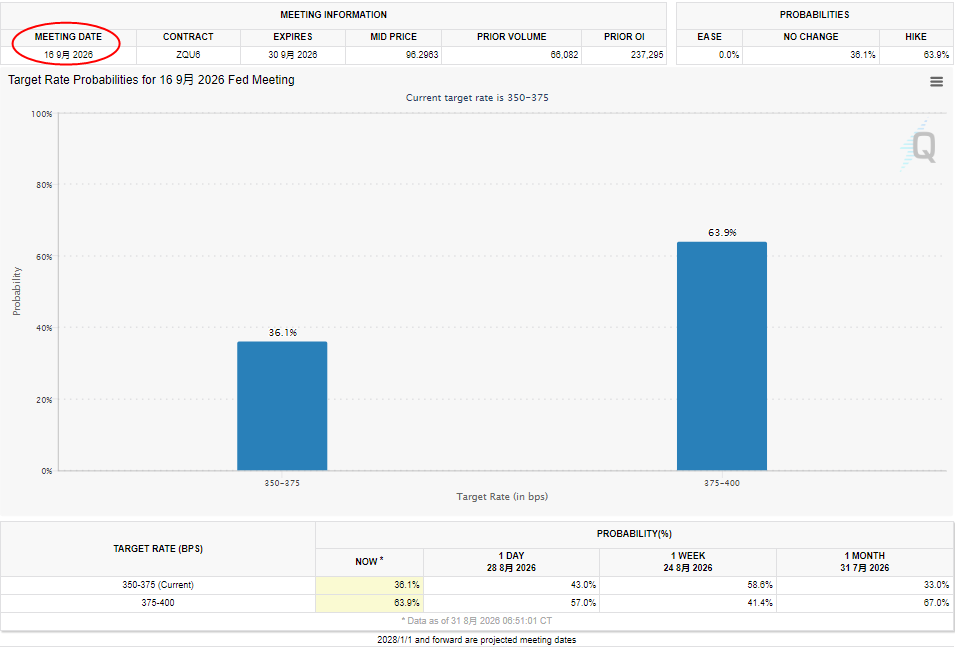 (FedWatch interest rate monitoring tool, source: CME Group) Rising interest rate expectations are directly suppressing gold prices. As a non-interest-bearing asset, gold does not generate any returns. When market expectations for interest rate hikes rise and US Treasury yields increase, the investment attractiveness of interest-bearing assets such as bonds increases significantly, leading to a continuous outflow of funds from the gold market. Simultaneously, hawkish rhetoric is pushing up the US dollar index, increasing the cost of dollar-denominated gold for holders of other currencies globally, further dragging down gold prices. Furthermore, the US 10-year Treasury yield remains stable around 4.71%, and this persistently high-yield environment puts continued valuation pressure on gold.
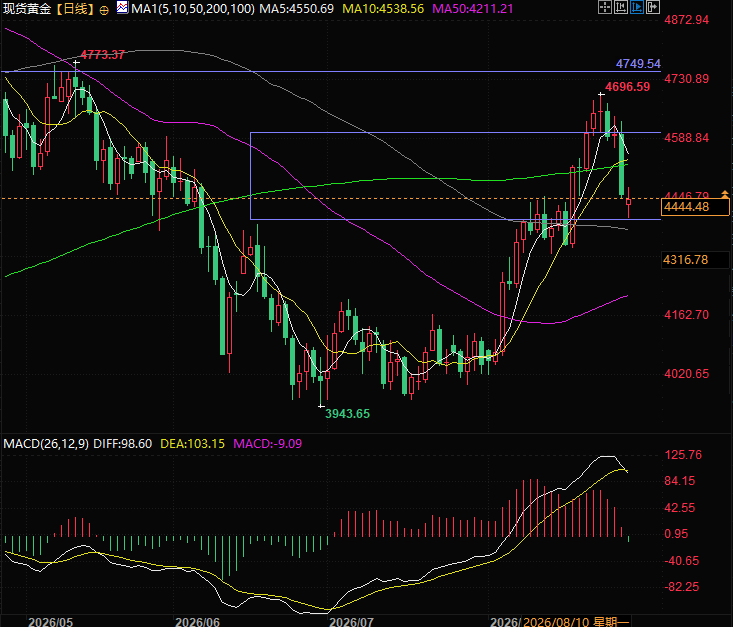 (Spot gold daily chart, source: EasyTrade) At 20:44 Beijing time, spot gold is currently trading at $4440 per ounce.
Hawkish comments from the Federal Reserve are putting downward pressure on gold prices due to interest rate expectations.
The core trigger for this round of sharp gold price correction was the hawkish remarks made by Federal Reserve Chairman Kevin Warsh at the Jackson Hole Economic Symposium. Warsh explicitly stated that the Fed has not yet completed its anti-inflation mission, and if inflation fails to steadily decline towards the 2% policy target, the central bank will continue to implement tightening policies to suppress inflation. These comments completely reversed the market's previous expectations of easing, and funds quickly repriced the probability of a Fed rate hike. According to data from the CME FedWatch Tool, the market currently expects a 57% probability of a Fed rate hike in September, and a further climb to 64% for a rate hike within 2026. (FedWatch interest rate monitoring tool, source: CME Group) Rising interest rate expectations are directly suppressing gold prices. As a non-interest-bearing asset, gold does not generate any returns. When market expectations for interest rate hikes rise and US Treasury yields increase, the investment attractiveness of interest-bearing assets such as bonds increases significantly, leading to a continuous outflow of funds from the gold market. Simultaneously, hawkish rhetoric is pushing up the US dollar index, increasing the cost of dollar-denominated gold for holders of other currencies globally, further dragging down gold prices. Furthermore, the US 10-year Treasury yield remains stable around 4.71%, and this persistently high-yield environment puts continued valuation pressure on gold.Multiple positive factors support gold prices, and the long-term upward trend remains unbroken.
Despite the pressure on prices at the end of the month, gold's strong rally in August was not accidental. Multiple positive fundamental factors provided solid support, and the long-term investment logic remains robust. In early August, the US Treasury unexpectedly expanded its purchases of long-term Treasury bonds, effectively lowering US Treasury yields and weakening the dollar, directly providing strong momentum for gold's rise. A deeper long-term positive factor stems from the massive US debt and expectations of currency devaluation. Currently, the US government debt has exceeded $40 trillion, and the fiscal deficit continues to expand, leading to widespread market concerns about the dilution of the dollar's credibility and a continued decline in purchasing power. Against this backdrop, gold, with its scarcity and inflation-hedging properties, has become a core target for market funds to hedge against currency devaluation and fiscal risks. This logic also drove a gold price surge of approximately 65% in 2025 and is the core basis for many institutions' long-term bullish outlook on gold.Institutions are not overly pessimistic about the future of gold.
ANZ Bank and other institutions have explicitly stated that this round of gold price correction is a phase of adjustment with relatively limited downside potential. The long-term core logic of gold as a hedge against dollar depreciation, geopolitical risks, and inflation risks remains unchanged. Goldman Sachs maintains its benchmark target of $4,900 for gold by the end of 2026, pointing out that the biggest short-term risk comes from further interest rate hikes by the Federal Reserve, but the two underlying supports—US fiscal debt pressure and continued central bank gold purchases—will not disappear. Instead, the correction presents a window for allocation. VanEck's multi-asset team also maintains its structural bull market judgment, recommending buying gold on dips and considering it a core part of a real asset portfolio. However, significant disagreements have emerged within institutions, with not all unanimously bullish. JPMorgan Chase warns that after the Fed's hawkish statements, interest rate expectations have once again become the dominant factor in gold prices. If inflation remains sticky and further interest rate hikes are implemented, gold prices face a short-term risk of testing the $4,300 level. Citigroup also cautions that rising real interest rates will continue to suppress gold prices in the short term, but it maintains its 6-12 month medium- to long-term target of $5,000, believing that high interest rates are only delaying the bull market, not ending it.Summary and Technical Analysis:
The market always seems to pay the price for sentiment. The recent surge in gold prices has been accompanied by a rapid increase in trading volume from both institutional and retail investors. When positions show significant profits, everyone becomes extremely risk-averse. Warsh's hawkish statements triggered profit-taking and panic selling, causing a collective retreat of those who chased the highs. Selling their gold brought them relief. For those who took profits, while their gains were smaller, their risk aversion subsided. For traders who chased the highs and were stopped out, although they lost money, the pain of being trapped was alleviated the moment they sold. Looking ahead, interest rate hike expectations, a strong dollar, and a short-term surge in oil prices are key factors suppressing gold prices. However, a global economic slowdown, resulting in weaker employment in the US, and the US Treasury's determination to lower Treasury yields and sell bonds to support the market due to its massive debt, provide a solid foundation for gold's upward movement. Warsh's hawkish statements come very close to this week's non-farm payroll data, and the market is further betting on potentially better-than-expected data. Meanwhile, Bessant's debt bailout plan and Trump's US-Iran policy will also influence gold's trajectory, likely positively. Meanwhile, since the market has already priced in the better-than-expected non-farm payrolls data, attention should be paid to US non-farm payrolls and other employment-related data to seize trading opportunities arising from the easing of negative labor market news. If the final data does not support an interest rate hike, gold prices will likely return to where they started to fall. Technically, spot gold has quickly adjusted to the bottom of its trading range, using space to buy time. Currently, the bulls still have the upper hand. The resistance level to watch is 4530, and the support level is at the bottom of the trading range. (Spot gold daily chart, source: EasyTrade) At 20:44 Beijing time, spot gold is currently trading at $4440 per ounce.
- Risk Warning and Disclaimer
- The market involves risk, and trading may not be suitable for all investors. This article is for reference only and does not constitute personal investment advice, nor does it take into account certain users’ specific investment objectives, financial situation, or other needs. Any investment decisions made based on this information are at your own risk.