Market complacency regarding US fiscal risks
2026-09-01 00:24:02
"Excessive privilege" refers to the United States' special ability to issue massive amounts of debt while simultaneously enjoying low yields and a strong dollar. Logically, endless policy noise and market volatility should have continuously eroded this privilege. After all, just a year ago, the market was fiercely debating whether the US was losing its reserve currency status. Recent unexpected developments at the US Treasury Department further confirm that the situation is far from optimistic, given the US's ever-growing debt behemoth. However, a horizontal comparison between the US and other G10 members reveals no signs of the market punishing the US for this. Admittedly, compared to ten years ago, the US's excessive privilege has weakened somewhat, but this is a long-term trend that began in recent years. 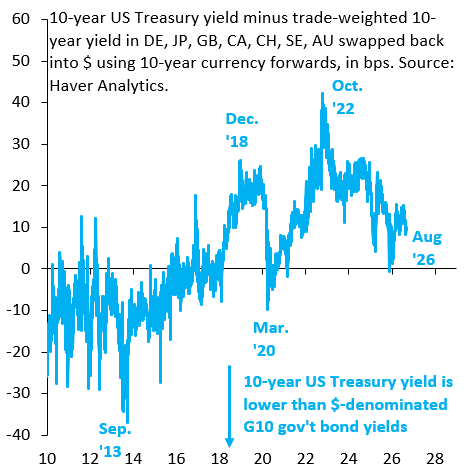 (Original chart: Calculate the yield on 10-year US Treasury bonds by subtracting the trade-weighted average yield on 10-year government bonds from those of Germany, Japan, the UK, Canada, Switzerland, Sweden, and Australia; use 10-year forward foreign exchange contracts to convert the yields of these countries' government bonds into US dollars. This spread is calculated entirely in US dollars and can effectively measure the "convenience yield"—that is, whether the global market is willing to accept a lower yield than other countries to buy US Treasury bonds, stemming from the "special attributes" of US Treasury bonds.) The chart above shows the daily time series of this US dollar-denominated 10-year yield spread, spanning from January 2010 to August 2026. Clearly, the "convenience yield" of US Treasury bonds no longer exists. In the past, the yield on 10-year US Treasury bonds was on average about 10 basis points lower than the yields on US dollar-denominated government bonds of other G10 countries; now, there is a 10 basis point premium. The excessive privilege of the United States has vanished, most likely because the growth rate of US debt far exceeds that of the other G10 economies. Meanwhile, there is no indication that the numerous policy malpractices of recent years have prompted the market to demand a higher risk premium. In fact, the opposite is true; the current market-demanded risk premium is even lower than during Biden's administration. I think of two explanations for this. First, the fiscal situation of economies outside the US is also deteriorating, particularly in Japan and some European countries. Since this interest rate differential is a relative indicator, even though the absolute level of US fiscal policy is weakening, the situation appears relatively acceptable in comparison. Second, the US is using market mechanisms to suppress long-term yields. In my view, this is the real reason why Kevin Warsh delivered a hawkish keynote speech at the Jackson Hole conference, not because the Fed genuinely wanted to raise interest rates. A completely new Treasury-Fed agreement is taking shape, with the core objective of anchoring long-term yields against the backdrop of runaway debt and deficit expansion. This move may have lowered the interest rate differential calculated in this article; if so, it again illustrates that real yields have deviated from shadow Treasury yields—the yield levels that should exist without government intervention. The fact that the market has not priced in a significant fiscal risk premium is deeply concerning to me. The logic is simple: if the market doesn't send out the necessary warning signals, policymakers lack the incentive to implement necessary reforms. The situation will likely only worsen before any hope of a turnaround emerges.
(Original chart: Calculate the yield on 10-year US Treasury bonds by subtracting the trade-weighted average yield on 10-year government bonds from those of Germany, Japan, the UK, Canada, Switzerland, Sweden, and Australia; use 10-year forward foreign exchange contracts to convert the yields of these countries' government bonds into US dollars. This spread is calculated entirely in US dollars and can effectively measure the "convenience yield"—that is, whether the global market is willing to accept a lower yield than other countries to buy US Treasury bonds, stemming from the "special attributes" of US Treasury bonds.) The chart above shows the daily time series of this US dollar-denominated 10-year yield spread, spanning from January 2010 to August 2026. Clearly, the "convenience yield" of US Treasury bonds no longer exists. In the past, the yield on 10-year US Treasury bonds was on average about 10 basis points lower than the yields on US dollar-denominated government bonds of other G10 countries; now, there is a 10 basis point premium. The excessive privilege of the United States has vanished, most likely because the growth rate of US debt far exceeds that of the other G10 economies. Meanwhile, there is no indication that the numerous policy malpractices of recent years have prompted the market to demand a higher risk premium. In fact, the opposite is true; the current market-demanded risk premium is even lower than during Biden's administration. I think of two explanations for this. First, the fiscal situation of economies outside the US is also deteriorating, particularly in Japan and some European countries. Since this interest rate differential is a relative indicator, even though the absolute level of US fiscal policy is weakening, the situation appears relatively acceptable in comparison. Second, the US is using market mechanisms to suppress long-term yields. In my view, this is the real reason why Kevin Warsh delivered a hawkish keynote speech at the Jackson Hole conference, not because the Fed genuinely wanted to raise interest rates. A completely new Treasury-Fed agreement is taking shape, with the core objective of anchoring long-term yields against the backdrop of runaway debt and deficit expansion. This move may have lowered the interest rate differential calculated in this article; if so, it again illustrates that real yields have deviated from shadow Treasury yields—the yield levels that should exist without government intervention. The fact that the market has not priced in a significant fiscal risk premium is deeply concerning to me. The logic is simple: if the market doesn't send out the necessary warning signals, policymakers lack the incentive to implement necessary reforms. The situation will likely only worsen before any hope of a turnaround emerges.
- Risk Warning and Disclaimer
- The market involves risk, and trading may not be suitable for all investors. This article is for reference only and does not constitute personal investment advice, nor does it take into account certain users’ specific investment objectives, financial situation, or other needs. Any investment decisions made based on this information are at your own risk.