Crude oil trading alert: Escalating tensions in the Middle East have raised supply concerns, and oil prices are approaching a range of resistance levels, awaiting a directional move.
2026-09-01 10:24:03
The crude oil market has re-entered a phase of rising risk premiums. Latest trading data shows that WTI crude oil rose to approximately $85.60 per barrel during Asian trading hours, marking its second consecutive day of gains; Brent crude oil, meanwhile, has climbed back above the $90 mark. On August 31, WTI futures settled up $2.36, or approximately 2.83%, at $85.76 per barrel, having continued to rise during the session.  The core driver of this round of price increases is the repricing of Middle Eastern energy supply risks. After a relatively calm month, renewed military conflict between the US and Iran has rapidly heightened market concerns about regional oil production, exports, and maritime transport security. Military activity, particularly around Lark Island and the Strait of Hormuz, has cast renewed uncertainty over the gradually recovering regional energy transport. The Strait of Hormuz previously handled about one-fifth of global oil shipments, so any sustained disruption to shipping could quickly translate into a supply risk premium in international oil prices. The market is currently particularly focused on the actual navigability of the Strait of Hormuz. Recent fires involving supertankers have further intensified concerns among shipping companies and energy traders about maritime transport risks. However, based on available information, some crude oil shipments from major Gulf oil-producing countries are still continuing, and exports from Saudi Arabia, the UAE, Kuwait, and Iraq have not completely ceased. This means that the primary issue facing the market is still reduced transport efficiency and supply uncertainty, rather than an immediate and complete disruption of global crude oil supply. This distinction is crucial from a market pricing perspective. If the Strait of Hormuz only maintains inefficient navigation, oil prices are more likely to reflect rising transportation and insurance costs through increased risk premiums. However, if shipping is further disrupted on a large scale, the market could shift from "risk premium trading" to "actual supply gap trading," potentially leading to more dramatic increases in both WTI and Brent crude. Meanwhile, drone and missile attacks on Russian refineries are also putting pressure on another supply chain. Reduced refinery capacity means that crude oil demand has not simply disappeared due to refinery damage; on the contrary, a contraction in the supply of refined products such as gasoline and diesel could lead to a rapid expansion of refining margins. The combined effect of Middle Eastern crude oil transportation risks and reduced Russian refining capacity means that the current tension in the energy market is not only reflected in crude oil but is also beginning to spread to the refined product market. Related refined product crack spreads have risen to new highs. This change may also alter investors' judgments on the future trend of oil prices. Previously, the market lowered crude oil risk premiums due to the gradual recovery of shipping through the Strait of Hormuz, with WTI falling to around $83 at the end of August, a weekly drop of about 4.5%. However, as the situation escalated again, the previously compressed risk premium quickly returned. It's worth noting that the new energy cooperation arrangement between the US and Venezuela has introduced another variable to the market. US President Donald Trump previously announced an energy agreement with Venezuela, and the White House subsequently released more details. According to the latest disclosures, the arrangement involves 17 Venezuelan oil fields with approximately 65 billion barrels of proven reserves and plans to improve local oil infrastructure through long-term investment. However, Venezuela's existing energy infrastructure is severely aging, and actual production recovery will take a long time. Therefore, the direct suppressive effect of such resource reserves on short-term oil prices is relatively limited. What the market is truly concerned about is whether Venezuela can develop stable and sustainable production capacity in the future. If capital, equipment, and transportation conditions can gradually recover, its new supply is expected to improve the elasticity of global crude oil supply in the medium to long term and help the US replenish its strategic petroleum reserves. However, given the current environment of suddenly increased supply risks in the Middle East, Venezuela's potential new supply is a medium- to long-term variable, while transportation through the Strait of Hormuz is a short-term variable; their impact on oil prices has different time dimensions. The US strategic petroleum reserves are also currently at a relatively low level. Latest data shows that U.S. strategic petroleum reserves fell by approximately 3.1 million barrels last week, down to about 286.6 million barrels, nearing decades-low levels. If energy prices continue to rise, the U.S. government may face a policy balance between replenishing strategic reserves and curbing fuel prices. From a macroeconomic perspective, rising oil prices are reinforcing global inflation concerns. A sustained rise in energy prices will be passed on to end-user prices through gasoline, diesel, transportation, and industrial costs, increasing pressure on major central banks to maintain tight monetary policies. Recent market performance already shows signs of this: the yield on 10-year U.S. Treasury bonds has risen to approximately 4.78%, putting pressure on global bond markets, and investors are beginning to reassess the impact of rising energy prices on inflation and interest rate paths. Therefore, the current oil market is not simply driven by "geopolitical risks," but rather by a multi-faceted pricing framework encompassing Middle East transportation risks, damaged Russian refining capacity, low strategic reserves, and insufficient potential new supply to be immediately realized. In the short term, risk premiums may persist; however, if transportation in the Strait of Hormuz does not deteriorate further, or if diplomatic channels show signs of improvement, the risk premiums previously accumulated in oil prices could quickly recede. From a daily chart perspective, WTI has regained the $85 area and broken through the previous short-term resistance zone around $83-$84, shifting the overall market structure from a correction to a bullish bias. $85 is currently a key battleground between bulls and bears, while $86-$87 constitutes the first resistance zone. If the price can effectively break through $87 and continue trading above it, the next stage may see a further test of the $89-$90 area; if risk sentiment continues to rise, a retest of previous higher highs cannot be ruled out. On the downside, the first support level to watch is around $84, followed by the $82-$83 area. As long as WTI remains stable above $82, the daily rebound structure remains largely intact. In terms of momentum, the daily price has resumed its upward trend, indicating that buyers have regained short-term control. However, the current rise is still highly dependent on geopolitical risk premiums, so its sustainability depends on whether actual supply is further affected. If the situation continues to deteriorate, momentum may strengthen further; conversely, once transportation resumes or the situation eases, the previously rapidly accumulated gains may trigger profit-taking. From a 4-hour chart perspective, WTI has formed a relatively clear short-term rebound structure, with the price trading above the short-term moving average system, and technical momentum shifting from weak to strong. The $85.50-$86 area is currently a key short-term breakout level. If the 4-hour candlestick can close stably above $86, the price is expected to extend further towards the $87.50-$88.50 area; however, if multiple attempts to break through $86 fail, a technical pullback should be anticipated. The first support level is around $84.50; a break below this level could lead to a retest of the $83.00-$83.50 area. Overall, the 4-hour chart remains bullish, but the recent rapid gains suggest investors should be wary of a quick pullback following a news-driven surge.
 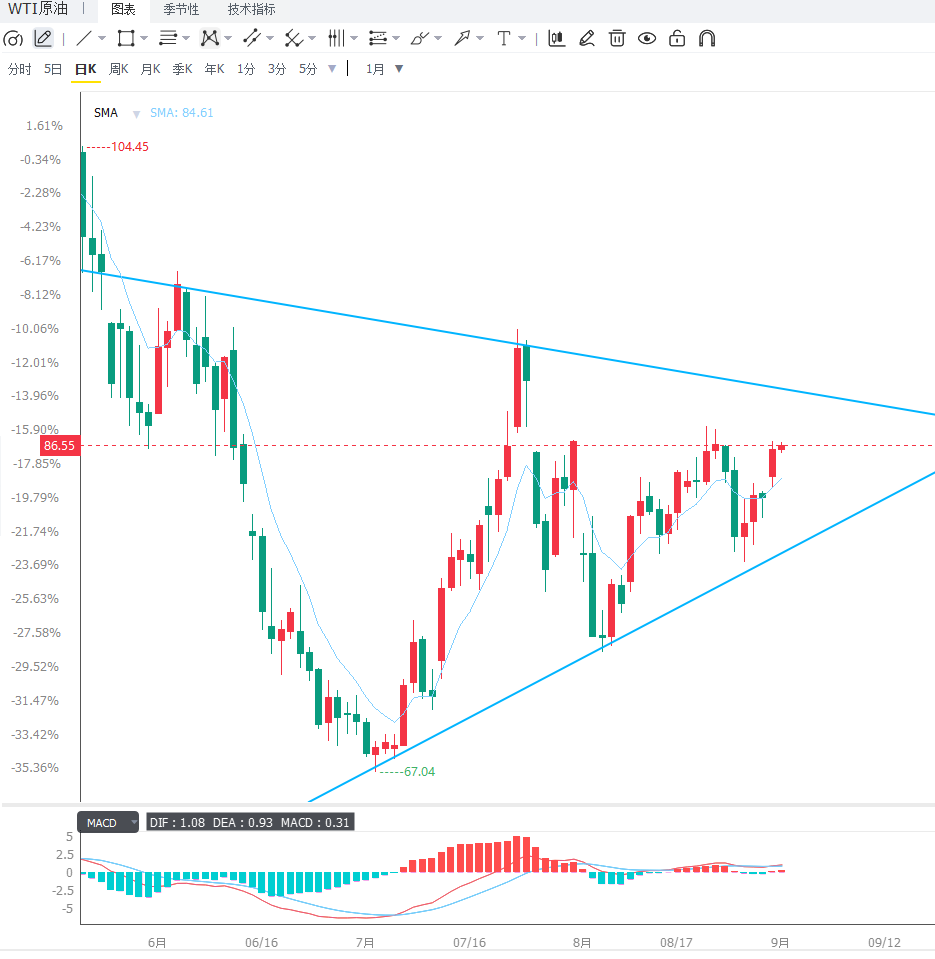 The editor's summary indicates that WTI's rebound above $85 suggests the market is re-incorporating Middle East supply risks. The key to the current price increase is not a large-scale supply disruption, but rather the simultaneous rise in uncertainty surrounding shipping safety in the Strait of Hormuz, regional energy infrastructure, and the refined product supply chain. In the short term, as long as shipping risks do not significantly ease, WTI still has the potential to test the $87-90 range. However, potential production increases in Venezuela, replenishment of US strategic reserves, and continued exports from Gulf oil-producing countries mean that the global crude oil market still has some buffer. Therefore, whether WTI can break through $90 and form a new medium-term upward trend ultimately depends on whether the risk event evolves from a "shipping threat" to an "actual supply gap." Going forward, key factors to watch include actual traffic volume in the Strait of Hormuz, Gulf country crude oil exports, US crude oil and refined product inventories, the recovery of Russian refineries, and whether the situation in the Middle East escalates further. If supply risks continue to materialize, $85-86 could become the starting point for a new round of price increases; if risks cool rapidly, the current risk premium may quickly decline.
The core driver of this round of price increases is the repricing of Middle Eastern energy supply risks. After a relatively calm month, renewed military conflict between the US and Iran has rapidly heightened market concerns about regional oil production, exports, and maritime transport security. Military activity, particularly around Lark Island and the Strait of Hormuz, has cast renewed uncertainty over the gradually recovering regional energy transport. The Strait of Hormuz previously handled about one-fifth of global oil shipments, so any sustained disruption to shipping could quickly translate into a supply risk premium in international oil prices. The market is currently particularly focused on the actual navigability of the Strait of Hormuz. Recent fires involving supertankers have further intensified concerns among shipping companies and energy traders about maritime transport risks. However, based on available information, some crude oil shipments from major Gulf oil-producing countries are still continuing, and exports from Saudi Arabia, the UAE, Kuwait, and Iraq have not completely ceased. This means that the primary issue facing the market is still reduced transport efficiency and supply uncertainty, rather than an immediate and complete disruption of global crude oil supply. This distinction is crucial from a market pricing perspective. If the Strait of Hormuz only maintains inefficient navigation, oil prices are more likely to reflect rising transportation and insurance costs through increased risk premiums. However, if shipping is further disrupted on a large scale, the market could shift from "risk premium trading" to "actual supply gap trading," potentially leading to more dramatic increases in both WTI and Brent crude. Meanwhile, drone and missile attacks on Russian refineries are also putting pressure on another supply chain. Reduced refinery capacity means that crude oil demand has not simply disappeared due to refinery damage; on the contrary, a contraction in the supply of refined products such as gasoline and diesel could lead to a rapid expansion of refining margins. The combined effect of Middle Eastern crude oil transportation risks and reduced Russian refining capacity means that the current tension in the energy market is not only reflected in crude oil but is also beginning to spread to the refined product market. Related refined product crack spreads have risen to new highs. This change may also alter investors' judgments on the future trend of oil prices. Previously, the market lowered crude oil risk premiums due to the gradual recovery of shipping through the Strait of Hormuz, with WTI falling to around $83 at the end of August, a weekly drop of about 4.5%. However, as the situation escalated again, the previously compressed risk premium quickly returned. It's worth noting that the new energy cooperation arrangement between the US and Venezuela has introduced another variable to the market. US President Donald Trump previously announced an energy agreement with Venezuela, and the White House subsequently released more details. According to the latest disclosures, the arrangement involves 17 Venezuelan oil fields with approximately 65 billion barrels of proven reserves and plans to improve local oil infrastructure through long-term investment. However, Venezuela's existing energy infrastructure is severely aging, and actual production recovery will take a long time. Therefore, the direct suppressive effect of such resource reserves on short-term oil prices is relatively limited. What the market is truly concerned about is whether Venezuela can develop stable and sustainable production capacity in the future. If capital, equipment, and transportation conditions can gradually recover, its new supply is expected to improve the elasticity of global crude oil supply in the medium to long term and help the US replenish its strategic petroleum reserves. However, given the current environment of suddenly increased supply risks in the Middle East, Venezuela's potential new supply is a medium- to long-term variable, while transportation through the Strait of Hormuz is a short-term variable; their impact on oil prices has different time dimensions. The US strategic petroleum reserves are also currently at a relatively low level. Latest data shows that U.S. strategic petroleum reserves fell by approximately 3.1 million barrels last week, down to about 286.6 million barrels, nearing decades-low levels. If energy prices continue to rise, the U.S. government may face a policy balance between replenishing strategic reserves and curbing fuel prices. From a macroeconomic perspective, rising oil prices are reinforcing global inflation concerns. A sustained rise in energy prices will be passed on to end-user prices through gasoline, diesel, transportation, and industrial costs, increasing pressure on major central banks to maintain tight monetary policies. Recent market performance already shows signs of this: the yield on 10-year U.S. Treasury bonds has risen to approximately 4.78%, putting pressure on global bond markets, and investors are beginning to reassess the impact of rising energy prices on inflation and interest rate paths. Therefore, the current oil market is not simply driven by "geopolitical risks," but rather by a multi-faceted pricing framework encompassing Middle East transportation risks, damaged Russian refining capacity, low strategic reserves, and insufficient potential new supply to be immediately realized. In the short term, risk premiums may persist; however, if transportation in the Strait of Hormuz does not deteriorate further, or if diplomatic channels show signs of improvement, the risk premiums previously accumulated in oil prices could quickly recede. From a daily chart perspective, WTI has regained the $85 area and broken through the previous short-term resistance zone around $83-$84, shifting the overall market structure from a correction to a bullish bias. $85 is currently a key battleground between bulls and bears, while $86-$87 constitutes the first resistance zone. If the price can effectively break through $87 and continue trading above it, the next stage may see a further test of the $89-$90 area; if risk sentiment continues to rise, a retest of previous higher highs cannot be ruled out. On the downside, the first support level to watch is around $84, followed by the $82-$83 area. As long as WTI remains stable above $82, the daily rebound structure remains largely intact. In terms of momentum, the daily price has resumed its upward trend, indicating that buyers have regained short-term control. However, the current rise is still highly dependent on geopolitical risk premiums, so its sustainability depends on whether actual supply is further affected. If the situation continues to deteriorate, momentum may strengthen further; conversely, once transportation resumes or the situation eases, the previously rapidly accumulated gains may trigger profit-taking. From a 4-hour chart perspective, WTI has formed a relatively clear short-term rebound structure, with the price trading above the short-term moving average system, and technical momentum shifting from weak to strong. The $85.50-$86 area is currently a key short-term breakout level. If the 4-hour candlestick can close stably above $86, the price is expected to extend further towards the $87.50-$88.50 area; however, if multiple attempts to break through $86 fail, a technical pullback should be anticipated. The first support level is around $84.50; a break below this level could lead to a retest of the $83.00-$83.50 area. Overall, the 4-hour chart remains bullish, but the recent rapid gains suggest investors should be wary of a quick pullback following a news-driven surge. The editor's summary indicates that WTI's rebound above $85 suggests the market is re-incorporating Middle East supply risks. The key to the current price increase is not a large-scale supply disruption, but rather the simultaneous rise in uncertainty surrounding shipping safety in the Strait of Hormuz, regional energy infrastructure, and the refined product supply chain. In the short term, as long as shipping risks do not significantly ease, WTI still has the potential to test the $87-90 range. However, potential production increases in Venezuela, replenishment of US strategic reserves, and continued exports from Gulf oil-producing countries mean that the global crude oil market still has some buffer. Therefore, whether WTI can break through $90 and form a new medium-term upward trend ultimately depends on whether the risk event evolves from a "shipping threat" to an "actual supply gap." Going forward, key factors to watch include actual traffic volume in the Strait of Hormuz, Gulf country crude oil exports, US crude oil and refined product inventories, the recovery of Russian refineries, and whether the situation in the Middle East escalates further. If supply risks continue to materialize, $85-86 could become the starting point for a new round of price increases; if risks cool rapidly, the current risk premium may quickly decline.
- Risk Warning and Disclaimer
- The market involves risk, and trading may not be suitable for all investors. This article is for reference only and does not constitute personal investment advice, nor does it take into account certain users’ specific investment objectives, financial situation, or other needs. Any investment decisions made based on this information are at your own risk.