Hawkish signals from the Federal Reserve have increased expectations of interest rate hikes, causing gold to continue its correction as it awaits this week's non-farm payroll data.
2026-09-01 10:30:03
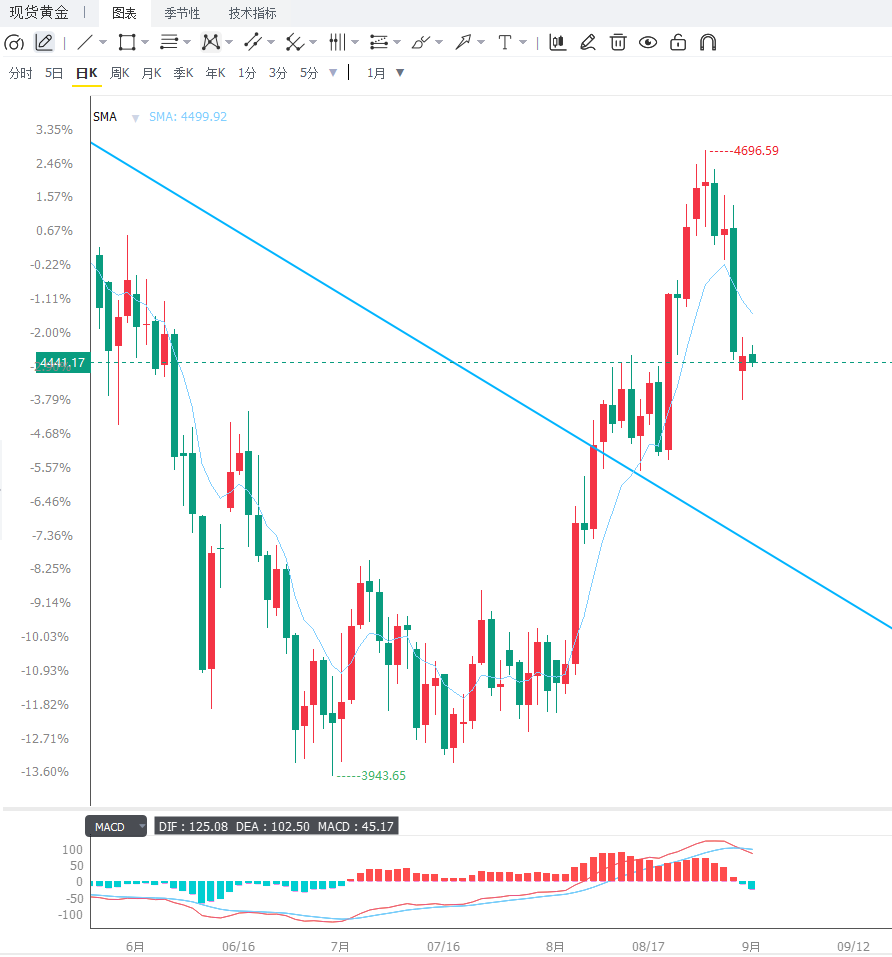
The gold market cooled significantly in early Asian trading on Tuesday, with spot gold prices falling back to around $4,445 per ounce, indicating a halt to the upward momentum. This correction was not simply due to weakened safe-haven demand, but rather a market reassessment of the Federal Reserve's future interest rate path. Against the backdrop of escalating tensions in the Middle East and rising energy prices, investors are concerned that higher energy costs could reignite inflationary pressures, thus limiting the Fed's room for monetary easing.  Recent tensions in the Middle East have escalated again, with renewed military clashes between the US and Iran, rapidly intensifying market focus on energy supplies and international oil prices. Rising oil prices increase risk premiums in the crude oil market and may also be passed on to end-user prices through fuel, transportation, and production costs. This creates a complex situation for gold: geopolitical risks typically favor safe-haven assets, but if risk events first drive up energy prices and strengthen inflation expectations, forcing the Federal Reserve to maintain higher interest rates, then a rise in the dollar and US Treasury yields could offset the safe-haven demand for gold. The market's primary focus has shifted from simple geopolitical risks to expectations regarding Federal Reserve policy. Federal Reserve Chairman Kevin Warsh delivered a relatively hawkish inflation signal at the Jackson Hole symposium, emphasizing that price stability remains a core objective of monetary policy and that the current decline in inflation is not yet sufficient to reassure policymakers. His remarks have led investors to re-price the possibility of further interest rate hikes. Traders now expect a rate hike at the Fed's September meeting to be around 65.4%, significantly higher than the approximately 39.9% before his remarks. This signifies a substantial shift in short-term interest rate expectations. For gold, which does not generate interest income, rising interest rate expectations typically mean an increased opportunity cost of holding gold, thus suppressing its price. More importantly, current inflation risks have not completely disappeared. While previous US inflation data showed some signs of cooling, the resurgence of energy prices could alter the inflation trajectory in the coming months. If crude oil remains strong, rising US gasoline and transportation costs could raise concerns about a slowdown in the rate of inflation decline. In this scenario, even if the Federal Reserve does not immediately raise interest rates, it may extend the period of high interest rates, which would also put pressure on gold valuations. Some institutions believe that Warsh's recent policy signals are clearly hawkish. Rajeev DeMello, Global Macro Portfolio Manager at GAMA Asset Management, stated that the shift to a more hawkish policy stance surprised many investors, and therefore gold may still face some resistance in the short term. This assessment reflects the biggest short-term contradiction in the current gold market: geopolitical risks increase gold's safe-haven value, while rising interest rate expectations increase the cost of holding gold. Meanwhile, the US dollar has also regained some support. The Federal Reserve's hawkish stance on inflation is conducive to maintaining high yields on dollar-denominated assets. For gold priced in US dollars, a stronger dollar typically increases the purchasing cost for non-dollar investors and puts additional pressure on gold prices. Therefore, whether gold can resume its upward trend depends not only on geopolitical risks but also on whether the US dollar index and US Treasury yields show a significant decline. However, gold's current medium-term technical structure has not completely weakened. On the daily chart, XAU/USD is still trading above the 100-day moving average of approximately $4370, while also holding near the 20-day moving average of approximately $4430. The 20-day moving average continues to provide some support, indicating that the previously formed medium-term upward structure has not been broken. The RSI is currently around 54, in the neutral-to-strong zone, indicating that market momentum has cooled somewhat but has not yet entered a clear bearish dominance. From the daily chart structure, $4430 is one of the most important short-term support levels, as it is close to the 20-day moving average and is also a point where the balance of power between bulls and bears has recently been rebalanced. If gold prices can stabilize above $4430 and break through $4500 again, the market is expected to retest the resistance area near $4600. Further upward movement will require attention to the $4700-$4725 area, which is close to the upper Bollinger Band and is expected to be a significant test for further bullish breakthroughs. Conversely, if $4430 is effectively breached, gold prices may further retrace to the 100-day moving average near $4370. If the 100-day moving average is also broken, the correction could extend to the $4200-$4140 area. From a 4-hour perspective, the short-term trend of gold prices has shifted from a strong upward surge to a weaker, more volatile pattern. After breaking below the short-term upward momentum, the bulls need to find new support. The $4430-$4440 area has become a key battleground for short-term bulls and bears. If prices can quickly recover to $4,500, it suggests the current pullback is more likely a technical correction within an uptrend, and a retest of the $4,550-$4,600 area is possible. If prices continue to trade below $4,430, the short-term weakness could extend further to around $4,370. Technically, short-term momentum is cooling, but there are no signals sufficient to confirm a medium-term trend reversal. Therefore, it's more appropriate to focus on breakouts of key support and resistance levels rather than simply judging a trend reversal. The next key indicators to watch are subsequent speeches by Fed officials, US inflation data, employment market performance, the US dollar index, and the 10-year US Treasury yield. If inflation rebounds and fuels further interest rate hike expectations, gold may continue to face valuation pressures. If subsequent economic data weakens, interest rate expectations decline again, and geopolitical risks persist, safe-haven demand for gold may regain dominance.
  Editor's Summary: The core contradiction facing gold is shifting from "safe-haven demand" to "the interplay between safe-haven demand and interest rate expectations." While the escalating tensions in the Middle East should have increased gold's appeal, rising oil prices have reinforced expectations that the Federal Reserve will maintain or even raise interest rates, making the dollar and US Treasury yields significant forces suppressing gold prices. Going forward, the market will need to focus on US inflation and employment data, as well as signals from the Federal Reserve's policy, while closely observing whether rising oil prices truly transmit to inflation expectations. Gold retains its safe-haven and asset allocation value in the medium to long term, but its short-term performance will be more dependent on changes in real interest rates, the dollar, and monetary policy expectations. Investors need to be wary of high volatility caused by the repricing of macroeconomic policies.
Recent tensions in the Middle East have escalated again, with renewed military clashes between the US and Iran, rapidly intensifying market focus on energy supplies and international oil prices. Rising oil prices increase risk premiums in the crude oil market and may also be passed on to end-user prices through fuel, transportation, and production costs. This creates a complex situation for gold: geopolitical risks typically favor safe-haven assets, but if risk events first drive up energy prices and strengthen inflation expectations, forcing the Federal Reserve to maintain higher interest rates, then a rise in the dollar and US Treasury yields could offset the safe-haven demand for gold. The market's primary focus has shifted from simple geopolitical risks to expectations regarding Federal Reserve policy. Federal Reserve Chairman Kevin Warsh delivered a relatively hawkish inflation signal at the Jackson Hole symposium, emphasizing that price stability remains a core objective of monetary policy and that the current decline in inflation is not yet sufficient to reassure policymakers. His remarks have led investors to re-price the possibility of further interest rate hikes. Traders now expect a rate hike at the Fed's September meeting to be around 65.4%, significantly higher than the approximately 39.9% before his remarks. This signifies a substantial shift in short-term interest rate expectations. For gold, which does not generate interest income, rising interest rate expectations typically mean an increased opportunity cost of holding gold, thus suppressing its price. More importantly, current inflation risks have not completely disappeared. While previous US inflation data showed some signs of cooling, the resurgence of energy prices could alter the inflation trajectory in the coming months. If crude oil remains strong, rising US gasoline and transportation costs could raise concerns about a slowdown in the rate of inflation decline. In this scenario, even if the Federal Reserve does not immediately raise interest rates, it may extend the period of high interest rates, which would also put pressure on gold valuations. Some institutions believe that Warsh's recent policy signals are clearly hawkish. Rajeev DeMello, Global Macro Portfolio Manager at GAMA Asset Management, stated that the shift to a more hawkish policy stance surprised many investors, and therefore gold may still face some resistance in the short term. This assessment reflects the biggest short-term contradiction in the current gold market: geopolitical risks increase gold's safe-haven value, while rising interest rate expectations increase the cost of holding gold. Meanwhile, the US dollar has also regained some support. The Federal Reserve's hawkish stance on inflation is conducive to maintaining high yields on dollar-denominated assets. For gold priced in US dollars, a stronger dollar typically increases the purchasing cost for non-dollar investors and puts additional pressure on gold prices. Therefore, whether gold can resume its upward trend depends not only on geopolitical risks but also on whether the US dollar index and US Treasury yields show a significant decline. However, gold's current medium-term technical structure has not completely weakened. On the daily chart, XAU/USD is still trading above the 100-day moving average of approximately $4370, while also holding near the 20-day moving average of approximately $4430. The 20-day moving average continues to provide some support, indicating that the previously formed medium-term upward structure has not been broken. The RSI is currently around 54, in the neutral-to-strong zone, indicating that market momentum has cooled somewhat but has not yet entered a clear bearish dominance. From the daily chart structure, $4430 is one of the most important short-term support levels, as it is close to the 20-day moving average and is also a point where the balance of power between bulls and bears has recently been rebalanced. If gold prices can stabilize above $4430 and break through $4500 again, the market is expected to retest the resistance area near $4600. Further upward movement will require attention to the $4700-$4725 area, which is close to the upper Bollinger Band and is expected to be a significant test for further bullish breakthroughs. Conversely, if $4430 is effectively breached, gold prices may further retrace to the 100-day moving average near $4370. If the 100-day moving average is also broken, the correction could extend to the $4200-$4140 area. From a 4-hour perspective, the short-term trend of gold prices has shifted from a strong upward surge to a weaker, more volatile pattern. After breaking below the short-term upward momentum, the bulls need to find new support. The $4430-$4440 area has become a key battleground for short-term bulls and bears. If prices can quickly recover to $4,500, it suggests the current pullback is more likely a technical correction within an uptrend, and a retest of the $4,550-$4,600 area is possible. If prices continue to trade below $4,430, the short-term weakness could extend further to around $4,370. Technically, short-term momentum is cooling, but there are no signals sufficient to confirm a medium-term trend reversal. Therefore, it's more appropriate to focus on breakouts of key support and resistance levels rather than simply judging a trend reversal. The next key indicators to watch are subsequent speeches by Fed officials, US inflation data, employment market performance, the US dollar index, and the 10-year US Treasury yield. If inflation rebounds and fuels further interest rate hike expectations, gold may continue to face valuation pressures. If subsequent economic data weakens, interest rate expectations decline again, and geopolitical risks persist, safe-haven demand for gold may regain dominance. Editor's Summary: The core contradiction facing gold is shifting from "safe-haven demand" to "the interplay between safe-haven demand and interest rate expectations." While the escalating tensions in the Middle East should have increased gold's appeal, rising oil prices have reinforced expectations that the Federal Reserve will maintain or even raise interest rates, making the dollar and US Treasury yields significant forces suppressing gold prices. Going forward, the market will need to focus on US inflation and employment data, as well as signals from the Federal Reserve's policy, while closely observing whether rising oil prices truly transmit to inflation expectations. Gold retains its safe-haven and asset allocation value in the medium to long term, but its short-term performance will be more dependent on changes in real interest rates, the dollar, and monetary policy expectations. Investors need to be wary of high volatility caused by the repricing of macroeconomic policies.
- Risk Warning and Disclaimer
- The market involves risk, and trading may not be suitable for all investors. This article is for reference only and does not constitute personal investment advice, nor does it take into account certain users’ specific investment objectives, financial situation, or other needs. Any investment decisions made based on this information are at your own risk.