Etsuko Kada confirmed coordinated US-Japan intervention but declined to comment on the current yen level, leaving the 160 level remaining an "open question."
2026-09-01 11:08:03
On Tuesday (September 1st) during Asian trading hours, the USD/JPY pair traded in a narrow range, currently below the psychological level of 160.00 and also below the one-month high of 160.20 reached last Friday. Japan's massive debt burden, soaring long-term borrowing costs, and continued expansionary fiscal policy have weakened confidence in the yen, while the USD/JPY interest rate differential remains around 250-275 basis points, making carry trades active. Hawkish comments from Federal Reserve Chairman Warsh pushed the probability of a September rate hike to approximately 60%, and the escalation of the US-Iran military conflict over the weekend provided safe-haven buying for the dollar. 
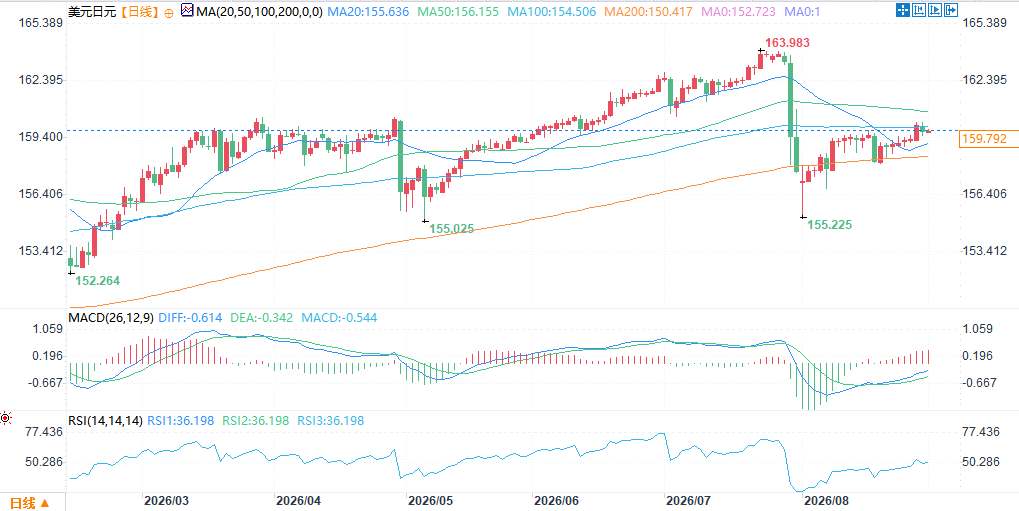 (USD/JPY daily chart, source: FX678) At 11:06 Beijing time, USD/JPY was trading at 159.78/79.
The interest rate differential between the US and Japan, coupled with fiscal concerns, continued to put pressure on the yen, while the dollar received support from both interest rate hikes and geopolitical factors.
Japan's massive debt burden, soaring long-term borrowing costs, and continued expansionary fiscal policy have eroded market confidence in the yen. The USD/JPY interest rate differential remains high at around 250-275 basis points, keeping carry trades active and further increasing selling pressure on the yen. Meanwhile, Fed Chairman Warsh's hawkish comments raised the probability of a September rate hike to around 60%, strengthening interest rate support for the dollar. The escalation of the US-Iran military conflict over the weekend also provided safe-haven buying for the dollar. Trump's threat of further strikes if Iran continues its attacks pushed up oil prices and indirectly supported the dollar. Under these combined factors, the USD/JPY pair still faces upward pressure in the short term, but the sensitivity around the 160 level keeps the market cautious.Fundamentals are bullish but concerns about intervention limit upside; market focus on US data.
The fundamentals are generally bullish for the US dollar, with the USD/JPY interest rate differential, Japanese fiscal concerns, and geopolitical risk aversion all supporting the exchange rate. However, concerns about a possible joint intervention by Tokyo and Washington are limiting further upside for USD/JPY. During the G20 meeting, the US and Japanese finance ministers reiterated the crucial importance of orderly exchange rates for global stability and affirmed the significance of joint intervention, but Etsuko Kada refused to characterize the current level as "disorderly," indicating that Tokyo is not yet ready to take immediate unilateral action. This week, the market will closely watch the US ISM Manufacturing PMI and Friday's non-farm payroll report. Strong data could further boost expectations of a Fed rate hike, supporting USD/JPY to break through the 160 level; weak data could trigger profit-taking, pushing the exchange rate back to the 158-159 range. Intervention risks and data guidance will jointly determine the short-term direction, and the exchange rate is expected to remain highly volatile.Japanese Finance Minister: Reaffirmed the importance of an orderly exchange rate with the US, but declined to comment on the current level of the yen.
Japanese Finance Minister Etsuko Kada held a bilateral meeting with US Treasury Secretary Bessenter during the G20 summit. Both sides affirmed that orderly exchange rates are crucial for the stability of global financial markets and reached a consensus on the importance of coordinated foreign exchange intervention. Kada stated that she fully agreed that joint efforts between Japan and the United States would continue to benefit global financial market stability and confirmed and agreed to continue coordinated foreign exchange actions with the US. She pledged that Japan would achieve a strong economy and sustainable fiscal policy, while clarifying that specific monetary policy decisions would be made by the Bank of Japan. When asked whether the current yen exchange rate was reasonable or whether recent movements were orderly, Kada declined to comment, saying it was difficult to say how specific factors would affect exchange rate movements, and she could not comment on the current level of Japanese government bond yields. She noted that speculative exchange rate fluctuations that do not reflect fundamentals have indeed increased, and when asked whether Tokyo was prepared to take decisive action against disruptive foreign exchange fluctuations, she stated that her position remained unchanged.Institutional Views
Despite the recent pullback to around 159 after hovering around 160 against the yen, Standard Chartered Bank's latest research report maintains its Q3 target of 158 and Q4 target of 160. Strategists point out that the yen faces drag from capital outflows that are insensitive to yields, and the risk of intervention remains, but the Bank of Japan's hawkish shift helps reshape the medium-term outlook. Overall, narrowing interest rate differentials and policy normalization will gradually support the yen, but short-term volatility will still be influenced by the pace of US-Japan policy and intervention expectations. The exchange rate is expected to fluctuate within a high range before slowly declining. HSBC's latest forecast shows a Q3 target of 161, a Q4 target of 162, and further targets of 163 in Q1 and 164 in Q2 of 2027. The bank believes that under the baseline scenario, the exchange rate will mainly fluctuate within a range: the Japanese Ministry of Finance's phased intervention will limit upside potential, while Japan's persistently negative real interest rates will provide support for the dollar. The current trading range may widen, influenced by both the uncertainty of US economic data and the Fed's policy stance, as well as by joint intervention and potential policy changes from the Bank of Japan and GPIF. HSBC emphasizes that the US-Japan interest rate differential and carry trades remain the dominant forces. While intervention can temporarily stabilize the exchange rate, it is difficult to fundamentally reverse the upward pressure driven by fundamentals. The market is likely to maintain high-level fluctuations and a moderate upward trend in the future.Summarize
The USD/JPY pair is currently trading below the 160 level. Concerns about Japanese fiscal policy and the USD/JPY interest rate differential are weighing on the yen, while expectations of a Fed rate hike and geopolitical risks are supporting the dollar. The fundamentals are bullish, but concerns about intervention are limiting upside. (USD/JPY daily chart, source: FX678) At 11:06 Beijing time, USD/JPY was trading at 159.78/79.
- Risk Warning and Disclaimer
- The market involves risk, and trading may not be suitable for all investors. This article is for reference only and does not constitute personal investment advice, nor does it take into account certain users’ specific investment objectives, financial situation, or other needs. Any investment decisions made based on this information are at your own risk.