USD/CAD continues its correction, awaiting guidance from US employment data.
2026-09-01 14:14:02
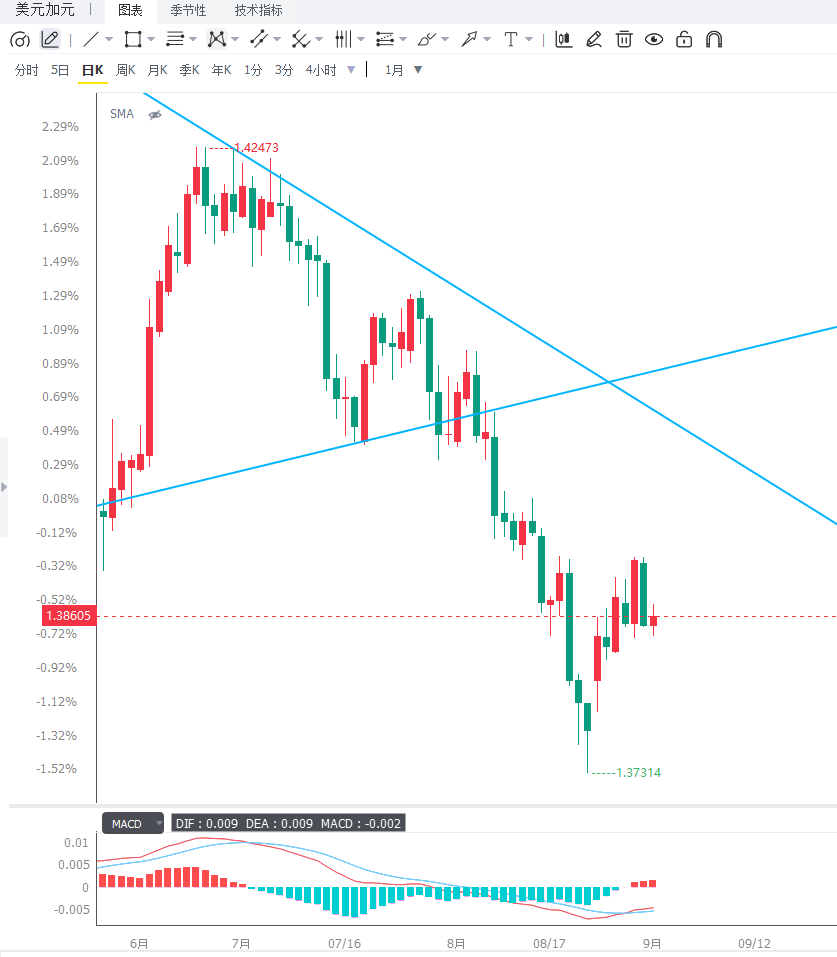
The USD/CAD pair remained around 1.3850 in early Asian trading on Tuesday, lacking further downward momentum after retreating from a more than two-week high in the previous session. The market is influenced by both rising oil prices and a weakening dollar, while also facing renewed hawkishness from the Federal Reserve and safe-haven demand for the dollar due to geopolitical risks. Therefore, the exchange rate is currently in a phase of mixed bullish and bearish factors in the short term.  Rising crude oil prices have been a key factor supporting the Canadian dollar recently. The renewed escalation of tensions in the Middle East has increased market concerns about global energy supply and the security of shipping in the Strait of Hormuz, leading to a rise in international oil price risk premiums. Since the Canadian economy and export revenue are strongly linked to the energy sector, stronger oil prices typically benefit the Canadian dollar, thus putting downward pressure on the USD/CAD pair. The correlation between oil prices and the Canadian dollar has once again become an important trading logic in the foreign exchange market. If energy prices continue to rise, expectations for Canadian trade and energy export revenue may improve, potentially providing further support for the Canadian dollar; conversely, if the Middle East risk premium dissipates rapidly, a decline in oil prices could weaken the Canadian dollar's recent advantage. The performance of the US dollar itself also influences the exchange rate direction. Previously, the US dollar maintained relative strength driven by rising expectations of Federal Reserve policy and safe-haven inflows, but has recently experienced some pullback. A weaker US dollar reduces upward pressure on the USD/CAD pair, making the support for the Canadian dollar from oil prices more readily reflected in the exchange rate. However, the fundamental support for the US dollar has not completely disappeared. Federal Reserve Chairman Kevin Warsh emphasized at the Jackson Hole symposium that US inflation remains high, and if price pressures cannot ease further, interest rates may need to remain high or even be adjusted further. The market subsequently significantly increased its bets on a tightening of policy at the Fed's September meeting, with the probability currently around 65%. If US inflation data and economic activity continue to be resilient, the Fed's hawkish outlook may strengthen further, the dollar will regain its interest rate advantage, and the downside for USD/CAD will be limited. Especially given that rising oil prices may again push up US inflation expectations, the correlation between energy prices and Fed policy warrants market attention. Canada's own policy environment is also a crucial variable affecting the Canadian dollar. If oil prices remain high, Canadian inflationary pressures may resurface, potentially complicating the Bank of Canada's policy path. Meanwhile, US economic data remains the primary variable determining the dollar's direction. This week sees a flurry of US macroeconomic data releases, with the ISM Manufacturing PMI being the initial focus, followed by the August non-farm payroll report, which will be a more significant directional catalyst. If US manufacturing and employment data are strong, the US dollar may strengthen again, limiting the pullback in USD/CAD. Conversely, if the data is significantly weaker than expected, the US dollar's interest rate advantage may diminish, creating conditions for a further rebound in the Canadian dollar. Furthermore, changes in trade policy between Canada and the US are also a risk factor for the Canadian dollar. If trade frictions escalate further, the market may reassess Canada's economic growth prospects, weakening the Canadian dollar's fundamental support. Therefore, the current USD/CAD movement is not simply driven by oil prices, but rather by the combined effects of crude oil, US monetary policy, and the North American trade environment. Market sentiment is currently generally cautious. Rising oil prices and a weaker US dollar have kept USD/CAD weak, but hawkish expectations from the Federal Reserve have limited further short-selling. If oil prices remain high while US data weakens, USD/CAD may continue its pullback; if US data is strong, the US dollar strengthens again, and oil prices fall, the exchange rate may see a significant rebound. Looking at the daily chart, USD/CAD previously encountered resistance near the 100-day moving average around 1.3917, indicating strong selling pressure above. Currently, the exchange rate remains below this resistance level, with an overall weak technical structure. The key resistance level to watch is 1.3917. A decisive break and hold above this level would open up further upside potential. Support levels to watch are 1.3800, 1.3750, and the 1.3650 area. A sustained break below 1.3800 could allow the bears to extend their advantage. On the 4-hour chart, the price is in a weak consolidation phase after falling from its highs, with short-term rebounds still limited by upward pressure. The 1.3850 area is currently a battleground between bulls and bears. A retest of 1.3900 could alleviate the short-term downtrend and allow for a test of 1.3917; a break below 1.3800 could open up further downside, with the next support level around 1.3750. Overall, the 4-hour chart shows a weak bias, but a rapid decline has not yet formed.
  Editor's Summary: The USD/CAD pair is currently under pressure from both rising oil prices and a weakening US dollar, but hawkish expectations from the Federal Reserve and US economic data still provide potential support for the dollar. Whether the Canadian dollar can continue to strengthen largely depends on whether oil prices can remain high and whether US economic data shows a significant cooling. In the short term, 1.3917 is a key technical level for a renewed strengthening of USD/CAD, while 1.3800 is a crucial support level for the continuation of the downtrend. If oil prices remain strong and US data weakens, the exchange rate may continue to seek support downwards; if expectations of a Fed rate hike further intensify or oil prices fall, USD/CAD may rebound. Investors should pay close attention to the US ISM Manufacturing PMI, non-farm payroll data, oil prices, the US dollar index, and changes in North American trade policies, and remain cautious before key technical levels are broken.
Rising crude oil prices have been a key factor supporting the Canadian dollar recently. The renewed escalation of tensions in the Middle East has increased market concerns about global energy supply and the security of shipping in the Strait of Hormuz, leading to a rise in international oil price risk premiums. Since the Canadian economy and export revenue are strongly linked to the energy sector, stronger oil prices typically benefit the Canadian dollar, thus putting downward pressure on the USD/CAD pair. The correlation between oil prices and the Canadian dollar has once again become an important trading logic in the foreign exchange market. If energy prices continue to rise, expectations for Canadian trade and energy export revenue may improve, potentially providing further support for the Canadian dollar; conversely, if the Middle East risk premium dissipates rapidly, a decline in oil prices could weaken the Canadian dollar's recent advantage. The performance of the US dollar itself also influences the exchange rate direction. Previously, the US dollar maintained relative strength driven by rising expectations of Federal Reserve policy and safe-haven inflows, but has recently experienced some pullback. A weaker US dollar reduces upward pressure on the USD/CAD pair, making the support for the Canadian dollar from oil prices more readily reflected in the exchange rate. However, the fundamental support for the US dollar has not completely disappeared. Federal Reserve Chairman Kevin Warsh emphasized at the Jackson Hole symposium that US inflation remains high, and if price pressures cannot ease further, interest rates may need to remain high or even be adjusted further. The market subsequently significantly increased its bets on a tightening of policy at the Fed's September meeting, with the probability currently around 65%. If US inflation data and economic activity continue to be resilient, the Fed's hawkish outlook may strengthen further, the dollar will regain its interest rate advantage, and the downside for USD/CAD will be limited. Especially given that rising oil prices may again push up US inflation expectations, the correlation between energy prices and Fed policy warrants market attention. Canada's own policy environment is also a crucial variable affecting the Canadian dollar. If oil prices remain high, Canadian inflationary pressures may resurface, potentially complicating the Bank of Canada's policy path. Meanwhile, US economic data remains the primary variable determining the dollar's direction. This week sees a flurry of US macroeconomic data releases, with the ISM Manufacturing PMI being the initial focus, followed by the August non-farm payroll report, which will be a more significant directional catalyst. If US manufacturing and employment data are strong, the US dollar may strengthen again, limiting the pullback in USD/CAD. Conversely, if the data is significantly weaker than expected, the US dollar's interest rate advantage may diminish, creating conditions for a further rebound in the Canadian dollar. Furthermore, changes in trade policy between Canada and the US are also a risk factor for the Canadian dollar. If trade frictions escalate further, the market may reassess Canada's economic growth prospects, weakening the Canadian dollar's fundamental support. Therefore, the current USD/CAD movement is not simply driven by oil prices, but rather by the combined effects of crude oil, US monetary policy, and the North American trade environment. Market sentiment is currently generally cautious. Rising oil prices and a weaker US dollar have kept USD/CAD weak, but hawkish expectations from the Federal Reserve have limited further short-selling. If oil prices remain high while US data weakens, USD/CAD may continue its pullback; if US data is strong, the US dollar strengthens again, and oil prices fall, the exchange rate may see a significant rebound. Looking at the daily chart, USD/CAD previously encountered resistance near the 100-day moving average around 1.3917, indicating strong selling pressure above. Currently, the exchange rate remains below this resistance level, with an overall weak technical structure. The key resistance level to watch is 1.3917. A decisive break and hold above this level would open up further upside potential. Support levels to watch are 1.3800, 1.3750, and the 1.3650 area. A sustained break below 1.3800 could allow the bears to extend their advantage. On the 4-hour chart, the price is in a weak consolidation phase after falling from its highs, with short-term rebounds still limited by upward pressure. The 1.3850 area is currently a battleground between bulls and bears. A retest of 1.3900 could alleviate the short-term downtrend and allow for a test of 1.3917; a break below 1.3800 could open up further downside, with the next support level around 1.3750. Overall, the 4-hour chart shows a weak bias, but a rapid decline has not yet formed. Editor's Summary: The USD/CAD pair is currently under pressure from both rising oil prices and a weakening US dollar, but hawkish expectations from the Federal Reserve and US economic data still provide potential support for the dollar. Whether the Canadian dollar can continue to strengthen largely depends on whether oil prices can remain high and whether US economic data shows a significant cooling. In the short term, 1.3917 is a key technical level for a renewed strengthening of USD/CAD, while 1.3800 is a crucial support level for the continuation of the downtrend. If oil prices remain strong and US data weakens, the exchange rate may continue to seek support downwards; if expectations of a Fed rate hike further intensify or oil prices fall, USD/CAD may rebound. Investors should pay close attention to the US ISM Manufacturing PMI, non-farm payroll data, oil prices, the US dollar index, and changes in North American trade policies, and remain cautious before key technical levels are broken.
- Risk Warning and Disclaimer
- The market involves risk, and trading may not be suitable for all investors. This article is for reference only and does not constitute personal investment advice, nor does it take into account certain users’ specific investment objectives, financial situation, or other needs. Any investment decisions made based on this information are at your own risk.